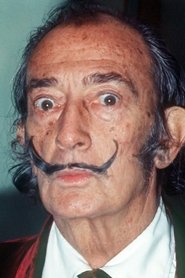
Salvador Dalí
Actor
- Born
- May 11, 1904, Figueres, Spain
- Died
- January 23, 1989
- Active
- 1929-1989
- Birth name
- Salvador Domingo Felipe Jacinto Dalí i Domènech, Marquess of Dalí of Púbol
Films 1
About Salvador Dalí
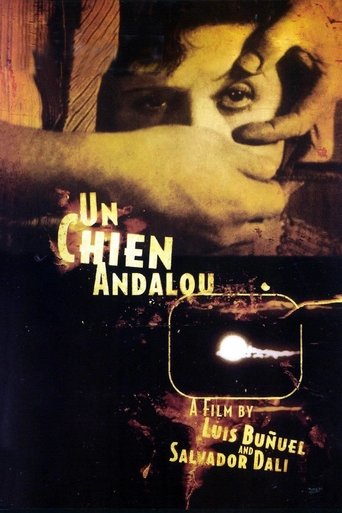
Salvador Dalí was a titan of the Surrealist movement whose foray into cinema during the late 1920s fundamentally altered the trajectory of avant-garde filmmaking. Born in Figueres, Spain, he moved to Madrid to study at the Real Academia de Bellas Artes de San Fernando, where he befriended filmmaker Luis Buñuel and poet Federico García Lorca. In 1929, Dalí collaborated with Buñuel to create 'Un Chien Andalou,' a film that discarded traditional narrative logic in favor of dream-like sequences and shocking imagery, including the infamous eye-slitting scene. Though primarily a painter, Dalí appeared as an actor in this seminal work, portraying one of the Marist brothers dragged across a room, symbolizing the weight of religious and social baggage. His cinematic contributions continued with the screenplay for 'L'Age d'Or' (1930), though his relationship with Buñuel soured during production. Throughout the Golden Age of Hollywood, Dalí remained a cinematic consultant and conceptual artist, most notably designing the haunting dream sequence for Alfred Hitchcock's 'Spellbound' (1945) and collaborating with Walt Disney on the short film 'Destino.' His presence in front of and behind the camera was characterized by a desire to provoke the subconscious and dismantle the conventions of reality.
More about Salvador Dalí
On screen
Dalí's acting was characterized by a deliberate 'anti-performance' style, rooted in the Surrealist concept of the 'found object' or 'found person.' In 'Un Chien Andalou,' his presence is stiff, symbolic, and intentionally jarring, serving as a physical manifestation of his own bizarre iconography rather than a traditional character portrayal. He utilized exaggerated facial expressions and a rigid physicality to emphasize the absurdity of the human condition.
Impact on culture
Salvador Dalí's impact on cinema is immeasurable, as he was the primary bridge between the fine arts and the moving image. By introducing Surrealism to the screen, he broke the 'fourth wall' of the subconscious, proving that film could be used to explore dreams, repressed desires, and irrationality rather than just linear storytelling. His collaboration with Hitchcock brought avant-garde sensibilities to mainstream Hollywood, influencing the visual language of psychological thrillers for decades.
Lasting legacy
Dalí's legacy in film history is cemented by 'Un Chien Andalou,' which remains a mandatory study for film students worldwide. He pioneered the use of the 'dream sequence' as a narrative tool, a technique that has become a staple in modern cinema. His aesthetic—melting clocks, long shadows, and distorted figures—continues to inspire the production design of contemporary directors like David Lynch, Terry Gilliam, and Guillermo del Toro.
Who they inspired
He influenced the development of music videos, fashion films, and experimental cinema. His belief that the camera could 'see' things the human eye could not led to advancements in visual effects and conceptual cinematography. Directors ranging from Jean Cocteau to contemporary auteurs have cited his visual provocations as the catalyst for their own creative explorations.
Off screen
Dalí's personal life was as eccentric as his art, dominated by his intense and complex relationship with his wife and muse, Gala (Elena Ivanovna Diakonova). They met in 1929 while she was married to poet Paul Éluard and remained together until her death in 1982. Dalí was known for his flamboyant public persona, including his waxed mustache and his habit of traveling with an ocelot.
Education
Real Academia de Bellas Artes de San Fernando, Madrid
Career milestones
- Co-wrote and acted in 'Un Chien Andalou' (1929), the most famous surrealist film in history
- Co-wrote the controversial 'L'Age d'Or' (1930), which was banned for decades in several countries
- Designed the iconic psychoanalytic dream sequence for Alfred Hitchcock's 'Spellbound' (1945)
- Collaborated with Walt Disney on the experimental short 'Destino' (started 1945, released 2003)
- Created the 'Rainy Taxi' installation for the 1938 International Surrealist Exhibition, later appearing in various filmed documentaries
- Published 'The Secret Life of Salvador Dalí' in 1942, detailing his cinematic theories
Iconic roles
- Marist Priest (Un Chien Andalou)
- Himself (Various documentaries and experimental shorts)
Must-see films
- Un Chien Andalou (1929)
- L'Age d'Or (1930)
- Spellbound (1945) - Dream Sequence Designer
- Destino (2003) - Concept and Storyboard
- Impressions de la Haute Mongolie (1975)
Awards
- Grand Cross of the Order of Isabella the Catholic (1964)
- Grand Cross of the Order of Charles III (1981)
- Gold Medal of the Generalitat de Catalunya (1982)
Nominations
- Academy Award Nomination for Best Animated Short Film (Destino, 2003 - Posthumous nomination for the project he originated)
Special recognition
- Marquess of Dalí of Púbol (Title granted by King Juan Carlos I in 1982)
- Associate Member of the Académie des Beaux-Arts (1978)
- Foreign Associate Member of the Académie des Beaux-Arts (1978)
Worked often with
- Luis Buñuel (Director/Writer)
- Alfred Hitchcock (Director)
- Walt Disney (Producer)
- Federico García Lorca (Writer)
- Man Ray (Photographer/Filmmaker)
Studios
- United Artists (Spellbound)
- Walt Disney Studios (Destino)
- Les Grands Films Classiques
Family
- Gala Dalí (1934-1982)
Did you know?
- The famous eye-cutting scene in 'Un Chien Andalou' actually used a dead calf's eye, not a human one.
- Dalí once showed up to a lecture in a deep-sea diving suit and nearly suffocated because he refused to take the helmet off.
- He was fired from the production of 'L'Age d'Or' after a falling out with Buñuel over the film's anti-clerical themes.
- His dream sequence for Hitchcock's 'Spellbound' was originally 20 minutes long but was heavily edited down by producer David O. Selznick.
- Dalí designed a 'Lobster Telephone' and a 'Mae West Lips Sofa,' both of which appeared in various filmed art documentations.
- He was a fan of the Marx Brothers and even wrote a screenplay for them titled 'Giraffes on Horseback Salad,' which was never filmed.
- He claimed that his mustache was a 'well-aligned antenna' that received messages from the universe.
- In 'Un Chien Andalou,' the ants crawling out of a hand were a recurring Dalí motif representing decay and transformation.
In their own words
The only difference between me and a madman is that I am not mad.
Surrealism is destructive, but it destroys only what it considers to be shackles limiting our vision.
I don't do drugs. I am drugs.
Drawing is the honesty of the art. There is no possibility of cheating. It is either good or bad.
Questions and answers
Who was Salvador Dalí in the context of cinema?
Salvador Dalí was a world-renowned Surrealist artist who co-created and acted in some of the most influential experimental films of the early 20th century, most notably 'Un Chien Andalou'.
What films is Salvador Dalí best known for?
He is best known for 'Un Chien Andalou' (1929), 'L'Age d'Or' (1930), and designing the dream sequence for Alfred Hitchcock's 'Spellbound' (1945).
When was Salvador Dalí born and when did he die?
Dalí was born on May 11, 1904, in Figueres, Spain, and passed away in the same city on January 23, 1989.
What awards did Salvador Dalí win for his film work?
While he did not win traditional acting awards, his film 'Destino' received a posthumous Oscar nomination, and he received numerous high-level state honors from Spain and France for his cultural contributions.
What was Salvador Dalí's cinematic style?
His style was Surrealist, focusing on the 'paranoiac-critical' method to create shocking, dream-like imagery that challenged logic and explored the human subconscious.
Did Salvador Dalí work with Walt Disney?
Yes, Dalí and Disney began a collaboration in 1945 on a short film called 'Destino,' which combined Dalí's surrealist art with Disney's animation, though it wasn't completed until 2003.