

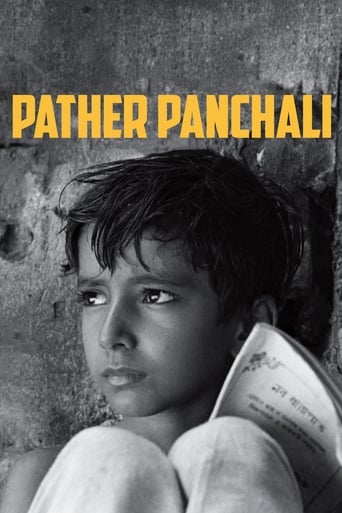
Apur Sansar
"Apu marries and faces tragedy in the Apu trilogy finale."
Keys: Space play/pause · ←/→ 10s · F fullscreen · M mute · </> speed
About this film
Apu, now an unemployed university graduate living in a Kolkata boarding house, dreams of becoming a writer while struggling to find meaningful employment. When his friend Pulu invites him to attend a village wedding in the countryside, Apu reluctantly agrees, only to find himself unexpectedly thrust into marriage when the groom is discovered to be mentally unstable. Apu marries the bride Aparna, and their relationship blossoms into a deep, tender love as they build a life together in a small apartment. Tragedy strikes when Aparna dies during childbirth, leaving Apu devastated and abandoning th…
Cast & crew
More films like this
More Drama films
View all →







More from Satyajit Ray
View all →


More about this film
About the production
Release dateMay 1, 1959
BudgetApproximately 150,000 rupees (very low budget even for its time)
Box officeModest initially in India, but significant international success through art house distribution
ProductionSatyajit Ray Productions
Filmed inKolkata (Calcutta), West Bengal, India, Bankura district, West Bengal (village scenes), Various locations in rural Bengal
The film faced severe financial difficulties during production, with Ray having to mortgage his life insurance policy and sell his personal possessions to complete it. The famous train sequence where Apu and Aparna travel together was shot in a single day with limited resources. Ray discovered Sharmila Tagore when she was only 14 years old, a relative of Rabindranath Tagore, and convinced her parents to let her act. The film was shot in chronological order to help the actors develop their characters naturally.
Themes
The journey from innocence to experienceGrief and healing through human connectionThe redemptive power of fatherhoodThe conflict between individual dreams and social responsibilitiesThe cyclical nature of life and death
Themes & topics
coming of agemarriagegrieffatherhoodreconciliationBengalpovertywritertragedyhopefamilylossrebirthfriendshiprural life
Historical background
Apur Sansar (1959) reached screens through Satyajit Ray Productions. Exhibitors of the time built studio-era schedules that mixed shorts, features, and live acts, so a clear premise helped Apur Sansar travel between cities and exchange markets.
Why this film matters
Archivists and revival programmers still cite Apur Sansar (1959) when tracing studio habits, casting pools, and the visual rhetoric audiences once took for granted. Even modest surviving prints help map how Apur Sansar fit beside competing releases of its day.
Making of
The production of Apur Sansar was marked by significant financial hardship. Satyajit Ray had already invested his personal savings into the first two films of the trilogy and struggled to secure funding for the conclusion. During filming, Ray ran out of money completely and had to halt production for several months. He eventually received a loan from the West Bengal government, but it came with strict conditions. The casting process was equally challenging - Ray searched extensively for the right actor to play the adult Apu before discovering Soumitra Chatterjee, a theater actor who perfectly embodied the character's intellectual yet vulnerable nature. For the role of Aparna, Ray initially considered several established actresses but ultimately chose the completely inexperienced Sharmila Tagore after being struck by her natural beauty and innocence in a photograph. The chemistry between the leads was so authentic that many viewers believed they were actually married in real life. Ray worked closely with cinematographer Subrata Mitra to develop the 'bounce lighting' technique, which allowed for more natural-looking indoor scenes without the harsh lighting typical of Indian cinema at the time.
What critics said
Trade coverage around 1959 discussed Apur Sansar for pacing, clarity, and program fit rather than blockbuster grosses. Later writers value it as evidence of period style and as a reference point beside other films from the same era.
Did you know?
- This was the debut film for both Soumitra Chatterjee (who would become Ray's most frequent collaborator) and Sharmila Tagore (who was only 14 when cast)
- The film completes Satyajit Ray's Apu Trilogy, which is now considered one of the greatest film trilogies ever made
- Sharmila Tagore was discovered by Ray through a photograph in a magazine and had no acting experience before the production
- The film was selected as India's official entry for the Best Foreign Language Film at the 32nd Academy Awards but was not nominated
- Ray had to stop production for several months due to lack of funds, resuming only after receiving financial help from the West Bengal government
- The famous scene where Apu shaves his beard after Aparna's death was improvised by Soumitra Chatterjee
- The film's title 'Apur Sansar' translates to 'The World of Apu' in English
- Ravi Shankar composed the score in just two weeks, working closely with Ray to match the music to the emotional tone of each scene
- The child actor who played young Kajal was actually director Satyajit Ray's son, Sandip Ray
- The film's final scene showing Apu and Kajal walking away together was shot on the last day of filming
Awards & recognition
- National Film Award for Best Feature Film in Bengali (1959)
- President's Gold Medal for Best Feature Film (India, 1959)
- Best Foreign Film - Bodil Awards (Denmark, 1960)
- Best Film - Vancouver International Film Festival (1959)
- Golden Gate Award for Best Picture - San Francisco International Film Festival (1959)
Visual style
Subrata Mitra's cinematography in Apur Sansar revolutionized Indian film photography through his innovative 'bounce lighting' technique, which involved reflecting light off painted surfaces to create soft, natural-looking illumination for indoor scenes. This approach allowed Ray to shoot in real locations rather than studio sets, enhancing the film's realism. Mitra's use of natural light, particularly in the outdoor scenes, created a luminous quality that captured the essence of rural Bengal. The famous train sequence, shot with available light passing through the windows, exemplified Mitra's ability to create poetic imagery from everyday situations. The camera work throughout the film is characterized by its observational quality, often maintaining a respectful distance from characters while capturing intimate moments. Mitra's compositions frequently used doorways and windows to frame subjects, creating visual metaphors for the boundaries between different worlds. The cinematography evolves with the story's emotional arc, from the bright optimism of Apu and Aparna's courtship to the shadowed grief following her death, ultimately resolving in the hopeful light of the final scene.
Innovations
Apur Sansar pioneered several technical innovations that would influence Indian and world cinema. Subrata Mitra's development of bounce lighting allowed for more naturalistic indoor cinematography, breaking from the harsh, artificial lighting typical of Indian films. Ray's use of sync sound recording was relatively advanced for Indian cinema at the time, contributing to the film's realism. The production team developed lightweight camera equipment that allowed for greater mobility in location shooting, particularly important for the rural sequences. The film's editing, done by Ray himself, employed a rhythmic pace that matched the emotional flow of the narrative, using longer takes to allow performances to breathe. The sound recording techniques used in the train sequence were particularly innovative, capturing both dialogue and ambient sounds authentically. Ray's use of actual locations rather than studio sets was revolutionary for Indian cinema and required creative solutions to technical challenges. The film's post-production process, including its careful sound mixing and color timing (for the few color sequences), set new standards for technical excellence in Indian independent cinema.
Music
Ravi Shankar's score for Apur Sansar represents a landmark collaboration between two of India's greatest artistic minds. Shankar composed the music in just two weeks, working closely with Ray to create a soundtrack that perfectly complemented the film's emotional journey. The score prominently features the sitar, Shankar's signature instrument, but also incorporates traditional Bengali folk elements and Western classical influences. Rather than providing constant background music, Shankar's compositions are used sparingly but powerfully, highlighting key emotional moments. The theme music for Apu and Aparna's relationship is particularly memorable, using a simple sitar melody that evolves throughout their courtship, marriage, and beyond. The score's minimalist approach reflects Ray's overall aesthetic philosophy, with music serving to enhance rather than dominate the narrative. Shankar's use of silence is as important as his use of sound, particularly in scenes depicting Apu's grief. The soundtrack was later released internationally and helped introduce Indian classical music to Western audiences, predating Shankar's own global fame in the 1960s.
Famous quotes
Apu: 'I have nothing to give you except my love.' (to Aparna during their courtship)
Aparna: 'Will you write about me someday?' (to Apu on the train)
Apu: 'I thought writing was everything, but now I know love is everything.' (reflecting on his marriage)
Pulu: 'Some things in life are meant to be, even if they don't make sense at first.' (to Apu about the marriage)
Apu: 'I was running away from myself, but I found you instead.' (to Kajal when reunited)
Apu: 'In losing everything, I found something more precious.' (about discovering fatherhood)
Aparna: 'Our love is like a story that will never end.' (to Apu)
Apu: 'Life takes away, but it also gives back in unexpected ways.' (final narration)
Memorable scenes
- The train journey where Apu and Aparna fall in love, shot with natural light passing through the windows as the countryside rushes by
- The wedding scene where Apu, initially reluctant, sees Aparna for the first time and is immediately captivated
- The intimate moments between Apu and Aparna in their small apartment, showing their growing love through simple domestic activities
- Apu shaving his beard after Aparna's death, a powerful visual representation of his grief and transformation
- The scene where Apu abandons his newborn son, heartbreakingly depicting his inability to face his loss
- The emotional reunion between Apu and Kajal years later, with the child initially rejecting his father
- The final scene showing Apu and Kajal walking away together into the sunset, symbolizing hope and renewal
- The montage of Apu's writing career struggles, intercut with his personal journey
What audiences thought
Initial audience reception in India was mixed, as the film's realistic style and slow pacing contrasted sharply with the popular musical extravagances of Bollywood. However, it found an appreciative audience among educated urban viewers and film enthusiasts. Internationally, the film resonated strongly with art house audiences who embraced its universal themes and emotional authenticity. Over time, as the trilogy's reputation grew, Apur Sansar developed a devoted following worldwide. The film's emotional power, particularly its depiction of Apu's journey from grief to redemption through fatherhood, continues to move audiences deeply. Modern audiences often discover the film through film studies, retrospectives, or streaming platforms, with many reporting that its themes of love, loss, and healing remain remarkably relevant today. The film's ending, showing Apu and his son walking together into the future, is frequently cited as one of cinema's most hopeful and emotionally satisfying conclusions.
Film connections
Influenced by
- Italian Neorealism (particularly Bicycle Thieves and Umberto D.)
- French Poetic Realism
- Jean Renoir's The River
- Vittorio De Sica's humanist cinema
- Bengali literary tradition, particularly works by Bibhutibhushan Bandyopadhyay
- Classical Indian music and performance traditions
This film influenced
- Pather Panchali (1955) - earlier film in the same trilogy
- Aparajito (1956) - second film in the trilogy
- The 400 Blows (1959) - similar coming-of-age themes
- Tokyo Story (1953) - influenced Ray's approach to family dynamics
- The Bicycle Thief (1948) - neorealist influence
- numerous Indian parallel cinema films of the 1960s-80s
- Children of Heaven (1997) - similar humanistic approach
- The World of Apu inspired countless coming-of-age narratives worldwide
Film restoration
The original negatives of Apur Sansar were preserved by the Academy Film Archive and the British Film Institute. In 2013, the Criterion Collection undertook a complete 4K restoration of the entire Apu Trilogy in collaboration with the Academy of Motion Picture Arts and Sciences. This restoration used the original camera negatives and audio elements, with frame-by-frame digital cleaning and color correction supervised by experts who had worked with Satyajit Ray. The restoration premiered at the 2015 Cannes Film Festival to critical acclaim. The film is also preserved in the National Film Archive of India. Due to the original negatives being in relatively good condition, the restoration was able to maintain the film's original aesthetic while significantly improving image and sound quality. The restored version is now considered the definitive version for both theatrical and home viewing.
Where to watch
- The Criterion Channel (streaming with the complete restored Apu Trilogy)
- MUBI (periodically available as part of their curated collection)
- Janus Films (theatrical screenings of restored version)
- Criterion Collection Blu-ray/DVD box set of The Apu Trilogy
- Various public library collections (DVD format)
- Film forum screenings at art house cinemas and museums
- Educational institutions through film studies programs
- Some international streaming platforms depending on region