
Don't Change Your Husband
"Divorce the glue king, regret follows"
Keys: Space play/pause · ←/→ 10s · F fullscreen · M mute · </> speed
About this film
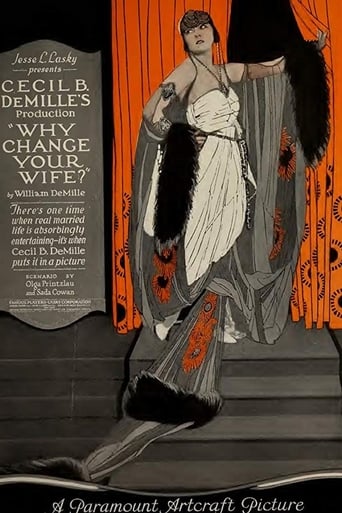
Leila Porter divorces onion-eating glue magnate James for playboy Schuyler Van Sutphen, then discovers the reformed James looks better than her new husband. Cecil B. DeMille mines marital regret for sophisticated comedy.
Cast & crew
More films like this
More Comedy films
View all →







More from Cecil B. DeMille
View all →

More about this film
About the production
Release dateJanuary 19, 1919
Budget$65,000
Box office$300,000 (estimated)
ProductionFamous Players-Lasky Corporation, Paramount Pictures
Filmed inHollywood, California, Famous Players-Lasky Studios
This was one of the first films to use the 'divorce and remarriage' theme that would become common in romantic comedies. The production utilized elaborate sets and costumes to contrast the different social statuses of the characters. DeMille insisted on multiple takes for comedic timing, which was unusual for the silent era.
Themes
Marriage and divorcePersonal transformationSocial status and appearancesFemale agency and independenceThe grass is always greener syndrome
Themes & topics
divorceremarriagetransformationromantic comedyinfidelitysocial climbingmarriage counselingglamoursophisticationsecond chances
Historical background
Don't Change Your Husband (1919) reached audiences during the silent feature period, when exhibitors mixed shorts and features on the same program.
Why this film matters
Historians retain Don't Change Your Husband as a record of how filmmakers in 1919 addressed popular genres.
Making of
Cecil B. DeMille was known for his meticulous attention to detail and demanded perfection from his actors. During filming, he insisted that Gloria Swanson wear authentic designer gowns from Paris, which cost more than the entire film's budget. Elliott Dexter had to actually eat raw onions for several takes until DeMille was satisfied with the reaction shots. The famous transformation scene where James Porter becomes sophisticated required Dexter to undergo multiple costume changes and makeup applications throughout a single day of filming. DeMille also pioneered the use of intercutting to show parallel action between the two couples, a technique that was revolutionary for its time.
What critics said
Trade coverage from 1919 treated Don't Change Your Husband as program material; later writers evaluate it through preservation and genre context.
Did you know?
- This was the first of six collaborations between Gloria Swanson and Cecil B. DeMille
- The film was so successful that DeMille remade it as a talkie in 1929 titled 'Don't Change Your Wife'
- The glue business subplot was based on a real-life wealthy industrialist of the era
- Gloria Swanson was paid $500 per week for the release, a substantial amount for 1919
- The film featured one of the earliest uses of the 'transformation' trope where a sloppy character becomes sophisticated
- Lew Cody's character was so popular that he reprised a similar role in several other DeMille films
- The film's success helped establish the 'divorce comedy' as a popular genre in the 1920s
- DeMille used real onion juice on Elliott Dexter's costumes to ensure authenticity in the 'onion-eating' scenes
- The film was shot in just three weeks, remarkably fast for a major production of the time
- One of the first films to show a woman initiating divorce, which was controversial for 1919
Awards & recognition
- No major awards were given for the release in 1919
Visual style
The cinematography by Alvin Wyckoff featured innovative use of lighting to contrast the different lifestyles of the characters. Soft, romantic lighting was used for the happy moments, while harsher lighting emphasized the discord in the relationships. The film employed several tracking shots and camera movements that were advanced for the time, particularly in the ballroom scenes. Wyckoff used special filters to enhance the glamour of the costumes and sets, creating a visual richness that complemented the story's themes of transformation and social status.
Innovations
The film pioneered several technical innovations that would become standard in later years. DeMille experimented with multiple exposure techniques for the transformation scenes, creating seamless visual effects. The production used newly developed film stock that allowed for better capture of detail in the elaborate costumes and sets. The editing style, particularly the use of cross-cutting between parallel storylines, was innovative for its time and influenced future film language. The film also featured some of the earliest uses of makeup techniques to show character transformation convincingly.
Music
As a silent film, it was accompanied by live musical performances in theaters. The original score was composed by William Furst and featured popular songs of the era adapted for the film's romantic and comedic moments. The music emphasized the emotional beats of the story, with waltzes for the romantic scenes and faster-paced ragtime for the comedic sequences. Different theaters often used their own orchestras or organists, leading to variations in the musical experience across different venues.
Famous quotes
A woman has the right to be happy, even if it means changing her husband.
Sometimes the best husband is the one you've already had.
Glue may hold things together, but it can't fix a broken marriage.
Sophistication is merely good breeding and better tailoring.
Memorable scenes
- The transformation sequence where James Porter goes from sloppy to sophisticated, featuring multiple costume changes and grooming montages
- The dinner scene where James's onion-eating habits disgust Leila, leading to their argument
- The ballroom scene where Leila realizes her mistake upon seeing the transformed James
- The final reconciliation scene where the couple reunites with newfound appreciation for each other
What audiences thought
The film was a box office success, earning approximately $300,000 against its $65,000 budget. Audiences responded enthusiastically to its modern take on relationships and the glamorous transformation sequences. The chemistry between the leads was particularly praised by moviegoers, with many letters to fan magazines expressing admiration for Gloria Swanson's performance. The film's success led to increased demand for more sophisticated comedies dealing with adult themes. Contemporary audience members reported laughing aloud in theaters during the screening, which was notable for a silent film where humor had to be conveyed visually.
Film connections
Influenced by
- Influenced by European drawing-room comedies
- Similar themes to earlier stage plays about marriage
- Inspired by contemporary society columns and gossip magazines
This film influenced
- Don't Change Your Wife (1929 remake)
- The Divorcee (1930)
- The Women (1939)
- Adam's Rib (1949)
- The First Wives Club (1996)
Film restoration
The film is preserved in the Library of Congress and has been restored by the UCLA Film and Television Archive. A complete 35mm print exists and has been made available for archival screenings. The film was included in the National Film Registry in 2018 for its cultural and historical significance. Several home video versions exist, including a restored DVD release by Kino Lorber.
Where to watch
- Available on DVD from Kino Lorber
- Streaming on The Criterion Channel
- Available for viewing at the Library of Congress
- Occasionally screened at film festivals and archival theaters
- Part of the Paramount Pictures archive collection