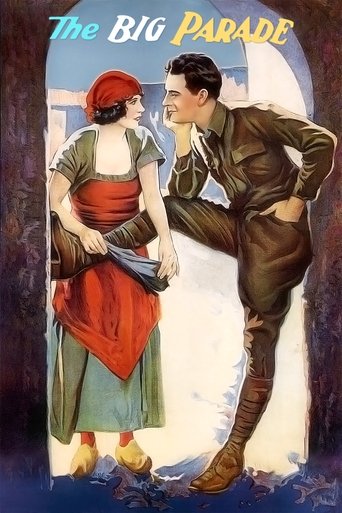
Hearts of the World
"Village love under German guns"
Keys: Space play/pause · ←/→ 10s · F fullscreen · M mute · </> speed
About this film
D.W. Griffith contrasts French village romance with German occupation horrors in a 1918 propaganda epic. A group of youngsters grow up and love in a peaceful French village. But war intrudes and peace is shattered. The German army invades and occupies village, bringing both destruction and torture. The young people of the village resist, some successfully, others tragically, until F.
Cast & crew
More films like this

More Drama films
View all →







More from D.W. Griffith
View all →
More about this film
About the production
Release dateMarch 3, 1918
Budget$500,000
Box office$3 million (enormous success for 1918)
ProductionD.W. Griffith Productions, Famous Players-Lasky Corporation, Paramount Pictures
Filmed inHollywood, California, England, France (near front lines), Long Island, New York
Griffith was commissioned by the British War Office to create a film that would help sway American public opinion toward entering WWI. The production was extremely dangerous as Griffith insisted on filming authentic war footage near the front lines in France. Both Lillian and Dorothy Gish nearly died from illness contracted during the European location shoot. The film was rushed into release to capitalize on America's recent entry into the war.
Themes
Love versus warPatriotism and sacrificeThe innocence of youth destroyed by conflictResistance against oppressionThe brutality of occupation
Themes & topics
World War IFrench villageGerman occupationYoung loveResistanceLiberationPropagandaBattlefieldSeparationReunionTortureHeroismSacrificePatriotismFamily
Historical background
1918 placed Hearts of the World within United States cinema as D.W. Griffith Productions navigated wartime markets, immigration audiences, and the shift from intertitles to sound.
Why this film matters
Archivists revisit Hearts of the World (1918) for D.W. Griffith style, genre norms at D.W. Griffith Productions, and the exhibition context of 117 minutes programming.
Making of
The production of 'Hearts of the World' was especially ambitious and dangerous undertakings in early cinema history. Griffith, having already established his reputation with 'The Birth of a Nation' and 'Intolerance,' was approached by the British government in 1917 to create a propaganda film that would help bring America into WWI. The director took his commission seriously, insisting on authenticity at every turn. He traveled to Europe with his cast and crew, including Lillian and Dorothy Gish, filming in actual war-torn villages in France. The production faced numerous challenges: the constant threat of enemy fire, outbreaks of disease among the cast, and the emotional toll of witnessing real warfare. Griffith reportedly came under shell fire while filming and had to be rescued. The Gish sisters both became seriously ill during the European shoot, with Lillian developing life-threatening pneumonia. Despite these hardships, or perhaps because of them, the film achieved a remarkable level of authenticity that audiences of the time found deeply moving. The relationship between Griffith and Lillian Gish also deepened during this perilous production, though their romantic involvement would end a few years later.
What critics said
Retrospective writing on Hearts of the World stresses craft by D.W. Griffith, print survival, and repertory value rather than opening-week gross alone.
Did you know?
- D.W. Griffith was paid $1 million for this film, making him the highest-paid director in Hollywood at the time.
- The film was partially shot on location near active WWI battlefields, making it among the leading dangerous film productions ever undertaken.
- British Prime Minister David Lloyd George personally requested Griffith to make the film as propaganda to encourage American entry into the war.
- Lillian Gish contracted pneumonia during filming in France and nearly died, delaying production for months.
- The film's success led to Griffith receiving an honorary degree from Oxford University.
- Several scenes featuring actual combat footage were filmed by Griffith himself, who risked his life to capture authentic war images.
- The original cut was over 3 hours long but was trimmed down for theatrical release.
- Dorothy Gish's performance as 'The Little Disturber' was so popular that it became her signature character type.
- The film was banned in Germany and Austria for its anti-German propaganda content.
- Griffith used real French villagers as extras, many of whom had actually experienced German occupation.
Awards & recognition
- 1918 Photoplay Magazine Medal of Honor (Special Award for Patriotic Contribution)
- 1918 National Board of Review Award (Best Picture)
Visual style
The cinematography of 'Hearts of the World' represented a significant advancement in visual storytelling, combining Griffith's innovative studio techniques with groundbreaking location photography. Billy Bitzer, Griffith's longtime cinematographer, employed a range of techniques including deep focus, tracking shots, and carefully composed close-ups that heightened the emotional impact of key scenes. The contrast between the idyllic pre-war village scenes, shot with soft, romantic lighting, and the harsh, documentary-style war footage created a powerful visual narrative. Griffith's decision to film near actual battlefields resulted in some of the most authentic combat footage ever captured in narrative cinema up to that time. The cinematography particularly excelled in its treatment of Lillian Gish, using innovative lighting techniques to emphasize her ethereal beauty and emotional vulnerability. The film also featured impressive night photography and carefully staged crowd scenes that conveyed the scale of both village life and military operations. The visual style influenced countless subsequent war films, establishing conventions for contrasting peaceful domestic scenes with the chaos of warfare that would become standard in the genre.
Innovations
'Hearts of the World' featured several technical innovations that pushed the boundaries of early cinema. Griffith's use of authentic location footage shot near active battlefields represented a breakthrough in documentary-style filmmaking within narrative cinema. The production employed portable cameras and faster film stocks that allowed for more mobile photography in difficult conditions. The film's editing techniques, particularly the cross-cutting between the home front and battle scenes, created a sense of simultaneous action that heightened dramatic tension. Griffith also experimented with multiple camera angles and perspectives during the battle sequences, giving audiences a more immersive experience of warfare. The film's special effects, while primitive by modern standards, were innovative for their time, including carefully staged explosions and miniature work for large-scale battle scenes. The production also pioneered new techniques in makeup and costume design to realistically depict the physical toll of war on soldiers. Perhaps most significantly, the film demonstrated how narrative cinema could effectively incorporate documentary footage, blurring the line between fiction and reality in ways that would influence both feature filmmaking and documentary practice for decades to come.
Music
As a silent film, 'Hearts of the World' would have been accompanied by live musical performances during its theatrical run. The original score was composed by Victor Herbert, among the leading prominent American composers of the era, who created a lush, romantic orchestral score that emphasized the film's emotional peaks and valleys. Herbert's composition included leitmotifs for the main characters and contrasting themes for the peaceful village scenes versus the violent war sequences. The score also incorporated popular patriotic songs of the period, including 'La Marseillaise' during the French liberation scenes. For major theatrical engagements, full orchestras performed the score, while smaller theaters used organists or pianists with cue sheets provided by the production company. The music was specifically designed to enhance the film's propaganda elements, with stirring martial themes accompanying the French soldiers and dissonant, ominous music underscoring the German occupation. The original score has been largely lost, though some fragments survive in archival collections, and modern restorations typically feature newly composed scores inspired by Herbert's original work.
Famous quotes
War is not glorious when you see it as I have seen it." (intertitle)
Love is stronger than hate." (intertitle)
Even in the darkest night, there is hope of dawn." (intertitle)
The little things we took for granted are now the things we fight for." (intertitle)
When peace comes, we will remember those who gave their lives for it." (intertitle)
Memorable scenes
- The idyllic opening sequence showing the young lovers in the peaceful French village before the war, with its soft lighting and romantic atmosphere establishing the world that will be destroyed.
- The dramatic German invasion scene, with soldiers marching through the village streets and the terrified reactions of the villagers, effectively conveying the sudden shock of occupation.
- Lillian Gish's emotional breakdown scene as she receives news of her lover's supposed death, considered especially powerful performances of the silent era.
- The torture sequence where the German commandant interrogates the French villagers, notable for its restrained but powerful depiction of brutality.
- The final liberation scene with French troops entering the village and the emotional reunion of the lovers, providing cathartic resolution to the narrative.
What audiences thought
Audiences in 1918 responded to 'Hearts of the World' with extraordinary enthusiasm, making it one of the biggest box office hits of the decade. The film played to packed theaters across America and Europe, with many viewers reportedly weeping openly during screening. Its emotional impact was so profound that it was credited with increasing enlistment numbers and war bond sales. Contemporary accounts describe audiences rising to their feet and cheering during the liberation scenes. The film's success was particularly notable given that it was released while the war was still ongoing, making its content immediate and relevant to viewers. Veterans and families with loved ones at the front found the film's depiction of warfare particularly moving. The character of 'The Little Disturber' played by Dorothy Gish became a cultural phenomenon, with audiences demanding more of her comic relief in Griffith's subsequent films. The film's popularity extended internationally, though it was predictably banned in Germany and Austria. Even decades after its release, veterans of WWI continued to cite 'Hearts of the World' as the most authentic depiction of their wartime experiences.
Film connections
Influenced by
- The Birth of a Nation (1915)
- Intolerance (1916)
- War literature of the period
- British government propaganda films
- Contemporary newspaper accounts of German occupation in France
This film influenced
- The Big Parade (1925)
- All Quiet on the Western Front (1930)
- Mrs. Miniver (1942)
- Casablanca (1942)
- The Best Years of Our Lives (1946)
- Saving Private Ryan (1998)
Film restoration
The film is preserved in several archives including the Library of Congress, the Museum of Modern Art, and the British Film Institute. Multiple versions exist, including Griffith's original cut and various shortened versions released for different markets. A comprehensive restoration was completed in the 1990s using surviving elements from various archives, though some scenes remain lost or damaged. The film is considered to be in relatively good condition for a silent-era production, with most key sequences intact.
Where to watch
- The Criterion Collection (Blu-ray/DVD)
- Kino Lorber (DVD release)
- The Museum of Modern Art's film collection (occasional screenings)
- Various streaming services specializing in classic cinema
- Film archives and cinematheques that occasionally program silent films