

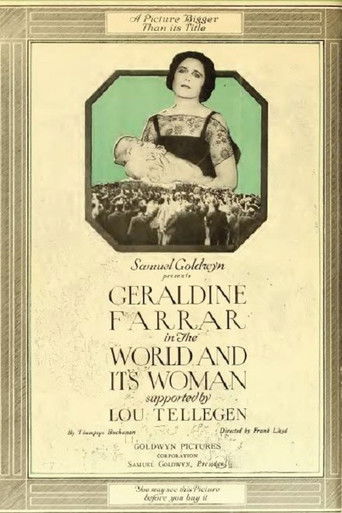
The World and the Woman
"In "The World and the Woman", Jeanne Eagels plays Mary, a prostitute (which…"
Keys: Space play/pause · ←/→ 10s · F fullscreen · M mute · </> speed
About this film
In "The World and the Woman", Jeanne Eagels plays Mary, a prostitute (which is implied by her walking the streets and being hassled by policemen) who reluctantly takes a better position at a country lodge as a maid. woodland community: she attends church and the path to S
Cast & crew
More films like this
More Drama films
View all →







More from Frank Lloyd
View all →

More about this film
About the production
Release dateApril 16, 1916
ProductionPallas Pictures
Filmed inCalifornia
The film was produced by Pallas Pictures, a company that would later merge into Paramount Pictures. Director Frank Lloyd was already establishing himself as a prominent filmmaker in Hollywood's early years. The production took place during a transitional period in American cinema, as feature-length films were becoming more common than short subjects.
Themes
Themes & topics
prostituteredemptionsalvationfaith healingcountry lodgereligious conversionmoral transformationfallen woman
Historical background
Released in 1916 during the silent era's formative years, The World and the Woman reached audiences when exhibitors were still defining programming conventions. The narrative hook—In "The World and the Woman", Jeanne Eagels plays Mary, a prostitute (which…—reflects what contemporary producers thought would draw viewers.
Why this film matters
The World and the Woman remains discussed by archivists tracing how screen stories of its period represented work, desire, conflict, and social order. Its central situation—In "The World and the Woman", Jeanne Eagels plays Mary, a prostitute (which…—still prompts questions about genre conventions and audience expectations.
Making of
The production of 'The World and the Woman' took place during Hollywood's transition from the East Coast to the West Coast, with California becoming the center of American filmmaking. Director Frank Lloyd, who had emigrated from Scotland, was quickly establishing himself as one of Hollywood's most reliable directors, known for his ability to handle both dramatic and action material. Jeanne Eagels, though not yet the figure she would become, was already noted for her intense, naturalistic acting style that set her apart from many of her contemporaries. The film's production values were typical of mid-1910s features, with location shooting in California's natural landscapes providing the contrast between the urban and rural settings that were central to the story's themes of redemption and transformation.
What critics said
Trade and newspaper notices for The World and the Woman generally emphasized casting, spectacle, and program fit rather than extended aesthetic argument. Retrospective screenings and archival notes continue to shape how viewers evaluate The World and the Woman today.
Did you know?
- This was one of Jeanne Eagels' early film roles before she became a major Broadway star and later an Academy Award nominee for 'The Letter' (1929)
- Director Frank Lloyd would go on to win three Academy Awards for Best Director, making him honored directors in Oscar history
- The film was produced by Pallas Pictures, which was founded by actress-producer Clara Kimball Young and her husband James Young
- The film's themes of redemption and morality were typical of the era, reflecting the strong influence of social reform movements on early American cinema
- Jeanne Eagels was known for her intense acting style, which was somewhat unusual for the period and helped establish her as a serious dramatic actress
- The film was released just months before the United States entered World War I, during a period when American audiences were increasingly seeking escapist entertainment
- Frank Lloyd directed over 140 films during his career, but only a small percentage of his silent work survives today
- The film's treatment of prostitution was relatively daring for its time, though it ultimately reinforced moral values through the protagonist's redemption
Visual style
The cinematography of 'The World and the Woman' employed the visual techniques typical of mid-1910s American cinema, with a focus on clear storytelling through visual contrast. The film likely used the urban versus rural setting dichotomy to visually represent Mary's journey from sin to redemption, with the city scenes photographed in darker, more shadowy tones while the country sequences featured brighter, more natural lighting. The camera work would have been relatively static by modern standards, with the use of intertitles to convey dialogue and narrative progression, as was standard for silent films of this period.
Innovations
While 'The World and the Woman' does not appear to have introduced any major technical innovations, it represents the solid craftsmanship of mid-1910s American feature filmmaking. The film was produced using standard 35mm film with the typical aspect ratio of the era. The production would have utilized the lighting, camera, and editing techniques that had become standard in Hollywood by this time, representing the industry's move toward more sophisticated visual storytelling compared to the earlier short films that dominated the first decade of cinema.
Music
As a silent film, 'The World and the Woman' would have been accompanied by live musical performance during its theatrical run. The typical practice for dramatic films of this era involved a pianist or small orchestra providing background music that enhanced the emotional tone of each scene. For a film with religious themes like this one, the musical accompaniment would likely have included hymns and sacred music during the church and redemption scenes, with more dramatic or melancholic pieces during the urban sequences. No original composed score exists for the film, as individual theaters would provide their own musical arrangements.
Famous quotes
Through faith, all things are possible
The world offers temptation, but the soul seeks salvation
In the quiet of the countryside, I found my true self
Memorable scenes
- Mary's first church service where she experiences spiritual awakening
- The healing scene where Mary uses her faith to cure the sick country folk
- The confrontation with her former employer that tests her newfound virtue
- Mary's final decision between her past and her spiritual future
What audiences thought
The film appears to have been moderately successful with audiences in 1916, particularly appealing to viewers who favored morally uplifting stories with clear messages of redemption. The theme of a fallen woman finding salvation through faith resonated strongly with the predominantly Protestant American movie-going audience of the period. While specific box office figures are not available, the film's release by Pallas Pictures suggests it was considered commercially viable enough for wide distribution. Audience response to Jeanne Eagels' performance was particularly strong, helping establish her as a rising star in the competitive Hollywood landscape of the mid-1910s.
Film connections
Influenced by
- Social reform literature
- Victorian morality plays
- Religious revival narratives
This film influenced
- The Red Kimono (1925)
- The Miracle Woman (1931)
- Sadie Thompson (1928)
Film restoration
The preservation status of 'The World and the Woman' is unclear, and the film may be lost. Many silent films from this period, particularly those produced by smaller companies like Pallas Pictures, have not survived. The Library of Congress and major film archives have no record of a complete print, though it's possible that fragments or copies may exist in private collections or smaller archives. The lack of available viewing sources suggests the film is likely lost or severely incomplete, which is unfortunately common for approximately 75% of American silent films.
Where to watch
- No known current viewing sources available - film appears to be lost or not commercially accessible