

West of the Divide
"Ted Hayden joins his father's killer's gang under a dead man's name."
Keys: Space play/pause · ←/→ 10s · F fullscreen · M mute · </> speed
About this film
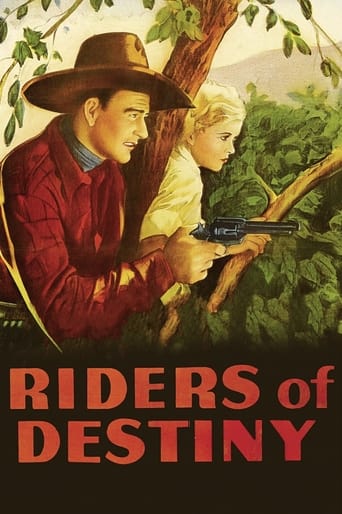
Ted Hayden impersonates a wanted outlaw to infiltrate Gentry's gang, then discovers Gentry murdered his father. Working inside the outlaw band, he searches for proof and revenge on the range.
Cast & crew
More films like this

More Action films
View all →
More from Robert N. Bradbury
View all →
More about this film
About the production
Release dateOctober 15, 1934
Box officeBox office figures not specifically recorded, but was profitable as part of John Wayne's successful Lone Star series
ProductionLone Star Productions, Monogram Pictures
Filmed inLone Pine, California, Alabama Hills, California, Monogram Movie Ranch, California
This was one of sixteen films John Wayne made for Lone Star Productions between 1933-1935. The film was shot in just six days, typical for the rapid production schedule of B-westerns. The Alabama Hills location was frequently used for westerns due to its dramatic rock formations that resembled the American West. George 'Gabby' Hayes was still developing his famous 'Gabby' persona and wasn't yet using that nickname in billing.
Themes
RevengeJusticeIdentity and deceptionHonorFamily loyalty
Themes & topics
impersonationgang infiltrationrevenge plotcattle rustlersundercover herofather's murderwestern towngang leaderromantic subplotfinal showdown
Historical background
Made in 1934, in United States, under Robert N. Bradbury, West of the Divide belongs to b western filmmaking as studio systems and national cinemas competed for audiences. West of the Divide is a 1934 American Western film directed by Robert N.
Why this film matters
Within b western history, Robert N. Bradbury's name attaches to the work; 1934 film directed by Robert N. Bradbury; Bradbury for Monogram, and starring John Wayne, Yakima Canutt and Gabby Hayes..
Making of
The production was typical of the fast-paced B-western factory system of the 1930s. Director Robert N. Bradbury was known for his efficiency and could complete filming in under a week. John Wayne was still developing his screen persona and was paid only $2,500 per film during this period. The cast and crew often worked 12-14 hour days to meet the tight production schedules. Virginia Brown Faire, a former WAMPAS Baby Star, was nearing the end of her career and this role represented one of her last significant parts. The film's minimal sets were reused from other Lone Star productions to save costs, a common practice in low-budget western production.
What critics said
Contemporary reviews of West of the Divide are sparse in open sources; later catalog entries chiefly summarize plot and credits.
Did you know?
- This was the first of three films that John Wayne and director Robert N. Bradbury made together in 1934
- George 'Gabby' Hayes appears clean-shaven in this film, before adopting his famous whiskered 'Gabby' character
- The film was originally titled 'The Man from Hell River' before being changed to 'West of the Divide'
- Virginia Brown Faire was a former silent film star making one of her last film appearances
- The character name 'Gat Ganns' that Wayne impersonates was likely a play on 'gat' (slang for gun) and 'gann' (to devour)
- This film was part of a package of eight Wayne westerns sold to television in the 1950s that helped establish his TV stardom
- The film's copyright was not renewed and entered the public domain in 1962
- Robert N. Bradbury was the father of Bob Steele, another popular western star of the era
- The film features an early example of the 'undercover hero' trope that would become common in westerns
- John Wayne performed his own stunts in the film, including horse falls and fight sequences
Visual style
The cinematography was handled by Archie Stout, who would later work with John Wayne on Stagecoach and become John Ford's regular cinematographer. The film utilizes natural lighting for outdoor scenes, typical of low-budget productions. The Alabama Hills locations provided dramatic backdrops that enhanced the visual scope despite the limited budget. Camera work was functional rather than innovative, focusing on clear storytelling and action visibility. The black and white photography emphasizes the stark contrasts of the western landscape.
Innovations
As a low-budget B-western, the film did not feature significant technical innovations. However, it represents the refinement of sound recording techniques for outdoor locations, which was still challenging in 1934. The film's efficient production methods and quick turnaround time demonstrated the industrialization of Hollywood filmmaking. The use of natural locations rather than studio sets helped establish the visual language of western cinema.
Music
The film featured a typical musical score for a 1934 western, with stock music tracks used throughout. No original songs were composed specifically for the film. The sound design emphasized gunshots, horse hooves, and ambient western sounds. Dialogue recording was primitive by modern standards, with the characteristic flat sound quality of early sound films. The musical cues followed the dramatic conventions of the era, with tense music for action scenes and romantic themes for love scenes.
Famous quotes
I'm looking for a man named Gentry. He killed my father.
You can't run from the law forever, Gentry.
Sometimes a man has to do what's right, even if it's dangerous.
This town needs someone who isn't afraid to stand up to troublemakers.
Memorable scenes
- The opening scene where Ted Hayden arrives in town and learns about Gentry's gang
- The confrontation where Ted reveals his true identity to Gentry
- The final shootout between Ted and the gang members
- The scene where Ted first meets Fay Winters and romantic tension is established
What audiences thought
The film was well-received by its target audience of Saturday matinee western enthusiasts. John Wayne's growing popularity among western fans helped ensure the film's commercial success. The film's straightforward revenge plot and action sequences satisfied the expectations of 1930s western audiences. In later years, the film found new audiences through television broadcasts and home video, particularly among John Wayne completists and classic western enthusiasts.
Film connections
Influenced by
- The traditional revenge western formula
- Earlier silent westerns
- Dime novel western stories
- Contemporary B-western conventions
This film influenced
- Later John Wayne westerns
- The undercover hero trope in westerns
- Revenge westerns of the 1930s-1950s
Film restoration
The film is preserved in the public domain. Multiple copies exist in various archives and collections. The quality varies depending on the source material, but complete versions are available. The film has been released on DVD by multiple public domain distributors.
Where to watch
- YouTube (public domain uploads)
- Internet Archive
- Amazon Prime Video (various public domain collections)
- DVD collections from public domain publishers
- Tubi (occasionally featured in western collections)