
Keys: Space play/pause · ←/→ 10s · F fullscreen · M mute · </> speed
Plot
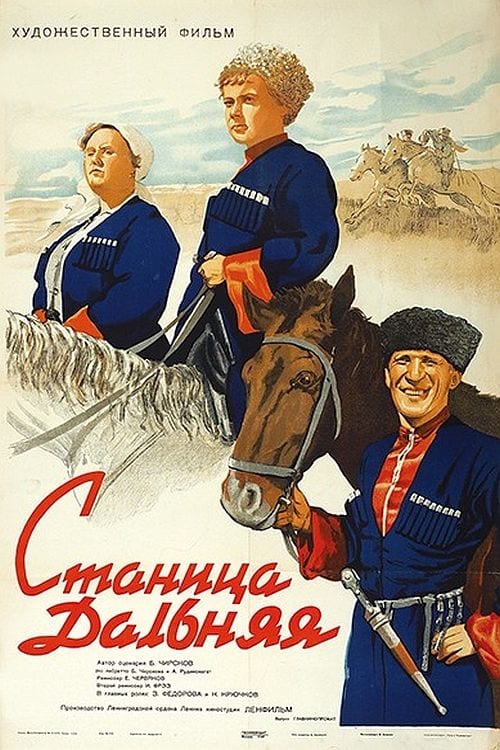
During military exercises in the Kuban region, two Cossack villages—Dalnyaya and Kochevskaya—engage in strategic war games. Mikhail, a charismatic Cossack from Kochevskaya, leads the reconnaissance unit with skill and bravado, while his fiancée Dasha Gorkunova serves as a communications officer for the opposing 'enemy' unit. The military maneuvers intensify as both sides employ clever tactics and strategies to outwit each other. Dasha, using her wit and knowledge of the terrain, successfully deceives her pursuers and escapes to deliver crucial intelligence to her own unit. The film combines military strategy with romantic elements, showcasing the Cossack spirit of competition and camaraderie while highlighting the resourcefulness of its characters in a lighthearted comedy of military maneuvers.
About the Production
Release Date 1939-03-15
Production Lenfilm
Filmed In Kuban region, Soviet Union, Leningrad Film Studios
The film was produced during the height of Stalin's purges but managed to maintain a lighthearted tone despite the political climate. Director Yevgeni Chervyakov worked closely with military consultants to ensure authenticity in depicting Cossack military tactics and traditions. The production faced challenges in securing authentic Cossack costumes and equipment, as many traditional items had been destroyed or confiscated during the preceding years of collectivization.








Themes & Topics
military maneuversCossacksKubanreconnaissancecommunicationsromancecompetitionstrategydeceptionpatriotism
Historical Background
The film was produced in 1939, a pivotal year in Soviet and world history. The Soviet Union was in the midst of Stalin's Great Purge, which had affected many in the film industry, yet this comedy managed to navigate the political tensions. The film's release came just months before the Molotov-Ribbentrop Pact and the subsequent Soviet invasion of Poland, events that would dramatically shift Soviet cinema toward patriotic wartime themes. The depiction of Cossacks in the film reflects the Soviet state's complex relationship with this historically independent group—once enemies of the Bolsheviks, now being rehabilitated as patriotic defenders of the Soviet motherland. The Kuban region, where the film is set, was an important agricultural area that had undergone forced collectivization in the early 1930s, resulting in widespread famine. By 1939, the region had recovered sufficiently to be portrayed as a thriving part of the Soviet Union. The film's military theme also reflects the Soviet Union's rapid military modernization program of the late 1930s, as the country prepared for the increasingly likely possibility of war.
Why This Film Matters
'Stanitsa Dalnyaya' represents an important moment in Soviet cinema history as one of the last major comedies before the outbreak of World War II. The film contributed to the rehabilitation of Cossack culture in Soviet popular consciousness, transforming them from historical adversaries of the Bolshevik regime into patriotic Soviet citizens. Its portrayal of strong, capable female characters, particularly Zoya Fyodorova's Dasha, offered a progressive vision of women's roles in Soviet society, combining traditional femininity with modern competence and agency. The film's success demonstrated that Soviet audiences still appreciated light entertainment despite the increasingly oppressive political atmosphere. The movie also helped establish Sergei Filippov as a major comedic talent who would go on to become one of the most beloved actors in Soviet cinema. The film's blend of military themes with comedy influenced subsequent Soviet war comedies, creating a template for balancing patriotic content with entertainment value.
Making Of
The production of 'Stanitsa Dalnyaya' took place during a complex period in Soviet cultural history. Director Yevgeni Chervyakov, known for his ability to balance entertainment with ideological messaging, worked carefully to create a film that would satisfy both audiences and state censors. The casting process was particularly challenging, as the studio needed actors who could embody the Cossack spirit while maintaining the film's comedic tone. Sergei Filippov was chosen for his physical comedy skills and his ability to portray the dashing Cossack archetype. The film was shot on location in the Kuban region, with additional studio work at Lenfilm in Leningrad. Military advisors from the Red Army were brought in to ensure the accuracy of the military maneuvers depicted. The production team faced difficulties in sourcing authentic Cossack uniforms and equipment, leading to extensive costume design work. The film's score incorporated traditional Cossack melodies arranged by composer Nikolai Kryukov, who would later become one of Soviet cinema's most prolific composers.
What Critics Said
Contemporary Soviet critics praised the film for its lighthearted approach to military themes and its authentic depiction of Cossack life. The official newspaper Pravda commended the film for showing 'the joyful enthusiasm of our young people defending their motherland' while maintaining entertainment value. Critics particularly appreciated Zoya Fyodorova's performance, noting her fresh, modern approach to the female lead. The film was recognized for successfully navigating the difficult balance between comedy and military subject matter, something many Soviet films struggled with during this period. In retrospect, film historians have noted the movie as an example of how Soviet cinema managed to produce quality entertainment even during the height of Stalin's repression. Modern critics have reevaluated the film as an important cultural artifact that reveals how Soviet identity was being constructed through popular cinema in the pre-war years.
Did You Know?
- The film was one of the last comedies produced in the Soviet Union before World War II and the subsequent shift to more serious wartime cinema.
- Sergei Filippov, who played Mikhail, would later become one of the Soviet Union's most beloved comic actors, though this was one of his early major roles.
- The film's depiction of Cossacks was carefully crafted to align with Soviet cultural policies, emphasizing their role as defenders of the motherland rather than their historical independence.
- Zoya Fyodorova's performance as Dasha was praised for its modern, independent female character, relatively rare in Soviet cinema of the 1930s.
- The military maneuvers depicted in the film were based on actual Red Army training exercises conducted in the Kuban region during the mid-1930s.
- Director Yevgeni Chervyakov died under mysterious circumstances in 1942 during the Siege of Leningrad, making this one of his final completed works.
- The film was briefly withdrawn from circulation in 1948 during the post-war cultural crackdown but was later reinstated.
- Authentic Cossack folk songs were incorporated into the soundtrack, though some lyrics were modified to fit Soviet ideological requirements.
- The film's success led to a wave of military-themed comedies in Soviet cinema during the late 1930s.
- Andrei Kostrichkin, who played a supporting role, was a veteran of silent cinema and successfully transitioned to sound films.
More film details Visual style, music, quotes, restoration, and more
Visual Style
The cinematography by Arkady Koltsaty employed both sweeping landscape shots of the Kuban steppe and intimate close-ups during comedic moments. The film made effective use of natural light in outdoor scenes, particularly during the military maneuver sequences, creating a sense of authenticity and immediacy. The camera work during action sequences was notably dynamic for its time, using tracking shots to follow horseback pursuits and tactical movements. The visual style balanced the epic scale of the military exercises with the intimate moments of comedy and romance, creating a varied visual texture throughout the film. The cinematography also paid careful attention to the authentic details of Cossack dress and equipment, using close-ups to highlight traditional elements while maintaining the film's modern Soviet context.
Innovations
The film employed innovative location filming techniques for its time, particularly in capturing large-scale military maneuvers on the Kuban steppe. The production utilized mobile camera units to follow horseback action sequences, creating a sense of movement and excitement that was technically challenging for 1939 Soviet cinema. The film's sound recording during outdoor scenes was particularly impressive given the limitations of the era's equipment, successfully capturing both dialogue and the ambient sounds of military exercises. The costume department achieved notable success in creating authentic Cossack uniforms while working with limited resources and historical materials. The film's editing effectively balanced the pacing between action sequences, comedic moments, and romantic interludes, maintaining audience engagement throughout its runtime.
Music
The film's score was composed by Nikolai Kryukov, who incorporated traditional Cossack folk melodies into his orchestral arrangements. The soundtrack featured several authentic Cossack songs, though some lyrics were modified to align with Soviet ideological requirements. The music served both as background for the military sequences and as enhancement for the comedic and romantic moments. Kryukov's composition effectively captured the spirit of the Kuban region while maintaining the film's overall lighthearted tone. The sound design was particularly notable for its realistic depiction of military maneuvers, including horse sounds, bugle calls, and the movement of troops. The film's musical themes would later be referenced in other Soviet works dealing with Cossack subjects.
Famous Quotes
A true Cossack never retreats, even in love!" - Mikhail
In war and in love, the smartest one wins!" - Dasha
Our village may be distant, but our hearts are close to the motherland!" - Village elder
Memorable Scenes
- The opening sequence showing the colorful military parade through the Kuban village, with Cossacks in traditional uniform riding on horseback
- The scene where Dasha cleverly disguises herself to escape from enemy pursuers, using her wit and knowledge of the terrain
- The romantic moment between Mikhail and Dasha by the river, where they discuss their competing loyalties during the maneuvers
- The climactic sequence where both units execute their final strategies, revealing Dasha's successful deception
What Audiences Thought
The film was well-received by Soviet audiences upon its release in 1939, providing welcome entertainment during increasingly tense times. Viewers particularly enjoyed the comedic elements and the romantic subplot between Mikhail and Dasha. The authentic Cossack setting and costumes resonated with audiences, many of whom had personal or family connections to Cossack heritage. Sergei Filippov's performance as the dashing Mikhail made him a rising star, with audiences responding positively to his physical comedy and charismatic screen presence. The film's success at the box office demonstrated that Soviet audiences still craved entertainment films despite the political climate. In the years following its release, the film developed a cult following, particularly among those who remembered the pre-war period with nostalgia. The movie continued to be shown in Soviet theaters throughout the 1940s and 1950s, though its screenings became less frequent as newer films took precedence. Today, the film is remembered fondly by classic Soviet cinema enthusiasts as an example of the lighter side of pre-war Soviet filmmaking.
Film Connections
Influenced By
- Traditional Cossack folk tales
- Soviet military training films
- Earlier Soviet comedies by Vsevolod Pudovkin
- Classic Russian literature about Cossack life
This Film Influenced
- Kuban Cossacks (1949)
- The Hussar Ballad (1962)
- Later Soviet military comedies of the 1960s-70s
Film Restoration
The film has been preserved in the Gosfilmofond archive in Russia. While some deterioration has occurred over the decades, the film remains viewable and has been periodically restored for special screenings. A digital restoration was completed in 2015 as part of a project to preserve classic Soviet comedies. The original negatives are stored under controlled conditions, though some scenes show signs of age-related wear. The film has been released on DVD in Russia as part of collections of classic Soviet cinema.
Where to Watch
- Available on Russian streaming platforms like Okko and Kinopoisk
- DVD releases from Russian distributors Mosfilm and Ruscico
- Occasional screenings at classic film festivals and retrospectives
- Available through some university film archives and libraries with Soviet film collections