
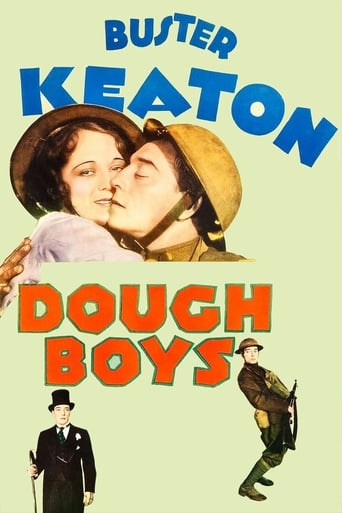
A Soldier's Plaything
"Two dim soldiers make trouble in occupied postwar Germany."
Keys: Space play/pause · ←/→ 10s · F fullscreen · M mute · </> speed
About this film
Occupation-era soldiers half-wits get into continuous mischief during the occupation of Germany after WW I.
Cast & crew
More films like this
More Comedy films
View all →







More from Michael Curtiz
View all →

More about this film
About the production
Release dateNovember 1, 1930
BudgetApproximately $400,000 (Estimated 'A' budget for the period)
Box officeConsidered a box office failure upon initial release
ProductionWarner Bros.
Filmed inWarner Bros. Burbank Studios, California
The film was originally conceived and filmed as a lavish musical comedy during the peak of the early sound 'musical craze.' However, by the time of its late 1930 release, American audiences had grown weary of the genre, leading Warner Bros. to drastically edit the film down from 71 minutes to 56 minutes, removing most of the musical numbers. It was also one of the few films shot in 'Vitascope,' a 65mm widescreen process developed by Warner Bros. to compete with Fox Grandeur, though it is debated if the widescreen version ever saw a wide theatrical release.
Themes
Mistaken IdentityGuilt and RedemptionWar-time RomanceThe 'Little Man' vs. AuthorityEscapism
Themes & topics
World War IOccupation of GermanyGamblingAccidental MurderArmy LifeStable CleaningInnocenceWidescreen
Historical background
Audiences around 1930 encountered A Soldier's Plaything in a market crowded with competing studios fighting for weekly program slots.
Why this film matters
Later homages and restorations keep A Soldier's Plaything circulating among silent- and classic-film communities long after its first run.
Making of
Production was marked by the technical challenges of the early sound era and the experimental Vitascope widescreen process. Michael Curtiz had to balance the slow, deliberate physical comedy of Harry Langdon with the faster-paced dialogue required for the new 'talkie' format. The studio's decision to gut the musical numbers after filming was completed left the narrative feeling disjointed, with title cards occasionally used to bridge gaps where songs once existed. This 'Frankenstein' editing process turned what was intended to be a prestige musical into a short, punchy 'B-movie' length comedy-drama.
What critics said
Press clipping files from 1930 rarely give A Soldier's Plaything headline space; mentions appear in roundup columns listing what played that week.
Did you know?
- This was silent film comedian Harry Langdon's first feature-length 'talkie.'
- The film was shot simultaneously in standard 35mm and the 65mm Vitascope widescreen format.
- Most of the film's songs were cut for the US release, leaving only a few piano-led numbers performed by Ben Lyon and Harry Langdon.
- The plot was based on a story by Viña Delmar, a popular novelist of the era known for 'Bad Girl.'
- Director Michael Curtiz, who later directed 'Casablanca,' was known for his efficiency and was assigned this project to navigate the transition to sound.
- Harry Langdon's character 'Tim' was a variation of his famous 'Little Elf' persona from the silent era.
- The film's failure at the box office contributed to the decline of Harry Langdon's career as a major leading man in sound features.
- The abrupt ending of the 56-minute version is a direct result of the heavy studio re-editing to remove musical sequences.
- Lotti Loder, the female lead, was a Hungarian actress who appeared in very few American films.
- Some of the comedic gags were reportedly recycled from Harry Langdon's earlier silent short, 'All Night Long' (1924).
Visual style
Shot by Barney McGill and J.O. Taylor, the film features notable early sound-era techniques, including double-exposure sequences used to visualize Georgie's memories of the US. The use of the Vitascope 65mm format allowed for much wider, more detailed compositions than the standard 1.33:1 aspect ratio of the time.
Innovations
One of the earliest experiments with 65mm widescreen (Vitascope). It also utilized early synchronized sound-on-disc/film technology, attempting to integrate musical numbers seamlessly into a narrative structure.
Music
The original soundtrack featured several songs including 'The Whole Town's Talking,' 'Say It With a Smile,' and 'Deep in My Heart.' In the surviving US version, most of these are reduced to instrumental background music or brief snippets.
Famous quotes
Georgie: 'I'm a soldier now!' Tim: 'A what?' Georgie: 'A soldier!' Tim: 'You're a chump!'
Captain Plover: 'You two bombs... I want you to wash the windows, tidy up the barracks, and shine the captain's shield!'
Tim: 'If you don't hear from me, why, you'll know that I'm dead!'
Memorable scenes
- The poker game fight where Georgie believes he has killed a man, setting the entire plot in motion.
- The 'stable cleaning' montage where Tim and Georgie are repeatedly punished by Captain Plover, showcasing Langdon's physical comedy.
- The scene in the German bar where Tim (Harry Langdon) sings a song for a girl, only to have a tantrum when he realizes she is deaf and couldn't hear him.
- The final revelation where Georgie's 'victim' walks into the camp, leading to a sudden and joyous reconciliation.
What audiences thought
Initial audiences were largely indifferent, as the film lacked the spectacle of the musicals they were tired of, yet didn't quite deliver the depth of the emerging 'Pre-Code' dramas. It 'tanked' at the box office, failing to recoup its significant production costs.
Film connections
Influenced by
- The silent comedies of Mack Sennett
- The 'buddy' dynamic of early military comedies
This film influenced
- Later military comedies like 'Buck Privates' (1941)
- The Laurel and Hardy feature 'Pack Up Your Troubles' (1932)
Film restoration
The original 71-minute musical version is considered lost. Only the 56-minute edited US theatrical version survives, which is preserved in the Library of Congress and the Warner Bros. archives.
Where to watch
- Available on DVD via the Warner Archive Collection
- Occasionally airs on Turner Classic Movies (TCM)
- Can sometimes be found on specialized streaming platforms like Fawesome or the Harry Langdon Archive on YouTube