
Bear Shooters
"Our Gang hunts a fake gorilla"
Keys: Space play/pause · ←/→ 10s · F fullscreen · M mute · </> speed
About this film
Our Gang campers hunt a bear but face poachers in a gorilla suit. A 1930 Hal Roach short.
Cast & crew
More films like this
More Comedy films
View all →







More from Robert F. McGowan
View all →

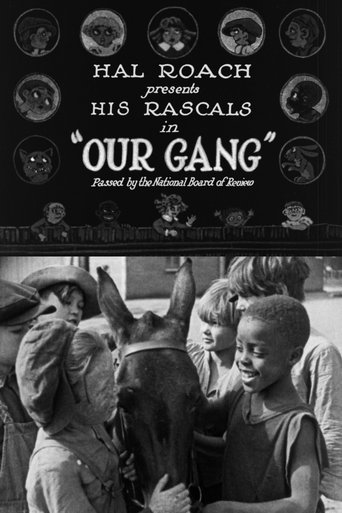
More about this film
About the production
Release dateMay 17, 1930
BudgetApproximately $30,000 (Estimated based on typical Hal Roach two-reeler budgets of the era)
ProductionHal Roach Studios, Metro-Goldwyn-Mayer (MGM)
Filmed inPalms neighborhood, Los Angeles, California, Hal Roach Studios, Culver City, California
The film was shot over 14 days between December 19, 1929, and January 4, 1930, with retakes on January 21. It was the 98th film in the 'Our Gang' series and one of the early 'all-talking' entries. The production utilized a script cataloged as B335 and was also filmed in a Spanish-language version titled 'Los Cazadores de Osos' to cater to international markets, a common practice for Hal Roach during the early sound transition.
Themes
Childhood AdventureResponsibility vs. FunUrban vs. Rural LifeOvercoming Fear
Themes & topics
campinggorilla suitbootleggersskunkcroupgoose greasemuleslapstick
Historical background
Archival records place Bear Shooters in 1930, a year when the early sound era shaped what theaters booked.
Why this film matters
Retrospectives include Bear Shooters when mapping craft and subject matter from the early sound era.
Making of
Director Robert F. McGowan was known for his 'naturalistic' approach, often hiding cameras or using long lenses so the children wouldn't be intimidated by the equipment. During the filming of 'Bear Shooters', the production faced the challenge of transitioning to sound, which required bulky 'icebox' camera housings and primitive microphones hidden in the scenery. The scene involving the skunk used a real animal, though its scent glands had been surgically removed for safety. The interaction between the kids and Charles Gemora in the gorilla suit was largely improvised to capture genuine reactions of surprise and excitement from the younger cast members like Wheezer.
What critics said
Critics revisiting Bear Shooters emphasize performative and technical choices visible in surviving prints.
Did you know?
- the release is a sound remake of the 1924 silent Our Gang short 'It's a Bear'.
- Allen 'Farina' Hoskins is the only cast member to appear in both the 1924 original and this 1930 remake.
- The film fell into the public domain in the 1960s because the copyright was not renewed, making it a staple of low-cost VHS and DVD collections.
- Charles Gemora, a famous Hollywood 'gorilla man' who specialized in ape suits, played the bootlegger in the gorilla costume.
- The 'goose grease' used on Wheezer was actually a mixture of various stage ointments, though Chubby mistakenly uses Limburger cheese in one scene.
- The mule used in the film, Dinah, was a recurring animal actor in the series and was known for her ability to follow complex cues.
- A deleted scene featured a police officer arriving at the end to officially arrest the bootleggers.
- The film was also reportedly prepared in a French-language version, though records of its completion are debated.
Visual style
Photographed by Len Powers, the film uses a standard 1.37:1 Academy ratio. The cinematography is notable for its extensive location shooting in the Palms neighborhood, which gives the film a more authentic, rugged feel than if it had been shot entirely on a soundstage. The lighting is primarily naturalistic to accommodate the outdoor 'camping' theme.
Innovations
The film successfully integrated synchronized dialogue and sound effects in an outdoor setting, which was technically difficult in 1930 due to the sensitivity of early microphones. The use of a specialized 'gorilla suit' by Charles Gemora represented the peak of practical creature effects for the era.
Music
The score features the iconic 'Our Gang' theme 'That Old Gang of Mine' by Ray Henderson. Other musical cues include 'Mademoiselle Promenade' by H. Maurice Jacquet and 'Music Box' by Paul Lincke. The sound recording used the Western Electric System, which was the industry standard at the time.
Famous quotes
Spud: 'I gotta stay home and grease Wheezer!'
Chubby: 'That ain't goose grease, that's Limburger cheese!'
Farina: 'I ain't scared of no gorilla, as long as he's in a cage!'
Memorable scenes
- The opening sequence where Spud tries to apply ointment to a resisting Wheezer.
- The gang traveling in their improvised wagon pulled by Dinah the mule.
- Chubby accidentally using Limburger cheese instead of goose grease on Wheezer's neck.
- The 'gorilla' chasing the kids through the woods, only to be outsmarted by their traps.
- The final scene where a skunk clears out both the kids and the bootleggers.
What audiences thought
Audiences in 1930 embraced the film as a welcome escape from the economic hardships of the time. The 'Little Rascals' shorts were incredibly popular as 'added attractions' in movie palaces. Today, it remains a favorite for nostalgic viewers and is frequently cited for the memorable 'goose grease' and 'gorilla' sequences.
Film connections
Influenced by
- It's a Bear (1924)
- The Boy Scouts movement (cultural influence)
This film influenced
- The Little Rascals (1994)
- The Goonies (1985)
Film restoration
The film is well-preserved and has undergone a high-definition restoration by ClassicFlix as part of 'The Little Rascals - The ClassicFlix Restorations, Volume 1'. Original 35mm elements exist in the MGM/Warner Bros. archives.
Where to watch
- YouTube (Public Domain)
- Internet Archive
- ClassicFlix Blu-ray/DVD
- Amazon Prime Video (via various classic film collections)