
Bharat Milap
"Sandals on the throne — Bharat waits"
Keys: Space play/pause · ←/→ 10s · F fullscreen · M mute · </> speed
About this film
Queen Kaikeyi exiles Rama; devoted Bharat rules as regent with Rama's sandals on throne. Bharat Milap (1942) dramatizes Ramayana episode of righteous regency.
Cast & crew
More films like this
More History films
View all →



More from Vijay Bhatt
View all →More about this film
About the production
Release date1942
ProductionPrakash Pictures
Filmed inBombay (now Mumbai), India
Bharat Milap was part of Vijay Bhatt's successful Ramayana trilogy, following 'Ram Rajya' (1943) and preceding other mythological films. The film was made during the Quit India Movement of 1942, when British authorities had restricted filmmaking activities, making its production particularly challenging. The elaborate sets depicting Ayodhya and the forest were constructed at Prakash Studios in Bombay. The film's costume design was particularly noteworthy, with authentic period attire created for the numerous characters. The production employed hundreds of extras for the palace and forest scenes, which was unusual for Indian cinema of that era.
Themes
Duty and DharmaFraternal DevotionSacrificeRighteousnessMaternal Conflict
Themes & topics
RamayanaExileThroneBrothersDevotionMythologyAncient IndiaPalace IntrigueForestRegentSandalsPromiseDutySacrificeReunion
Historical background
Bharat Milap (1942) brought mythological righteousness to wartime Indian audiences seeking moral clarity.
Why this film matters
Ramayana episodes on screen shaped Hindu devotional cinema conventions for decades.
Making of
The making of Bharat Milap was marked by several remarkable stories that have become part of Indian film folklore. Vijay Bhatt was known for his meticulous attention to detail in mythological films, and he spent months researching authentic costumes and jewelry from ancient Indian texts. The casting of Prem Adib as Rama was controversial initially as he was relatively unknown, but Bhatt was convinced of his screen presence and ability to convey divine grace. Shobhna Samarth, who played Sita, was pregnant during filming but continued to shoot demanding scenes, including those in the forest setting. The film's most challenging sequence was the emotional confrontation between Bharat and Kaikeyi, which reportedly took three days to shoot as Durga Khote wanted to perfectly capture the complex emotions of a mother torn between ambition and maternal love. The production team faced difficulties obtaining film stock due to wartime restrictions, leading to careful planning of each shot to minimize waste. The elaborate palace sets were so impressive that they were reused in several subsequent Prakash Pictures productions.
What critics said
Indian critics praised piety; devotees still reference its throne imagery.
Did you know?
- Bharat Milap was especially successful films of 1942 and ran for over 50 weeks in many theaters, becoming a silver jubilee hit.
- Prem Adib and Shobhna Samarth, who played Rama and Sita in the production, became the most famous on-screen couple of the 1940s, starring together in numerous mythological films.
- The film was so popular that it was re-released multiple times in subsequent decades, particularly during religious festivals.
- Durga Khote's portrayal of Kaikeyi was considered so powerful that audiences would throw coins at the screen when she appeared on screen in later shows.
- The film's success established Vijay Bhatt as the leading director of mythological films in Indian cinema.
- The scene where Bharat places Rama's sandals on the throne became defining images in Indian cinema history.
- Despite being made during World War II and the Indian independence movement, the film managed to secure sufficient film stock, which was rationed at the time.
- The film's dialogues were written by Pandit Narendra Sharma, who was renowned for his command of Sanskritized Hindi.
- The music composer Shankar Rao Vyas created several songs that became popular devotional numbers played in Indian households for decades.
- The film's prints were manually color-tinted in certain sequences to enhance the visual impact, a common practice in Indian cinema of the 1940s.
Awards & recognition
- Bengal Film Journalists' Association Awards - Best Film (1942)
Visual style
The cinematography of Bharat Milap, handled by V. Avadhoot, was pioneering for its time and set new standards for visual storytelling in Indian cinema. The film employed dramatic lighting techniques to differentiate between the palace scenes and forest sequences, using soft, diffused lighting for the divine characters and harsher contrasts for scenes of conflict. The camera work was particularly innovative in the emotional confrontation scenes, using close-ups to capture the subtle expressions of the actors without resorting to melodrama. The film featured elaborate tracking shots through the palace sets, creating a sense of grandeur and scale rarely seen in Indian cinema of the 1940s. The cinematography also made effective use of shadows and silhouettes, especially in the forest scenes, to enhance the mythological atmosphere. The film's visual palette was carefully designed, with the palace sequences dominated by golds and rich colors while the forest scenes used earth tones to emphasize Rama's exile. The technical quality of the cinematography was noted by contemporary critics as being comparable to international standards of the time.
Innovations
Bharat Milap showcased several technical achievements that were groundbreaking for Indian cinema in 1942. The film featured some of the most elaborate set designs seen in Indian cinema up to that point, with the Ayodhya palace sets spanning multiple studio floors and incorporating intricate architectural details based on ancient Indian texts. The production pioneered the use of forced perspective techniques to create the illusion of grander spaces within the constraints of studio filming. The film's makeup department, led by a team of specialists, developed new techniques for creating divine appearances for the characters, using innovative combinations of lighting and cosmetics. The sound recording overcame the limitations of mono technology by creating depth through strategic microphone placement during musical sequences. The film's editing introduced smooth transitions between dramatic and devotional scenes, maintaining narrative flow without jarring shifts in tone. Special effects, though primitive by modern standards, were cleverly employed to suggest divine interventions, using double exposure techniques that were advanced for the time. The film also experimented with color tinting in select sequences, manually coloring black and white prints to highlight important moments.
Music
The music of Bharat Milap was composed by Shankar Rao Vyas, with lyrics penned by Pandit Narendra Sharma, creating a soundtrack that became integral to the film's success and cultural impact. The film featured nine songs that blended classical Indian music with accessible melodies, making them both artistically sophisticated and popularly appealing. Notable songs included 'Jai Siya Ram' which became a devotional standard, and 'Bharat Ki Beti' which captured the emotional core of the story. The soundtrack made innovative use of classical ragas, with each song carefully matched to the emotional tone of its scene. The orchestration combined traditional Indian instruments with Western arrangements, reflecting the evolving sound of Indian cinema music. The songs were performed by leading playback singers of the era, including Amirbai Karnataki and Govindrao Tembe, whose voices perfectly complemented the on-screen performances. The music recording was particularly challenging due to wartime technical limitations, but the final product achieved remarkable clarity and richness. The soundtrack's success led to its release on gramophone records, making it one of the first Indian film soundtracks to be commercially available outside theaters.
Famous quotes
Main rajya nahi maa ko chahata, mere paas toh sirf Rama bhaiya hain" - Bharat refusing the kingdom
Yeh rajya Rama ke charanon ka hai, main toh ek sevak hoon" - Bharat placing the sandals on the throne
Pitri-vachan ki raksha karna hi Rajdharm hai" - Rama explaining his duty
Chaudah varsh ka vanwas hamara dharm hai, Bharat" - Rama to Bharat in the forest
Memorable scenes
- The emotional confrontation between Bharat and Kaikeyi where Bharat refuses to accept the throne and condemns his mother's actions
- The forest meeting between Rama and Bharat where Bharat begs Rama to return to Ayodhya
- The iconic scene where Bharat places Rama's sandals on the throne and takes an oath to rule as regent
- The departure of Bharat from the forest with Rama's sandals, promising to await his return
What audiences thought
Bharat Milap received an extraordinary reception from audiences across India, becoming one of the biggest box office successes of 1942. Theaters reported houseful shows for weeks, with many viewers returning multiple times to watch their favorite scenes. Audience reactions were often emotional and vocal, with many viewers reportedly weeping during the scenes between Bharat and Rama. The film struck a particularly strong chord with women audiences, who identified with the complex emotions portrayed by the female characters. In rural areas, where the film traveled with mobile theaters, it was often treated as a religious event, with viewers performing traditional rituals before screenings. The film's dialogues became part of popular parlance, and its songs were sung in homes and religious gatherings. The success of Bharat Milap established Prem Adib and Shobhna Samarth as the definitive Rama and Sita of their generation, with audiences refusing to accept other actors in these roles for years. The film's popularity endured long after its initial release, with re-runs during festivals continuing to draw crowds well into the 1960s.
Film connections
Influenced by
- Ramayana by Valmiki
- Traditional Indian Theater
- Previous Indian Mythological Films
- Classical Indian Dance Dramas
This film influenced
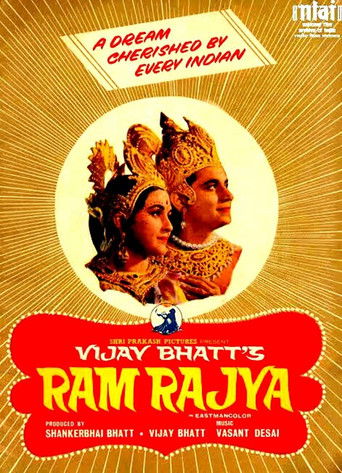
- Ram Rajya (1943)
- Subsequent Vijay Bhatt mythological films
- Later Ramayana adaptations in Indian cinema
Film restoration
Bharat Milap is partially preserved with some prints existing in the National Film Archive of India and private collections. However, like many films from the 1940s, complete pristine copies are rare, and some sequences may be lost or severely deteriorated. The Film Heritage Foundation has undertaken restoration efforts for important scenes, particularly the iconic throne sequence. Several archives worldwide hold fragments or complete prints of varying quality. The film has been digitized in parts but a full restoration has not yet been completed due to the deteriorated condition of available source material.
Where to watch
- YouTube (partial uploads)
- National Film Archive of India (viewing by appointment)
- Film Heritage Foundation screenings
- Classic film festivals specializing in Indian cinema
- Some regional streaming platforms during special programming