



Hell's Angels
"When the Great War breaks out, brothers Roy and Monte Rutledge, each…"
Keys: Space play/pause · ←/→ 10s · F fullscreen · M mute · </> speed
About this film
When the Great War breaks out, brothers Roy and Monte Rutledge, each attending Oxford University, enlist with the Royal Flying Corps.
Cast & crew
More films like this

More Drama films
View all →







More from Howard Hughes
View all →
More about this film
About the production
Release dateMay 27, 1930 (Premiere at Grauman's Chinese Theatre)
Budget$2.8 million to $4 million (sources vary, but it was the most expensive film of its time)
Box office$2.5 million (theatrical rentals)
ProductionThe Caddo Company
Filmed inMetropolitan Studio, Hollywood, California, Van Nuys, California, Oakland, California, San Diego, California, Santa Cruz, California
Production began in 1927 as a silent film but was drastically overhauled after the success of 'The Jazz Singer' (1927) signaled the end of the silent era. Howard Hughes spent nearly three years and millions of dollars reshooting dialogue scenes for sound and perfecting the aerial combat. The original lead, Greta Nissen, was replaced by Jean Harlow because Nissen's Norwegian accent was deemed unsuitable for the new 'talkie' format. Hughes' perfectionism led him to fire several directors, eventually taking the helm himself for the action sequences while hiring James Whale to direct the dialogue.
Themes
Brotherhood and ConflictCowardice vs. HeroismThe Loss of InnocenceThe Brutality of WarSexual Temptation and Betrayal
Themes & topics
Historical background
Released in 1930 during the early sound era, Hell's Angels reached audiences when exhibitors were still defining programming conventions. The narrative hook—When the Great War breaks out, brothers Roy and Monte Rutledge, each…—reflects what contemporary producers thought would draw viewers.
Why this film matters
Hell's Angels remains discussed by archivists tracing how screen stories of its period represented work, desire, conflict, and social order. Its central situation—When the Great War breaks out, brothers Roy and Monte Rutledge, each…—still prompts questions about genre conventions and audience expectations.
Making of
The making of 'Hell's Angels' is a tale of Howard Hughes' obsession. After filming for over a year as a silent movie, Hughes realized the industry was shifting to sound and ordered a total reshoot of the non-aerial scenes. He built a private air force of vintage WWI planes, including Fokkers and Sopwith Camels, to ensure absolute authenticity. The aerial sequences were filmed without the use of miniatures, using real pilots performing actual dogfights. James Whale was brought in specifically to handle the actors because Hughes felt he lacked the temperament for dialogue direction. The production was plagued by delays, including a period where Hughes waited months for the 'perfect' cloud formations to provide a sense of speed in the sky.
What critics said
Trade and newspaper notices for Hell's Angels generally emphasized casting, spectacle, and program fit rather than extended aesthetic argument. Retrospective screenings and archival notes continue to shape how viewers evaluate Hell's Angels today.
Did you know?
- It was the most expensive film ever made until 'Gone with the Wind' (1939).
- Three pilots and one mechanic died during the production due to the dangerous nature of the aerial stunts.
- Howard Hughes personally piloted a plane for a stunt that his professional pilots refused to do; he crashed and suffered a skull fracture that required facial surgery.
- Jean Harlow was only 18 years old when she was cast in the role that made her a superstar.
- The film features the only color footage ever captured of Jean Harlow, a two-color Technicolor sequence at a ball.
- Hughes rented 185 arc lights for the film's premiere, which was so bright it was said to be visible for miles.
- The film used 137 pilots and nearly 100 aircraft to film the massive dogfight sequences.
- James Whale, who directed the dialogue scenes, made his uncredited film debut here before going on to direct 'Frankenstein' (1931).
- The film's production was so long that it outlasted Hughes' marriage to his first wife, Ella Rice.
- Stanley Kubrick cited 'Hell's Angels' as one of his top ten favorite films.
Awards & recognition
- The film did not win any major competitive awards at the time of release but is recognized as a landmark in technical achievement.
Visual style
The film utilized aerial photography techniques. Cinematographers Tony Gaudio and Harry Perry used multiple cameras mounted on planes to capture dynamic angles. The film also features a mix of black-and-white, tinted sequences (such as the red-tinted night scenes), and a notable two-color Technicolor sequence for the charity ball.
Innovations
use of multi-camera setups for aerial combat and the integration of synchronized sound with high-action footage. It also featured early use of Multicolor/Technicolor processes and large-scale practical effects, such as the destruction of a massive Zeppelin model.
Music
The score was composed by Hugo Riesenfeld. As an early sound film, it made significant use of synchronized sound effects, particularly the roar of airplane engines and the rattle of machine guns, which added a visceral layer of realism that silent films lacked.
Famous quotes
Would you be shocked if I put on something more comfortable?
Tired. Take me home, Monte. It's not far.
Never love a woman, just make love to her.
Murder! That's what this dirty, rotten politician's war is! Murder!
Memorable scenes
- The Zeppelin Raid: A haunting sequence where a German airship emerges from the clouds over London, culminating in the crew jumping to their deaths to lighten the load.
- The Charity Ball: The only sequence in the film shot in full color, showcasing Jean Harlow's backless dress.
- The Final Dogfight: A massive aerial battle involving dozens of planes that remains impressive action sequences in cinema history.
- The Execution: The tragic final scene where Roy shoots his own brother to save him from the dishonor of betrayal before facing his own death.
What audiences thought
Audiences were enthralled by the spectacle. Despite the high ticket prices and the Great Depression, it was a massive hit, drawing crowds to see the unprecedented aerial dogfights and the scandalous performance of Jean Harlow. The premiere at Grauman's Chinese Theatre was one of the largest in Hollywood history, with an estimated 50,000 to 500,000 people lining the streets.
Film connections
Influenced by
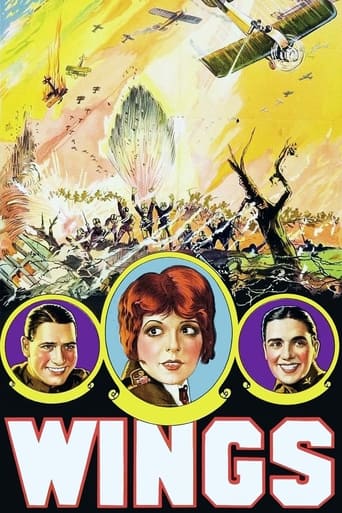
- Wings (1927)
- The Big Parade (1925)
- What Price Glory (1926)
This film influenced
- The Dawn Patrol (1930)
- Top Gun (1986)
- The Aviator (2004) - which depicts the making of the film
- Dunkirk (2017)
Film restoration
The film is well-preserved and has undergone various restorations. It was released on Blu-ray and UHD by The Criterion Collection, which restored the original color tinting and the Technicolor sequences.
Where to watch
- The Criterion Channel
- Amazon Prime Video (Rent/Buy)
- Apple TV (Rent/Buy)
- Physical Media (Criterion Collection Blu-ray/DVD)