
Robin Hood
"Blood on the feature"
Keys: Space play/pause · ←/→ 10s · F fullscreen · M mute · </> speed
About this film
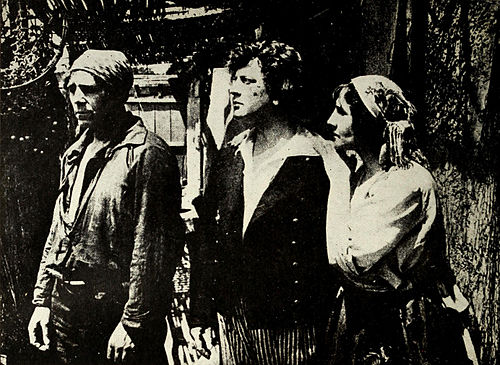
The movie's costumes feature enormous versions of the familiar hats of Robin and his merry men, and uses the unusual effect of momentarily superimposing images different animals over each character to emphasize their good or evil qualities. A restored copy of the 30-minute film exists and was exhibited in 2006 at the Museum of Modern Art in New York City.
Cast & crew
More films like this
More Romance films
View all →




More from Étienne Arnaud
View all →
More about this film
About the production
Release date1912
Box officeBox office records not available for 1912 releases
ProductionEclair American Company
Filmed inFort Lee, New Jersey
was produced during Fort Lee's golden age as America's film capital before the industry migrated to Hollywood. The production featured elaborate costumes with oversized hats that became a distinctive visual trademark. The innovative use of superimposition techniques to overlay animal images over characters was groundbreaking for its time, symbolizing their moral alignment. The film was shot on location in the natural settings of New Jersey, utilizing the area's forests to stand in for Sherwood Forest.
Themes
Justice and righteousnessNobility versus tyrannyLove and romanceSocial equalityHonor and chivalry
Themes & topics
Historical background
Made in its country of production around 1912, Robin Hood belongs to the silent era's formative years. Its story of the movie's costumes feature enormous versions of the familiar hats of robin and his merry men, and uses the unusual effect of momentarily superimposing images different animals over each character to emphasize their good or evil qualities spoke to audiences of the day through familiar genres and topical settings.
Why this film matters
Archivists and historians still cite Robin Hood when tracing how the silent era's formative years filmmakers staged costumes and feature on screen.
Making of
The production of this 1912 Robin Hood adaptation took place during a pivotal moment in American cinema history. Eclair Studios, originally a French company, had established a major production facility in Fort Lee, New Jersey, which was then the center of America's film industry. The dual direction by Étienne Arnaud and Herbert Blaché reflected the collaborative nature of early filmmaking, where directors often worked in teams. The casting of Robert Frazer as Robin Hood represented an early example of star casting in American cinema. The production faced the technical challenges of creating elaborate costumes and special effects with the limited technology available in 1912. The innovative superimposition effects required careful planning and multiple exposures of the film negative, a time-consuming process that demonstrated the studio's commitment to visual innovation. The film's preservation and restoration decades later revealed the sophisticated techniques used by early filmmakers to create compelling visual narratives despite technological limitations.
What critics said
Reviews from 1912 weighed Robin Hood on pacing, performance, and novelty. Later criticism reads its emphasis on costumes, feature, enormous through modern standards of craft and representation.
Did you know?
- This was one of the earliest film adaptations of the Robin Hood legend, predating the famous 1922 Douglas Fairbanks version by a decade
- The film was produced by Eclair Studios, a French company that established one of America's first major film production facilities in Fort Lee, New Jersey
- The distinctive oversized hats worn by Robin and his Merry Men were designed to be easily recognizable to audiences in an era of visual storytelling
- The superimposition technique used to show animals over characters was an innovative special effect for 1912, representing one of the earliest uses of visual effects to convey character traits
- Director Étienne Arnaud was a French filmmaker who brought European cinematic sensibilities to American productions
- Co-director Herbert Blaché was married to Alice Guy-Blaché, one of cinema's first female directors and a pioneer in early film
- The film's restoration in the early 2000s preserved one of the few surviving examples of early American adventure cinema
- Fort Lee, New Jersey, where this was filmed, was home to over a dozen major film studios in the 1910s before the industry moved west to Hollywood
- The 30-minute runtime was considered feature-length for 1912, when most films were much shorter
- Writer Eustace Hale Ball was a prolific screenwriter during the silent era, contributing to numerous early adaptations of classic stories
Visual style
The cinematography of this 1912 production employed innovative techniques that were advanced for its time. The most notable technical achievement was the use of superimposition to overlay animal images over characters, creating a visual metaphor for their moral qualities - a sophisticated narrative device in the silent era. The filmmakers utilized natural lighting and outdoor locations in New Jersey to create authentic forest settings for the Sherwood Forest scenes. The camera work likely involved static shots typical of the period, but with careful composition to capture the elaborate costumes and action sequences. The visual style emphasized clarity and spectacle, with the oversized hats and distinctive costumes designed to be easily readable to audiences in an era before close-ups became common. The cinematography served the narrative needs of early cinema, prioritizing visual storytelling and character identification through costume and special effects.
Innovations
The film's most significant technical achievement was the pioneering use of superimposition effects to overlay animal imagery over characters, representing one of the earliest examples of visual effects used for character development in cinema. This technique required multiple exposures of the film negative and precise alignment to achieve the desired effect. The production also featured elaborate costume design with distinctive oversized elements that were specifically created to be visually effective in the medium of early film. The film's 30-minute runtime was substantial for 1912, requiring careful planning and execution to maintain narrative coherence over an extended duration. The outdoor filming in natural settings demonstrated the industry's move away from studio-bound productions toward more realistic locations. These technical innovations contributed to the evolution of cinematic language and storytelling capabilities during film's formative years.
Music
As a silent film, the 1912 Robin Hood would have been accompanied by live musical performance during its original theatrical release. Typical accompaniment would have included a pianist or small orchestra performing popular classical pieces, folk tunes, or original compositions appropriate to the medieval setting. The music would have been synchronized with the on-screen action, with faster tempos for chase scenes and romantic melodies for the Robin and Marian sequences. The specific musical selections used for are not documented, which was common for silent era productions where musical accompaniment was often improvised or selected by individual theater musicians. Modern screenings of the restored version would likely feature newly composed scores or carefully selected period-appropriate music to recreate the authentic silent film experience.
Memorable scenes
- The innovative superimposition sequence where animal images are overlaid on characters to symbolize their moral nature, with noble animals appearing over Robin and his men while predatory animals represent their enemies. The dramatic archery contest scene where Robin Hood demonstrates his marksmanship. The romantic forest meeting between Robin and Maid Marian, enhanced by the natural outdoor setting. The final confrontation between Robin's forces and the Sheriff's men, showcasing the film's action sequences and costume design.
What audiences thought
Audience reception data from 1912 is not reliably preserved, but the film's subject matter - the Robin Hood legend - was already familiar and popular with theater audiences, suggesting it would have been well-received by contemporary moviegoers. The visual spectacle of the costumes and innovative special effects would have been particularly impressive to early cinema audiences who were still discovering the possibilities of the medium. The film's 30-minute length was substantial for the period, indicating it was marketed as a significant attraction rather than a short subject. The survival and preservation of the film suggest it was considered valuable enough to warrant preservation efforts, indicating some level of popular or critical success during its initial release.
Film connections
Influenced by
- Traditional Robin Hood ballads and folklore
- Howard Pyle's 1883 novel 'The Merry Adventures of Robin Hood'
- Stage adaptations of the Robin Hood legend popular in the 19th century
- Earlier silent film adaptations of literary classics
This film influenced
- Robin Hood (1922) starring Douglas Fairbanks
- The Adventures of Robin Hood (1938) starring Errol Flynn
- Later Robin Hood film and television adaptations
- Other adventure films of the silent era that adopted similar visual storytelling techniques
Film restoration
A restored copy of the film exists and has been preserved through film restoration efforts. The film was exhibited at the Museum of Modern Art in New York City in 2006, indicating successful preservation and restoration work. The survival of this 1912 production is notable given the high rate of film loss from the silent era, with estimates suggesting that over 75% of silent films have been lost permanently.
Where to watch
- Museum of Modern Art film screenings and archives
- Specialized film archives and cinematheques
- Academic film collections and university libraries
- Occasional screenings at silent film festivals and classic cinema events
- Potential availability through specialized film preservation organizations