

Sunny
"showgirl falls for a society boy but has to win"
Keys: Space play/pause · ←/→ 10s · F fullscreen · M mute · </> speed
About this film
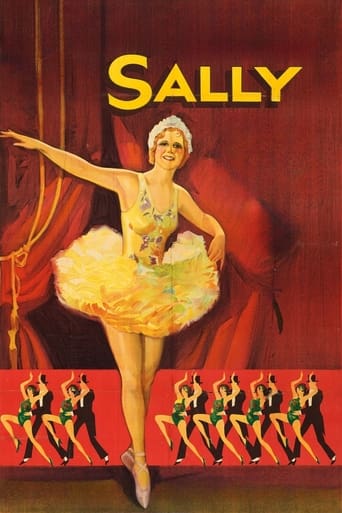
A showgirl falls for a society boy but has to win over his family.
Cast & crew
More films like this
More Music films
View all →
More from William A. Seiter
View all →


More about this film
About the production
Release dateNovember 9, 1930
Budget$745,000
Box office$690,000
ProductionFirst National Pictures, Warner Bros.
Filmed inWarner Bros. First National Studios, Burbank, California
The picture was originally planned and announced as a full Technicolor production to capitalize on the success of Marilyn Miller's previous hit, 'Sally' (1929). However, due to a sudden and severe public backlash against musicals in late 1930, the studio pivoted to a black-and-white release for the domestic market. Large portions of the musical numbers were edited out or significantly truncated to minimize the 'musical' aspect of the picture for American audiences, though a full musical version was reportedly released internationally.
Themes
Social Class ConflictIdentity and DisguiseThe Search for True LoveAmerican vs. British Cultural ClashesOptimism and Resilience
Themes & topics
circus performerstowawayocean linersham marriagepre-codesociety familybroadway adaptation
Historical background
First National Pictures's 1930 release of Sunny fit contemporary United States programs that mixed fiction, news, and novelty subjects for repeat weekly attendance.
Why this film matters
Programmers and historians revisit Sunny (1930) because its story—a showgirl falls for a society boy but has to win over his family—illustrates popular narrative habits and production norms of the period.
Making of
Production was marked by the transition of Broadway legend Marilyn Miller to the silver screen. Director William A. Seiter had to manage the technical limitations of the Vitaphone system, which required actors to stay near hidden microphones, often resulting in static staging. The set for the ocean liner was noted for its massive, cavernous design, particularly a ribbed corridor that crew members joked looked like the inside of a whale. The most significant behind-the-scenes drama involved the post-production 'gutting' of the picture; as musical numbers were being cut, the narrative had to be re-edited with additional exposition to bridge the gaps left by the missing songs.
What critics said
English-language trade reviews of Sunny are limited for 1930. Where notices survive, they stress pacing and photographic clarity; later criticism values the title as archival evidence of studio style.
Did you know?
- Marilyn Miller was paid a staggering $500,000 for her work on, making her one of the highest-paid stars of the era.
- the picture is based on the 1925 Broadway musical of the same name which ran for 517 performances.
- O.P. Heggie, who plays Sunny's father, is best known to modern audiences as the blind hermit in 'Bride of Frankenstein' (1935).
- The 1930 version of 'Sunny' was one of the last major films to utilize the Vitaphone sound-on-disc process before the industry fully transitioned to sound-on-film.
- The song 'Who?' became a massive hit and remains especially enduring standards from the Jerome Kern and Oscar Hammerstein II catalog.
- the picture features a 'Hunt Dance' performed by Marilyn Miller, which her unique blend of tap and ballet-influenced choreography.
- Due to the 'musical fatigue' of 1930, the title song 'Sunny' was actually cut from the final American release, though it is heard played by a circus band.
- A 1941 remake was produced by RKO starring Anna Neagle, but it lacked the pre-Code edge of the 1930 original.
Visual style
The cinematography by Ernest Haller (who later won an Oscar for 'Gone with the Wind') and Arthur Reeves is typical of early sound films, featuring high-key lighting and relatively stationary camera setups. Despite the move to black-and-white, the picture retains a 'lavish' look with high-contrast circus and shipboard sets that were originally designed to pop in Technicolor.
Innovations
the picture is a primary example of the Vitaphone sound-on-disc technology in its twilight. It also experimented with translating complex Broadway dance choreography to the screen, using multiple camera angles to capture Marilyn Miller's footwork, a precursor to the more fluid musical cinematography of the mid-1930s.
Music
The score features music by Jerome Kern with lyrics by Oscar Hammerstein II and Otto Harbach. Notable songs include 'Who?', 'I Was Alone', 'The Hunt Dance', and 'When We Get Our Divorce'. Several songs like 'D'Ya Love Me?' and 'Two Little Love Birds' were filmed but cut from the domestic release.
Famous quotes
Sunny: 'I'm not going to marry him, and I'm not going to marry Julius either!'
Tom: 'There are just as many girls with just as much money who aren't half-witted.'
Jim: 'You're the first real human being that's been in this family since Jean the Pirate!'
Memorable scenes
- The 'Who?' musical number where Marilyn Miller and Lawrence Gray perform a romantic duet that became the picture's signature moment.
- The 'Hunt Dance' sequence where Sunny performs an acrobatic and graceful dance in traditional fox-hunting attire.
- The comedic climax involving the revelation of Sunny's sham marriage to the stuffy Warren family.
What audiences thought
Audiences in 1930 were beginning to cool on the musical genre, which reflected in the picture's box office performance—it failed to recoup its high production budget. However, Miller's personal fans remained loyal, and the picture was a significant draw in international markets where the musical backlash was less severe.
Film connections
Influenced by
- The 1925 Broadway musical 'Sunny'
- The success of 'Sally' (1929)
This film influenced
- Sunny (1941 remake)
- The Gay Divorcee (1934)
- Various 'backstage' musicals of the 1930s
Film restoration
the picture is preserved in the Library of Congress. However, it only survives in the truncated 78-minute American cut. The audio quality of current circulating prints is often poor, having been transferred from original Vitaphone discs in the 1950s, though the original discs still exist and could potentially be used for a high-quality restoration.
Where to watch
- Warner Archive Collection (DVD)
- Available for rent/purchase on digital platforms like Amazon Video
- Occasional broadcasts on Turner Classic Movies (TCM)