The Fugitive Apparitions
Plot
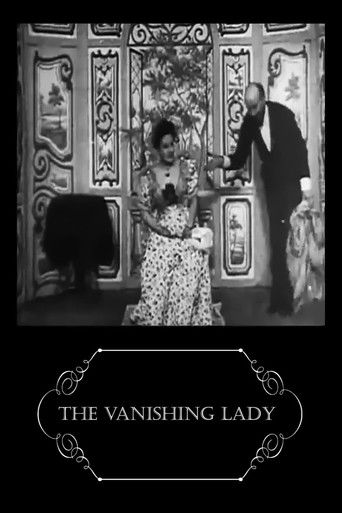
In this brief early Georges Méliès fantasy, a magician performs a stage illusion in which a woman suddenly appears, vanishes, and reappears at his command. The action is built around a succession of rapid visual tricks rather than a conventional narrative, with the magician using theatrical gestures to control the transformations. As in many of Méliès's trick films, the pleasure lies in the spectacle of impossible events made to seem effortless on screen. The film plays like a moving magic act, emphasizing surprise, transformation, and the playful instability of the image itself.
Director
Georges MélièsCast
About the Production
The film was made during Georges Méliès's prolific period of one-reel trick films for the Star Film Company, when he was refining the cinematic vocabulary of substitutions, appearances, and disappearances through stop-camera effects. Like many of his early fantasies, it was staged entirely in front of a static camera on a theatrical set, with the illusion created in-camera rather than through post-production. The production likely relied on painted scenery, carefully timed cuts, and Méliès's practiced choreography as performer-director to make the magical transformations appear seamless. Surviving documentation on exact budget, release date, and original exhibitor materials is limited, which is common for films from this era.
Historical Background
The Fugitive Apparitions was made in 1904, when cinema was still in its first decade and was rapidly evolving from a fairground novelty into a recognized entertainment form. In France, Méliès stood at the intersection of theater, magic, and film, creating fantastical shorts that contrasted sharply with the actuality films and everyday scenes being produced by the Lumière tradition. This period was also marked by intense international competition among film producers, with early companies seeking distinctive visual attractions to draw audiences in an increasingly crowded market. The film matters historically because it exemplifies one of the earliest and most influential uses of cinema for pure illusion: not to record reality, but to create impossible transformations that only film could present so convincingly.
Why This Film Matters
The film is part of the foundational body of work that established fantasy cinema and cinematic trick effects as central possibilities of the medium. Méliès's approach helped define the idea of film as a space for transformation, spectacle, and imaginative visual narrative, influencing later fantasy, horror, and special-effects traditions. Even though this title is not among his most famous works, it belongs to the same creative lineage that produced some of the most studied films in world cinema history. Its significance lies in its contribution to the grammar of screen illusion and in demonstrating how early filmmakers could turn a simple stage trick into a durable cinematic form.
Making Of
The film was made at a time when Georges Méliès had fully embraced cinema as a tool for conjuring stage illusions that could not be duplicated in a live theater with the same ease. He typically worked in his purpose-built glass studio in Montreuil, where abundant natural light made it possible to film painted sets and actors in elaborate costume with clarity. For this type of production, the main creative challenge was not narrative complexity but precision: the performer had to hit marks exactly so that the camera could be stopped and restarted for substitution edits without visible disruption. The result is a carefully controlled piece of cinematic sleight of hand that demonstrates Méliès's mastery of early special-effects technique and his understanding of screen illusion as performance.
Visual Style
The cinematography is characteristic of Méliès's early fantasy films: a static camera, a frontal theatrical composition, and a clearly arranged stage-like set that keeps the action fully visible. The visual style depends on clarity and legibility so the viewer can appreciate the illusion as it happens, with the magician and the woman positioned to maximize the impact of each disappearance and appearance. Lighting would have been driven by the glass-studio environment, producing a bright, evenly exposed image suited to painted scenery and pantomime performance. The frame functions like a proscenium stage, making the film feel like a live magic act translated into motion pictures.
Innovations
The main technical achievement is its use of stop-camera substitution effects to create the illusion of instantaneous appearance and disappearance. This technique, associated closely with Méliès, transformed film editing into a tool for magical metamorphosis rather than simple continuity. The film also demonstrates the refined staging needed to execute such effects cleanly within a single fixed setup, showing how early filmmakers used theatrical blocking, set design, and camera interruption as part of a unified illusion. It is a clear example of early cinematic special effects before the development of more elaborate compositing or optical printing methods.
Music
No original synchronized soundtrack exists, as the film predates synchronized sound cinema. Like most silent-era shorts, it would have been shown with live musical accompaniment that varied by venue, ranging from a pianist to a small ensemble depending on the exhibition context. Modern presentations may use archival accompaniment, improvised music, or newly commissioned scores to support the viewing experience. No single historically definitive score is known.
Memorable Scenes
- The magician causes the woman to appear as if by enchantment, then immediately vanishes her again through a substitution trick, creating the film's central visual surprise.
Did You Know?
- The film is one of many early Méliès trick pictures built around a stage magician, a recurring figure in his work because it mirrored cinema's own capacity for illusion.
- Its English-language title, The Fugitive Apparitions, reflects the kind of poetic, evocative naming often used for Méliès's fantasy films in export catalogs.
- The film is catalogued within the Star Film Company's numbered production system, though surviving records for many of these short films are incomplete or inconsistent across sources.
- As with many Méliès productions, the special effects were achieved in-camera rather than with editing effects that became common later in cinema history.
- The film survives in film-historical records and catalog references, but detailed contemporary reviews are not known to be widely preserved.
- Méliès frequently performed in his own films, and this one is no exception: he is credited as the cast member and likely played the magician himself.
- The entire concept of the film is based on a transformation gag, a hallmark of Méliès's cinema that later influenced fantasy filmmaking, slapstick, and visual comedy.
- Although the plot is extremely simple, it belongs to a larger body of early cinema experimentation in which motion pictures were used as visual magic acts.
- The title suggests an emphasis on ghosts or specters, but the film is better understood as a theatrical illusion piece than a supernatural horror film.
What Critics Said
There is little surviving evidence of detailed contemporary critical response specific to this short film, which is typical for many early 1900s releases. At the time, such films were generally received as novelties and attractions rather than as works to be critically reviewed in the modern sense. Later film historians have valued it as part of Méliès's trick-film output, appreciating it less for narrative depth than for its demonstration of early special-effects artistry and the development of fantasy cinema. In retrospective criticism, works like this are often discussed as key building blocks in the evolution of film language and visual magic.
What Audiences Thought
Original audience response is not well documented, but films of this kind were widely popular with early cinema audiences who delighted in transformations, surprises, and comic magical effects. Méliès's trick films were especially effective in nickelodeons and fairground exhibition settings because they offered immediate visual astonishment without requiring complex story comprehension. Modern audiences usually encounter the film as a historical curiosity or as part of retrospectives of silent cinema, where its appeal lies in its clever simplicity and its evidence of cinema's earliest special effects.
Film Connections
Influenced By
- Stage magic and music-hall illusion acts
- Georges Méliès's own theatrical background as a magician
- Earlier actuality and staged performance films that inspired fantasy experimentation
This Film Influenced
- The development of trick films and fantasy shorts in early cinema
- Later magic and transformation sequences in fantasy and horror cinema
- The cinematic special-effects tradition associated with stop-motion and substitution editing
You Might Also Like
More Fantasy Films
View allMore from Georges Méliès
View allFilm Restoration
The film is historically documented and appears in surviving catalog and reference records; specific preservation details are limited, but it is generally treated as extant rather than a completely lost title. Complete archival condition, restoration history, and element provenance are not consistently documented in widely available sources.