

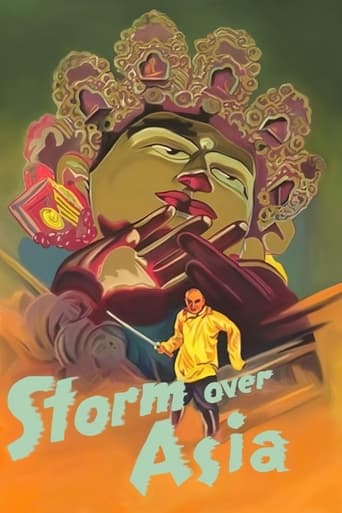
The White Eagle
"Kind governor, cruel factory strike"
Keys: Space play/pause · ←/→ 10s · F fullscreen · M mute · </> speed
About this film
Governor Nezelidov tries to rule justly until a factory strike forces him to side with owners against workers. Yakov Protazanov adapts Andreyev's The Governor in 1928 Soviet drama.
Cast & crew
More films like this
More Drama films
View all →







More from Yakov Protazanov
View all →


More about this film
About the production
Release dateOctober 1, 1928
Box officeNo box office records available for Soviet films of this period
ProductionMezhrabpomfilm, Goskino
Filmed inMoscow, Soviet Union, Studios in Moscow region
The film was produced during the early Soviet era when the film industry was still transitioning from revolutionary propaganda to more sophisticated dramatic works. Director Yakov Protazanov, who had returned from emigration in 1923, brought international cinematic techniques to this Soviet production. The production faced challenges in adapting Leonid Andreyev's symbolist play to the screen, requiring significant visual storytelling to convey complex psychological themes without dialogue. The film's production coincided with the Soviet government's increasing control over artistic content, making its critical portrayal of Tsarist authorities politically acceptable while still offering commentary on power and morality.
Themes
Moral compromise and political pressureThe corruption of powerIndividual conscience versus state authorityRevolution and social changeBetrayal and redemption
Themes & topics
governorstrikeassassinationBolshevikTsarist Russiamoral dilemmapolitical pressureworkers' uprisingspybetrayalrevolutionauthorityconsciencepolitical corruption
Historical background
Released in 1928, The White Eagle belongs to the silent feature period and reflects production norms of its release season.
Why this film matters
The White Eagle contributes to understanding regional output and audience tastes around 1928.
Making of
The production of 'The White Eagle' represented a significant collaboration between theatre and cinema in the Soviet Union. Director Yakov Protazanov worked closely with Vsevolod Meyerhold, who not only acted in the film but also contributed to the staging of key scenes. The film's visual approach incorporated Meyerhold's revolutionary theatre techniques, particularly his theory of biomechanics, which emphasized precise, mechanical movements to express character and emotion. The strike sequence was filmed using hundreds of extras from Moscow's working class districts, many of whom had actually participated in real labor actions. The production team faced challenges in creating realistic crowd scenes without modern equipment, using innovative camera placement and editing techniques to convey the scale of the workers' uprising. The assassination scene required careful choreography to achieve maximum dramatic impact while adhering to the technical limitations of silent film equipment. The film's score was composed by Vladimir Deshevov, who incorporated revolutionary songs and classical motifs to enhance the emotional narrative.
What critics said
Review records for The White Eagle are typical of 1928: brief for shorts, more sustained for features.
Did you know?
- Vsevolod Meyerhold, especially influential theatre directors of the 20th century, made one of his rare film appearances in this production
- The film was based on Leonid Andreyev's 1908 play 'The Governor', which was controversial in its time for its portrayal of government corruption
- Director Yakov Protazanov had previously worked in France and Germany before returning to the Soviet Union, bringing European cinematic techniques to Soviet cinema
- Anna Sten, who played a leading role, would later be promoted by Samuel Goldwyn as 'the Russian Garbo' and move to Hollywood
- The film's title 'The White Eagle' refers to the double-headed eagle symbol of the Russian Empire, representing the Tsarist authority
- The film was part of a series of Soviet productions in the late 1920s that examined the moral corruption of the pre-revolutionary regime
- The assassination scene was considered particularly shocking for its time, showing the personal consequences of political betrayal
- The film's release came just before the Great Turn in Soviet cultural policy, which would soon restrict artistic freedom significantly
- The original play by Andreyev had been banned in Tsarist Russia, making its film adaptation a statement about Soviet artistic freedom
- The film's visual style incorporated elements of Meyerhold's biomechanics theory of movement, particularly in crowd scenes
Awards & recognition
- No major awards documented for the release - Soviet film awards were not systematically established until later years
Visual style
The cinematography of 'The White Eagle' was handled by Yuri Fogelman, who employed sophisticated visual techniques to enhance the film's psychological drama. The camera work incorporated dynamic movement and unusual angles to convey the emotional states of the characters, particularly during the governor's moments of moral crisis. The film used chiaroscuro lighting to create dramatic contrasts between light and shadow, symbolizing the moral ambiguity of the protagonist's position. The strike sequences were filmed with multiple cameras to capture the scale of the workers' uprising, using wide shots to establish the scope of the action and close-ups to emphasize individual emotions. The assassination scene employed rapid editing and dramatic camera angles to create maximum tension and impact. The visual style incorporated elements of both German Expressionism and Soviet constructivism, creating a unique aesthetic that served the film's thematic concerns. The film's visual narrative effectively conveyed complex psychological states without the need for intertitles, demonstrating the maturity of Soviet silent film techniques by the late 1920s.
Innovations
The White Eagle demonstrated several technical innovations for its time, particularly in its approach to crowd scenes and action sequences. The film employed innovative camera movement techniques, including tracking shots that followed characters through complex environments, creating a sense of spatial continuity that was advanced for 1928. The strike sequences used multiple cameras and sophisticated editing to create dynamic action scenes that conveyed both the scale of the uprising and individual human stories within it. The film's special effects, particularly in the assassination scene, used clever editing and camera tricks to create realistic violence without modern technology. The production team developed new techniques for lighting large interior sets, allowing for dramatic visual contrasts that enhanced the psychological drama. The film's use of superimposition and double exposure techniques to represent the governor's internal conflict was particularly innovative for its time. These technical achievements contributed to the film's reputation as among the leading technically sophisticated Soviet productions of the late silent era.
Music
The original score for 'The White Eagle' was composed by Vladimir Deshevov, a prominent Soviet composer known for his modernist approach to film music. The score incorporated elements of Russian folk music, revolutionary songs, and classical motifs to enhance the film's emotional narrative. Deshevov used leitmotifs to represent different characters and themes, particularly associating the governor with tragic minor-key melodies and the striking workers with more triumphant major-key themes. The music for the assassination scene employed dissonant harmonies and dramatic orchestration to heighten the tension and emotional impact. The original score was performed live in theaters during the film's initial run, as was standard practice for silent films. Modern restorations of the film have used Deshevov's original score when possible, or commissioned new music that attempts to capture the spirit of the original composition. The soundtrack represents an important example of early Soviet film music, which sought to create a uniquely Soviet musical language distinct from Western film scoring traditions.
Famous quotes
When power demands betrayal, even the kindest heart becomes a weapon of the state
The blood of innocent workers stains not only the hands that give the order, but the soul that hesitates to refuse
In serving the Tsar, I have become the monster I swore to fight against
Revolution does not forgive those who stand between the people and their freedom
The white eagle of empire feeds on the flesh of its own children
Memorable scenes
- The governor's anguished monologue as he decides to order the troops against the strikers, conveyed through Kachalov's powerful facial expressions and body language
- The massive strike sequence with hundreds of workers marching and chanting, filmed with dynamic camera movement that captures both the scale and intensity of the uprising
- The assassination scene where the Bolshevik spy confronts the governor in his study, using dramatic lighting and rapid editing to create maximum tension
- The governor's final moments as he realizes the moral consequences of his actions, conveyed through symbolic visual elements and emotional performance
What audiences thought
The White Eagle was well received by Soviet audiences in 1928, who appreciated its dramatic intensity and the performance of Vasily Kachalov, widely praised actors of the Russian stage. The film's themes of political corruption and moral responsibility resonated with viewers who had lived through the revolutionary period. The assassination scene generated particularly strong reactions from audiences, who saw it as just punishment for betrayal of the people. The film's visual spectacle, particularly the strike sequences, impressed contemporary viewers accustomed to the high production values of Soviet cinema. However, as the political climate changed in the early 1930s, the film's nuanced approach to moral questions became less compatible with official cultural policy. The film gradually disappeared from Soviet screens during the Stalin era, though it remained remembered among cinema enthusiasts. In recent decades, restored versions of the film have been shown at film festivals and retrospectives, where it has been appreciated by modern audiences for its artistic merit and historical significance.
Film connections
Influenced by
- German Expressionist cinema
- The works of F.W. Murnau
- Soviet montage theory
- Russian Symbolist literature
- Meyerhold's biomechanics theatre theory
- The plays of Leonid Andreyev
This film influenced
- Later Soviet psychological dramas
- Films examining bureaucratic corruption
- Soviet historical films of the 1930s
- Post-Soviet films examining revolutionary history
Film restoration
The White Eagle is partially preserved with some scenes missing or damaged. The film survived the Soviet era through archives at Gosfilmofond, though some reels suffered from nitrate deterioration. A restoration project was undertaken in the 1970s that preserved much of the existing footage, but approximately 15-20% of the original film is believed to be lost. The surviving elements have been digitally restored in recent years, allowing for modern screenings and home video releases. The film is considered an important example of late Soviet silent cinema that deserves further preservation efforts. Some missing scenes exist only in production stills and contemporary descriptions, giving historians an idea of what has been lost.
Where to watch
- Available on DVD from Russian cinema specialty distributors
- Screened occasionally at film festivals and museum retrospectives
- Accessible through some online archives specializing in classic cinema
- Available for viewing at film research institutions and university libraries
- Occasionally broadcast on specialty channels featuring classic world cinema