Brute Force
"Invent the club — win the mate"
Keys: Space play/pause · ←/→ 10s · F fullscreen · M mute · </> speed
About this film
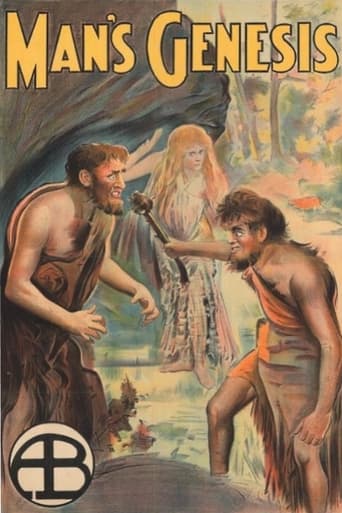
Clubman reads primitive-man book dreaming Weakhands inventing club to win mate from Bruteforce. Brute Force (1914) is D.W. Griffith prehistoric allegory in one reel.
Cast & crew
More films like this



More Adventure films
View all →

More from D.W. Griffith
View all →
More about this film
About the production
Release dateApril 25, 1914
BudgetApproximately $5,000 - $10,000 (Estimated based on Biograph two-reel standards)
ProductionBiograph Company
Filmed inChatsworth Park, Los Angeles, California, USA
The film was a significant production for the Biograph Company, serving as a more elaborate sequel to Griffith's 1912 short 'Man's Genesis.' It was filmed in the rugged terrain of Chatsworth Park to simulate a prehistoric wasteland. Griffith utilized a large number of extras for the battle scenes, which was a precursor to the massive scale he would later employ in 'The Birth of a Nation.' The production faced challenges in creating believable prehistoric creatures, leading to the use of a live alligator with a prosthetic fin to portray a 'winged lizard' and other early practical effects.
Themes
Evolution vs. Primal InstinctIntellect as a Weapon (Brains over Brawn)The Invention of TechnologyRomantic RivalryMasculinity and Strength
Themes & topics
CavemanDinosaurPrehistoricInvention of the ClubBow and ArrowTribal WarfareDream SequenceEvolution
Historical background
Brute Force (1914) belongs to Griffith's allegorical shorts translating evolution debate into slapstick.
Why this film matters
Prehistoric parody shorts were common allegories for modern courtship and technology.
Making of
The production was marked by Griffith's growing ambition to move beyond simple one-reelers. Working with his cinematographer Billy Bitzer, Griffith experimented with depth of field and cross-cutting to heighten the tension of the tribal battles. The 'monsters' were created using a mix of puppetry and live animals; for instance, a snake was used to represent a prehistoric serpent, and a mechanical dinosaur was constructed for certain shots, though it remained largely stationary. The cast, including Robert Harron and Mae Marsh, were part of Griffith's 'stock company' and were frequently subjected to the director's rigorous and often dangerous filming conditions in the California heat.
What critics said
Exhibitors enjoyed novelty; scholars connect it to social Darwinism discourse.
Did you know?
- It is widely considered the first live-action film to feature dinosaurs.
- The film is a sequel to D.W. Griffith's earlier 1912 short film 'Man's Genesis.'
- Mae Marsh took the role of Lilywhite after Mary Pickford famously refused it because she did not want to wear the revealing grass-skirt costume.
- The 'dinosaurs' in the film were actually live lizards and alligators filmed in close-up to appear giant, a technique later known as 'slurpasaur' effects.
- The film was also released under the alternative title 'The Primitive Man.'
- It features a 'film-within-a-film' or 'picture-in-picture' effect, which was highly innovative for 1914.
- The modern-day framing story was a common trope in early 'prehistoric' cinema to justify the fantasy elements to audiences.
- The film's subtitle references Charles Darwin, reflecting the era's fascination with evolutionary theory.
Visual style
Billy Bitzer used innovative techniques such as the 'iris' shot to focus audience attention and experimented with backlighting to create a sense of depth in the rocky California landscapes. The film also features early examples of 'forced perspective' to make the live-animal 'dinosaurs' appear larger than the human actors.
Music
As a silent film, it had no recorded soundtrack. Original screenings would have been accompanied by a live pianist or organist, often playing stock 'dramatic' or 'primitive' musical cues provided by the distributor.
Famous quotes
Subtitle: 'A Psychological Comedy Founded on the Darwinian Theory of the Evolution of Man.'
Intertitle: 'Necessity is the mother of invention.'
Intertitle: 'The birth of the first weapon.'
Memorable scenes
- The transition scene where the modern-day protagonist falls asleep and the party fades into the prehistoric cave setting.
- The battle between Weakhands and the 'winged lizard' (an alligator with a prosthetic fin).
- The moment Weakhands discovers how to create a club by wedging a stick into a stone.
- The final battle where the bow and arrow are used for the first time to defeat the Bruteforce tribe.
What audiences thought
Audiences in 1914 were captivated by the film's 'monsters' and the action-packed tribal warfare. The comedic elements of the modern framing story provided a relatable entry point for viewers, making the prehistoric fantasy more accessible. It was successful enough to warrant a re-release in 1915 by the General Film Company.
Film connections
Influenced by
- Darwin's 'On the Origin of Species'
- Man's Genesis (1912)
- The works of H.G. Wells
This film influenced
- The Lost World (1925)
- King Kong (1933)
- One Million Years B.C. (1966)
- Quest for Fire (1981)
Film restoration
The film is preserved and exists in the archives of the Library of Congress (35mm paper print) and the Museum of Modern Art (35mm acetate master).
Where to watch
- YouTube (Public Domain)
- Internet Archive
- Silent Hall of Fame (Streaming)
- Included in various D.W. Griffith DVD collections such as 'Robert Harron Rare Shorts'