
The Birth of a Race
"An answer film that lost its answer"
Keys: Space play/pause · ←/→ 10s · F fullscreen · M mute · </> speed
About this film
Conceived by Emmett J. Scott as a Black-led answer to D. W. Griffith's The Birth of a Nation, the production began with ambitions to dramatize African American history and racial progress. White investors and wartime pressures reshaped the project into a sprawling biblical and patriotic pageant that jumps from sacred history through Columbus, Paul Revere, and Lincoln to a World War I subplot about divided German-American brothers. Much of the footage Scott intended to celebrate Black achievement was cut before release, leaving a disjointed spectacle that disappointed audiences and critics alik…
Cast & crew
More films like this

More Drama films
View all →







More about this film
About the production
Release dateDecember 1918
Budget$75,000 (originally planned for $250,000)
Box officePoor - considered a commercial failure
ProductionEmmett J. Scott Film Company, George P. Johnson Company
Filmed inChicago, Illinois, Tallahassee, Florida, Various locations in the American South
The film was originally conceived as a direct response to D.W. Griffith's 'The Birth of a Nation,' intended to showcase African American contributions to civilization. Production began in 1916 but faced numerous challenges including funding shortages, creative differences, and the departure of key personnel. Originally planned as a 12-reel epic focusing on African American history, the final version was heavily altered to include broader historical narratives. The film's production was plagued by financial difficulties, leading to multiple shooting schedules and a reduced scope. Despite its noble intentions, the final product was criticized for compromising its original vision.
Themes
Freedom and liberationRacial equality and brotherhoodDivine providence and destinyThe struggle against oppressionUniversal human dignity
Themes & topics
Biblical storiesAmerican historyWorld War ISlaveryEmancipationCivil rightsDemocracyFreedomRace relationsHistorical epicSocial justiceHuman dignity
Historical background
Silent-era production in 1918 relied on intertitles, live accompaniment, and studio systems that were rapidly consolidating into national industries.
Why this film matters
Early works like The Birth of a Race help map how filmmakers, exhibitors, and viewers developed the visual language of cinema during the medium's first decades. Later revivals, archive screenings, and digitization have kept such titles accessible to researchers and dedicated viewers long after their first commercial runs.
Making of
The Birth of a Race emerged from the African American community's outrage over D.W. Griffith's 'The Birth of a Nation.' Emmett J. Scott, former secretary to Booker T. Washington, secured funding from wealthy African American investors and sympathetic white philanthropists. The project initially attracted significant attention and support from the NAACP and other civil rights organizations. However, creative tensions soon emerged between Scott and the production team. The original director, W.S. Smith, was replaced by John W. Noble early in production. As financial difficulties mounted, investors demanded changes to make the film more commercially viable, leading to the dilution of its original African American focus. The production employed hundreds of actors and extras, including both professional performers and local residents in filming locations. Despite the challenges, the film represented one of the first attempts by African Americans to produce a feature-length response to racist Hollywood portrayals.
What critics said
Trade and newspaper reviews from the silent period for The Birth of a Race survive only in fragments, making precise reception history difficult to reconstruct. Modern assessment tends to emphasize historical value, craft, and cultural context rather than box-office performance.
Did you know?
- The film was conceived as a direct cinematic response to D.W. Griffith's controversial 'The Birth of a Nation' (1915)
- Originally titled 'The New Birth of a Nation' before being changed to avoid legal issues
- The film's budget was slashed from the planned $250,000 to just $75,000, forcing significant changes to the production
- Emmett J. Scott, who had served as Booker T. Washington's secretary, was the driving force behind the project
- The original script focused heavily on African American history but was altered to include more general historical content to appeal to white audiences
- Production took over two years due to financial problems and creative disputes
- The film featured both black and white actors in leading roles, unusual for the period
- Despite its intentions, the film was criticized by African American leaders for not being bold enough in its message
- Only one complete copy of the film is known to exist, held at the Library of Congress
- The film's commercial failure discouraged other African American filmmakers from attempting similar projects for years
Visual style
The cinematography, handled by James E. Abbe and Arthur Edeson, attempted to emulate the epic scale of D.W. Griffith's work but was hampered by budget constraints. The film employed some location shooting in the American South, which was relatively unusual for the period. Visual techniques included biblical recreations, historical battle scenes, and symbolic imagery meant to convey the universal struggle for freedom. The film used some innovative camera movements for its time, including tracking shots during battle sequences. However, much of the cinematography was criticized for being technically uneven, with some scenes appearing amateurish due to rushed production schedules and limited resources.
Innovations
The film's primary technical achievement was its ambitious scope, attempting to cover thousands of years of human history in a single feature film. It employed large-scale sets for biblical and historical scenes, requiring significant production design work. The film utilized some early special effects techniques for scenes like Noah's Ark and the parting of the Red Sea. However, budget limitations prevented the film from achieving the technical polish of contemporary Hollywood productions. The use of both black and white actors in integrated scenes was technically and socially progressive for its time, though the film ultimately maintained many of the era's racial casting conventions.
Music
As a silent film, The Birth of a Race would have been accompanied by live musical performances during theatrical screenings. The film likely used a combination of classical music pieces and original compositions tailored to the epic nature of the story. Music would have been particularly important during the biblical sequences, battle scenes, and emotional moments to enhance the dramatic impact. Unfortunately, specific details about the original musical scores or typical accompaniment arrangements have been lost to history, as was common with many silent films of the era.
Famous quotes
From the dawn of creation, the race of man has struggled toward the light of freedom
Peace and brotherhood are the birthright of all mankind
When tyranny threatens, the free must unite or perish
The arc of history bends toward justice, though the path be long and hard
In every age, there are those who would enslave and those who would liberate
Memorable scenes
- The opening sequence depicting Noah building the ark as humanity faces divine judgment
- Moses leading the Israelites through the parted Red Sea in a spectacular display of divine intervention
- The crucifixion of Christ with its message of redemption and universal love
- Abraham Lincoln signing the Emancipation Proclamation, symbolizing hope for the oppressed
- The climactic World War I battle sequence showing the forces of democracy confronting autocracy
- The final montage of free peoples from all nations united in their quest for peace
What audiences thought
Audience reception was generally poor, with the film failing to attract significant viewership in either black or white theaters. African American audiences were disappointed that the film didn't more directly address their experiences and contributions to American history. White audiences showed little interest, and many theaters refused to book the film. The poor box office performance was attributed to various factors including its altered focus, inadequate marketing, and the general reluctance of theaters to screen controversial racial content. The commercial failure was particularly disheartening for the African American community, which had hoped the film would prove the viability of black-produced cinema.
Film connections
Influenced by
- The Birth of a Nation (1915) - as a direct response
- Biblical epics of the silent era
- D.W. Griffith's cinematic techniques
- Booker T. Washington's philosophy of racial uplift
- NAACP's civil rights activism
This film influenced
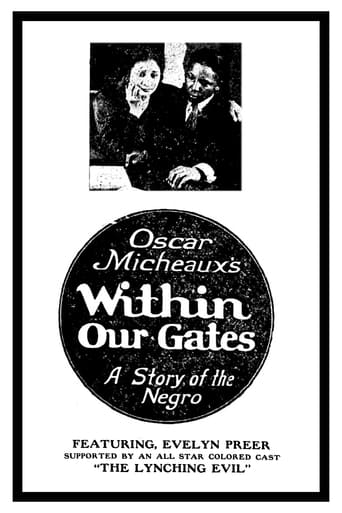
- Within Our Gates (1920) by Oscar Micheaux
- The Symbol of the Unconquered (1920) by Oscar Micheaux
- Later African American independent films
- Race films of the 1920s-1940s
Film restoration
The film is partially preserved with one complete copy held at the Library of Congress. The print is in fragile condition but has been digitized for preservation purposes. Some sequences may be incomplete or damaged. The film is considered at-risk due to the deterioration of nitrate film stock, though the Library of Congress copy provides reasonable visual quality for study purposes. No original negatives are known to survive.
Where to watch
- Library of Congress (research access)
- Various film archives and museums with special screenings
- Academic institutions with film studies programs
- Occasionally shown at film festivals specializing in silent or African American cinema