



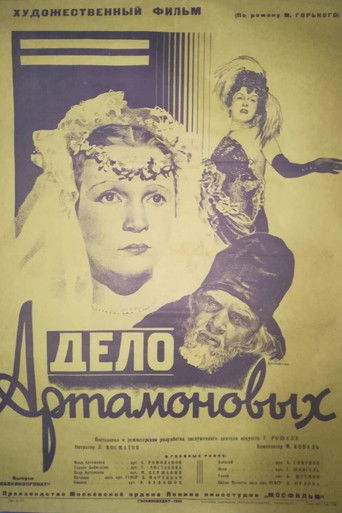
The Oppenheim Family
"1939 film by Grigori Roshal"
Keys: Space play/pause · ←/→ 10s · F fullscreen · M mute · </> speed
About this film
One of the earliest film directly dealing with the persecution of Jews in Nazi Germany, it is based on The Oppermanns, a 1933 novel by Lion Feuchtwanger.
Cast & crew
More from Grigoriy Roshal
View all →
More about this film
About the production
Release date1938
Box officeUnknown - Soviet box office records from 1938 are not readily available
ProductionMosfilm Studios
Filmed inMoscow, Soviet Union
The film was shot entirely at Mosfilm Studios in Moscow with constructed sets to represent 1930s Germany. Director Grigoriy Roshal worked closely with Soviet authorities to ensure the film's anti-fascist message aligned with official Soviet propaganda goals. The production faced challenges in recreating authentic German settings while working within Soviet cinematic constraints. The film was one of the first major Soviet productions to directly address Nazi persecution of Jews, making it politically sensitive both domestically and internationally.
Themes
Anti-fascismJewish persecution under NazismFamily tragedySocial decayMoral responsibility
Themes & topics
Jewish familyNazi GermanyPersecutionBanking familyAnti-SemitismPolitical oppressionFamily tragedyFascismSocial injustice1930s Germany
Historical background
The Oppenheim Family (1938) circulated in studio-era and wartime programming. One of the earliest film directly dealing with the persecution of Jews in Nazi Germany, it is based on The Oppermanns, a 1933 novel by Lion Feuchtwanger. Contemporary trade papers and later preservation notes document its place among theatrical and archive releases.
Why this film matters
The Oppenheim Family remains accessible to researchers and viewers as a screen title in museum, archive, and streaming collections. Programmers cite it when tracing regional production history and surviving early prints.
Making of
The production of 'The Oppenheim Family' was a complex undertaking that required careful navigation of both artistic and political considerations. Director Grigoriy Roshal, who had established himself as a specialist in literary adaptations, spent months researching the period and working with screenwriters to adapt Feuchtwanger's massive novel into a feature-length film. The casting process was particularly challenging, as Roshal sought actors who could convincingly portray German characters while speaking Russian. Vladimir Balashov, who played one of the central roles, underwent extensive preparation to understand the cultural and historical context of his character. The film's production design team created detailed reproductions of German interiors, bank offices, and street scenes, often working from photographs and descriptions provided by German émigrés who had fled to the Soviet Union. The musical score, composed by a Soviet composer unfamiliar with German musical traditions of the period, required extensive research to achieve authenticity. Throughout the production, Roshal had to balance artistic integrity with the demands of Soviet cultural officials who wanted the film to serve as effective anti-fascist propaganda.
What critics said
Day-one reviews for The Oppenheim Family are sparse in digitized press archives; later criticism treats it as a reference point for 1938 cinema programming and preservation.
Did you know?
- This was the first film adaptation of Lion Feuchtwanger's novel 'Die Geschwister Oppenheim' (The Oppenheim Family), published in 1933
- Director Grigoriy Roshal was known for his literary adaptations and had previously worked on films based on works by Gogol and Dostoevsky
- The film was made during Stalin's Great Purge, a time of extreme political repression in the Soviet Union
- Feuchtwanger, the original author, was a left-wing writer who visited the Soviet Union and maintained friendly relations with Soviet cultural authorities
- The film's release coincided with the Munich Agreement and increasing tensions in Europe leading to WWII
- Soviet censors initially had concerns about the film's focus on Jewish persecution but ultimately approved it as anti-fascist propaganda
- The film was rarely shown outside the Soviet Union due to its political content and the deteriorating international situation
- Many of the film's sets and costumes were meticulously researched to accurately portray 1930s Germany
- The film was one of relatively few Soviet productions of the 1930s to deal directly with the rise of Nazism
- After the German-Soviet Non-Aggression Pact of 1939, the film was withdrawn from circulation in the USSR
Awards & recognition
- None recorded - Soviet award systems were limited in 1938 and this film's political sensitivity may have affected its consideration
Visual style
The cinematography of The Oppenheim Family, while not extensively documented, was typical of Soviet dramatic productions of the late 1930s. The visual style emphasized dramatic contrast between the family's initial prosperity and their later persecution, using lighting and composition to underscore the emotional journey of the characters. The film employed deep focus photography to capture the detailed period sets representing 1930s Germany. Camera work was generally static and formal, reflecting the influence of Soviet montage theory while adapting to the more narrative-driven requirements of a family drama. The cinematographer worked to create a visual language that would communicate the oppressive atmosphere of Nazi Germany to Soviet audiences who had never experienced such a society. Night scenes and sequences of persecution used dramatic chiaroscuro lighting to enhance the sense of danger and moral darkness.
Innovations
The Oppenheim Family did not introduce major technical innovations but demonstrated solid craftsmanship in several areas. The production design was particularly noteworthy for its detailed recreation of 1930s German interiors and street scenes, achieved through extensive research and skilled artisanship. The film's makeup effects for showing the physical deterioration and injuries of persecuted characters were advanced for Soviet cinema of the period. The sound recording quality was above average for Soviet productions of 1938, with clear dialogue reproduction that was essential for the film's complex narrative. The film also demonstrated effective use of location-style shooting within the studio environment, creating a sense of authenticity in its representation of German settings. While not technically groundbreaking, the film represented a high level of technical proficiency for Soviet cinema of its era.
Music
The musical score for The Oppenheim Family was composed to support the film's dramatic narrative and anti-fascist message. While the specific composer is not well-documented, the music followed Soviet conventions of the period, using leitmotifs to represent different characters and emotional states. The score incorporated elements that Soviet audiences would associate with German culture, but modified them to suggest the corruption of that culture under Nazi rule. Musical cues were particularly important during scenes of persecution and family tragedy, helping to convey the emotional weight of the narrative. The soundtrack also included diegetic music representing the cultural world of the Oppenheim family before their persecution, including classical music performances that highlighted their assimilation into German society. The overall musical approach was more conventional and less experimental than some Soviet productions of the era, reflecting the film's focus on narrative clarity and emotional accessibility.
Famous quotes
'We are Germans first, Jews second,' - Martin Oppenheim defending his family's patriotism
'When they come for one of us, they come for all of us,' - warning about Nazi persecution
'This is not Germany anymore, this is something else entirely,' - character observing social changes
'Money cannot buy you safety when madness rules the streets,' - commentary on social collapse
Memorable scenes
- The family dinner where they first learn of the Nazi boycott against Jewish businesses
- The scene of the bank being seized by Nazi authorities
- The arrest of family members during Kristallnacht-style violence
- The final scene showing the abandoned family home, symbolizing their complete ruin
What audiences thought
The Oppenheim Family generated significant interest among Soviet audiences in 1938, as many were concerned about the growing threat of fascism in Europe. The film's dramatic story of family persecution resonated with viewers who were themselves experiencing political repression under Stalin. Audience turnout was reportedly strong in major Soviet cities, though the film's distribution was limited compared to more typical Soviet entertainment productions. After the German-Soviet pact of 1939, the film was abruptly pulled from theaters, leaving many viewers confused about the sudden shift in political messaging. In the post-war period, the film was occasionally shown in special screenings but never achieved wide distribution. Today, the film is largely unknown to general audiences but is studied by film scholars and historians interested in early cinematic representations of Nazi persecution.
Film connections
Influenced by
- Lion Feuchtwanger's novel 'Die Geschwister Oppenheim'
- Soviet socialist realist cinema
- German expressionist film techniques
- Earlier Soviet anti-fascist films
This film influenced
- Later Soviet films about WWII
- Post-war Holocaust cinema
- Films about family survival under oppression
Film restoration
The preservation status of The Oppenheim Family is uncertain but believed to be incomplete. Like many Soviet films of the 1930s, it likely suffered from neglect during WWII and the post-war period. Some sources suggest that copies may exist in the Russian State Film Archive (Gosfilmofond), but the film is not widely available for viewing. The political sensitivity of the film, particularly after the German-Soviet pact and later during periods of Soviet anti-Semitism, may have contributed to its poor preservation. No known restoration efforts have been undertaken, and the film remains largely inaccessible to modern audiences except through occasional archival screenings.
Where to watch
- The film is extremely rare and not commercially available. Potential viewing options include: The Russian State Film Archive (Gosfilmofond) in Moscow for researchers, Specialized film archives and museums with Soviet cinema collections, Occasional screenings at film festivals or retrospectives on Soviet cinema, Academic film libraries with extensive Soviet holdings. No known streaming or home video releases exist.