



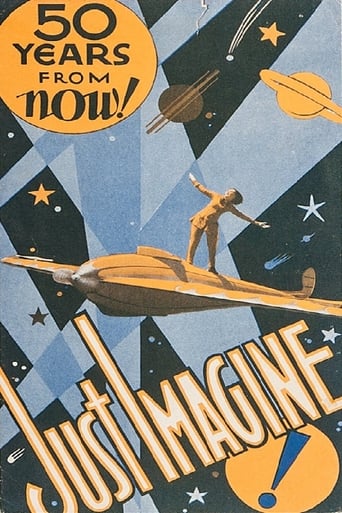
Madam Satan
"Madam Satan (1930)"
Keys: Space play/pause · ←/→ 10s · F fullscreen · M mute · </> speed
About this film
A socialite masquerades as a notorious femme fatale to win back her straying husband during a costume party aboard a doomed dirigible.
Cast & crew
More films like this


More Romance films
View all →




More from Cecil B. DeMille
View all →
More about this film
About the production
Release dateSeptember 20, 1930
Budget$1,000,000
Box officeEstimated loss of $250,000 to $390,000
ProductionMetro-Goldwyn-Mayer (MGM)
Filmed inMGM Studios, Culver City, California, USA
The film was Cecil B. DeMille's second production for MGM and his only attempt at a musical. It was the most expensive film MGM produced in 1930. The production was noted for its massive scale, particularly the Zeppelin set which featured a full-sized ballroom. DeMille originally sought Dorothy Parker to work on the script, but settled on vaudeville writer Elsie Janis. The film was shot in 59 days, finishing ahead of its 70-day schedule despite its complexity.
Themes
Marital InfidelityIdentity and MasqueradeFemale Empowerment/ReinventionTechnological HubrisClass and Decadence
Themes & topics
ZeppelinMasquerade BallFemme FataleParachutePre-CodeInfidelityArt DecoDisaster
Historical background
Contemporary records classify Madam Satan (1930) as 1930 film by cecil b. demille, placing it within the studio-system peak and early sound decades.
Why this film matters
Madam Satan (1930) helps trace genre evolution, performer careers, and the material conditions of sound exhibition.
Making of
The production was a massive undertaking that saw DeMille attempting to blend his silent-era 'bedroom farce' style with the new demands of the 'talkie' musical and disaster genres. Mitchell Leisen, who later became a major director, served as an assistant director and art director, contributing significantly to the film's avant-garde visual style. The Zeppelin sequence was a technical marvel of its time, utilizing intricate miniatures and massive practical sets to simulate the airship's destruction. Tensions existed regarding the choreography; DeMille wanted Theodore Kosloff, but MGM insisted on Leroy Prinz, though many historians believe Kosloff still choreographed the 'Ballet Mecanique' uncredited.
What critics said
Modern write-ups on Madam Satan (1930) tend to focus on preservation status, stylistic choices, and placement within director or studio filmographies.
Did you know?
- Kay Johnson, who plays Angela/Madam Satan, was the mother of actor James Cromwell.
- The 'Ballet Mecanique' sequence features 120 dancers in costumes representing electricity, spark plugs, and lightning bolts.
- Cecil B. DeMille's voice can be heard in the film as the radio announcer during the final reel.
- The film was originally released with sequences in 'Multicolor,' an early color process, though these only survive in black and white today.
- Gloria Swanson was DeMille's first choice for the lead, but she turned it down on the advice of Joseph P. Kennedy.
- The dirigible in the film is named the 'CB-P-55,' a nod to DeMille's initials.
- Lillian Roth, who plays Trixie, later became the first celebrity to publicly associate herself with Alcoholics Anonymous.
- The film features a 'sing-off' between the wife and the mistress on the dance floor.
- The elaborate costumes were designed by the Adrian, while the Art Deco sets were by Cedric Gibbons.
- At the time of its release, it featured the longest unbroken musical score yet placed in a talking picture (approx. 10.5 minutes).
Visual style
Photographed by Harold Rosson, the film utilizes high-contrast lighting and deep focus to highlight the intricate Art Deco sets. The use of 'Multicolor' for the party sequence was intended to create a dreamlike, vibrant atmosphere, though modern viewers must rely on the black-and-white preservation which still showcases the brilliant textures of Adrian's costumes.
Innovations
The film is a landmark in early sound-era special effects, particularly the use of miniatures and mechanical effects to depict the breaking apart of the Zeppelin. The 'Ballet Mecanique' sequence is a masterpiece of production design, blending human performance with industrial, machine-like aesthetics.
Music
The score includes songs such as 'Live and Love Today,' 'This Is Love,' and 'Low Down.' Abe Lyman and his Band provide the music for the masquerade ball. The soundtrack was notable for its technical integration, featuring long stretches of continuous music that were rare in early sound films.
Famous quotes
I'll make him so sick of vice he'll scream for decency!
When we got married, you ceased being my pal and became just my wife.
I am Madam Satan! I've come from hell to take you back with me!
Memorable scenes
- The 'Ballet Mecanique' sequence where dancers dressed as electrical components perform a surreal tribute to technology.
- The reveal of Angela's 'Madam Satan' costume, which features a cloak that opens to reveal a skin-tight, sequined gown with a devilish motif.
- The climax where the Zeppelin is struck by lightning and the socialites must jump into the night sky over New York City.
- The 'sing-off' between Angela and Trixie on the Zeppelin dance floor.
What audiences thought
Audiences in 1930 were largely confused by the film's jarring shift from domestic comedy to musical revue to disaster epic, leading to a significant box office loss for MGM. However, the Zeppelin sequence was generally viewed as a spectacular achievement. Today, it enjoys a dedicated following in the 'Pre-Code' and 'Camp' film communities.
Film connections
Influenced by
- Die Fledermaus (Operetta)
- The Guardsman (Play)
- Metropolis (1927)
- The sophisticated comedies of Ernst Lubitsch
This film influenced
- The Hindenburg (1975)
- The Poseidon Adventure (1972)
- Flash Gordon (1980) - Visual aesthetic
Film restoration
The film is preserved, though the original 'Multicolor' sequences are currently only available in black and white. It has been released on DVD via the Warner Archive Collection.
Where to watch
- Warner Archive Collection (DVD)
- Turner Classic Movies (TCM) - Occasional broadcasts
- Digital rental/purchase on platforms like Amazon or Apple (Availability varies by region)