
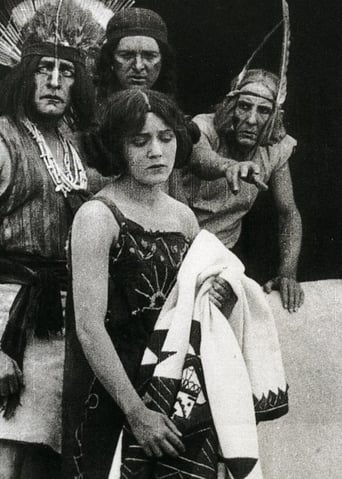
Ramona
"California rancho, forbidden love, injustice"
Keys: Space play/pause · ←/→ 10s · F fullscreen · M mute · </> speed
About this film
Ramona, residing on her wealthy Spanish adoptive mother's rancho in California, falls in love with the Indian Alessandro. When Ramona is denied permission to marry Alessandro, the lovers elope, only to find a life of great hardship and unhappiness amidst the greed and injustice o.
Cast & crew
More films like this

More Drama films
View all →







More from D.W. Griffith
View all →
More about this film
About the production
Release dateMay 23, 1910
ProductionAmerican Mutoscope and Biograph Company
Filmed inCalifornia, Santa Barbara area, Southern California locations
This was one of D.W. Griffith's early Biograph films during his most prolific period, where he was developing many cinematic techniques that would later define his career. The film was shot on location in California, which was somewhat unusual for the time as many productions still relied on studio sets. Mary Pickford was already demonstrating the star quality that would make her 'America's Sweetheart' and especially powerful figures in Hollywood.
Themes
Racial prejudice and discriminationThe tragic consequences of social intoleranceThe conflict between love and social conventionThe exploitation and displacement of Native AmericansThe romanticization of California's Spanish past
Themes & topics
interracial romanceadoptionNative AmericanSpanish Californiaelopementprejudicetragedyinjusticeland rightsorphanranchosocial classforbidden lovehardshipdeath of childmurderredemption
Historical background
Ramona reached screens in 1910 from American Mutoscope and Biograph Company, when exhibitors still paired shorts and features in mixed programs.
Why this film matters
Students of early cinema study Ramona as an example of 1910 treatment of ramona, residing on her wealthy spanish adoptive mother's rancho in california, falls in l.
Making of
The production of 'Ramona' occurred during D.W. Griffith's transformative period at Biograph, where he was developing many of the cinematic techniques that would later define his career. Griffith was known for his insistence on shooting on location rather than using studio sets when possible, and for 'Ramona,' he took his cast and crew to California to capture the authentic atmosphere of the Spanish rancho setting. Mary Pickford, who was 18 at the time, was already demonstrating the screen presence that would make her 'America's Sweetheart.' The film was made during a period when Biograph was releasing multiple films per week, creating a demanding production schedule. Griffith's attention to detail and his emerging directorial style are evident in this early work, which shows his interest in social issues and his ability to elicit emotional performances from his actors.
What critics said
Contemporary journalism left scarce detail on Ramona, leaving later critics to infer its 1910 reception.
Did you know?
- This was one of the earliest film adaptations of Helen Hunt Jackson's popular 1884 novel 'Ramona'
- The film was part of D.W. Griffith's prolific period at Biograph, where he directed hundreds of short films between 1908-1913
- Mary Pickford, who played Ramona, was only 18 years old but already becoming a major star
- The film is now considered lost, like approximately 90% of American films made before 1920
- The novel 'Ramona' was extremely popular and had already been adapted for the stage multiple times before this film version
- The story deals with themes of racial prejudice and the mistreatment of Native Americans, which were controversial topics for 1910
- Henry B. Walthall, who played Alessandro, would later star as the Little Colonel in Griffith's controversial 'The Birth of a Nation' (1915)
- The film was released during a period when California was romanticizing its Spanish and Mexican past
- This was one of the first films to address social issues regarding Native American rights in American cinema
- The film's two-reel length was substantial for the period, allowing for more complex storytelling than typical one-reel productions
Visual style
The cinematography in 'Ramona' was typical of Biograph productions of the era but showed Griffith's emerging attention to visual storytelling. G.W. Bitzer, Griffith's frequent collaborator, likely served as cinematographer. The film utilized the natural California landscapes to create authentic atmosphere, a practice Griffith championed over studio backdrops. The camera work was relatively static by modern standards but included some movement and varied angles that were innovative for the time. The use of location shooting in natural light gave the film a visual authenticity that distinguished it from many contemporary productions. The cinematography effectively captured the contrast between the opulent rancho and the harsh wilderness where Ramona and Alessandro struggle to survive, using visual elements to reinforce the narrative themes.
Innovations
While 'Ramona' doesn't feature the groundbreaking technical innovations that would characterize Griffith's later work, it demonstrates several technical aspects that were advancing cinema in 1910. The film's use of location shooting rather than studio sets represented a commitment to visual authenticity that was still relatively uncommon. The editing techniques, while basic by modern standards, showed Griffith's developing sense of narrative pacing and his ability to build emotional impact through shot selection and sequence. The film's two-reel length (approximately 16 minutes) was substantial for the period and allowed for more complex storytelling than the typical one-reel productions of the era. The technical craftsmanship in 'Ramona' reflects the transitional period of cinema, moving from the simple actualities of the early 1900s toward more sophisticated narrative filmmaking.
Music
As a silent film from 1910, 'Ramona' would have been accompanied by live musical performance during its theatrical exhibition. The specific musical score is not documented, but theaters typically used compilation scores drawing from classical pieces, popular songs, and stock musical cues appropriate to the film's mood and setting. For a romantic drama like 'Ramona,' the music would likely have included sentimental melodies, Spanish-themed pieces, and dramatic musical interludes to enhance the emotional impact of key scenes. Some theaters might have employed small orchestras, while others used a single pianist or organist. The music would have been crucial in conveying the film's emotional arc, particularly during the tragic elements of the story.
Memorable scenes
- The emotional first meeting between Ramona and Alessandro at the rancho
- Ramona's defiance of Señora Moreno's objections to her relationship with Alessandro
- The elopement scene where Ramona and Alessandro run away together
- The harsh winter sequence showing the couple's struggle to survive in the wilderness
- The tragic death of their infant child
- Alessandro's murder at the hands of a white landowner
- Ramona's return to the rancho and her eventual acceptance by the family
What audiences thought
'Ramona' was well-received by audiences of 1910, many of whom were already familiar with Helen Hunt Jackson's popular novel. The film's tragic romance and exotic California setting appealed to moviegoers of the era. The story's emotional impact resonated with audiences, and Mary Pickford's growing popularity helped draw viewers to theaters. The film's success contributed to the increasing public appetite for narrative feature films and helped establish the commercial viability of adapting popular literature for the screen. However, like most films of this period, specific box office figures and detailed audience reaction data are not well-documented. The film's popularity also reflected contemporary American fascination with the romanticized Spanish past of California, a theme that would continue to appear in Hollywood productions for decades.
Film connections
Influenced by
- Helen Hunt Jackson's 1884 novel 'Ramona'
- Previous stage adaptations of the novel
- Contemporary literary traditions of sentimental romance
- The social reform movement of the Progressive Era
- D.W. Griffith's growing interest in socially conscious storytelling
This film influenced
- Later film adaptations of 'Ramona' (1928, 1936)
- Other early films dealing with racial and social issues
- The romantic Western genre
- Films dealing with Native American themes
- D.W. Griffith's later socially conscious works
Film restoration
'Ramona' (1910) is considered a lost film. Like many early Biograph productions, particularly those from before 1912, the original nitrate negatives and prints have not survived. The film is listed as lost in the American Film Institute catalog and other film preservation databases. No known copies or fragments of the film exist in major film archives such as the Library of Congress, the Museum of Modern Art, or the UCLA Film & Television Archive. The loss of 'Ramona' represents a significant gap in the documented filmography of both D.W. Griffith and Mary Pickford, particularly as it was one of Pickford's early starring roles and demonstrated Griffith's interest in socially conscious themes.
Where to watch
- Since 'Ramona' (1910) is a lost film, it is not available for viewing through any platform. No known copies exist in film archives or private collections. Film enthusiasts interested in the story can watch later adaptations of 'Ramona,' particularly the 1928 version starring Dolores del Río or the 1936 version with Loretta Young. Helen Hunt Jackson's original novel remains in print and is widely available. Some film historians and archives may have production stills, promotional materials, or contemporary reviews that provide some visual documentation of the lost film.