
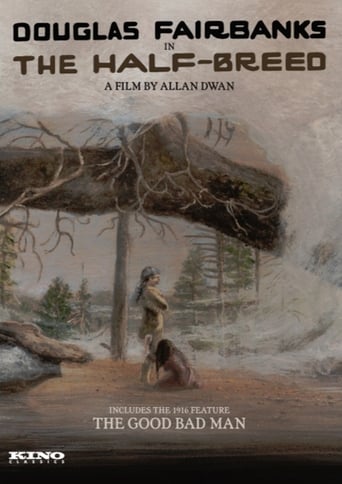
The Good Bad-Man
"Badge of mercy on a wanted man"
Keys: Space play/pause · ←/→ 10s · F fullscreen · M mute · </> speed
About this film
An outlaw calling himself Passin' Through halts his "evil" ways long enough to help out some children in difficulty. Exhibitors circulated the 1916 print in short programs.
Cast & crew
More films like this
More Western films
View all →

More from Allan Dwan
View all →


More about this film
About the production
Release dateMay 21, 1916
ProductionFine Arts Film Company, Triangle Film Corporation
Filmed inCalifornia, Santa Monica Mountains
This film was part of Douglas Fairbanks' contract with Triangle Film Corporation, where he had significant creative control. The production utilized natural outdoor locations extensively, which was typical for Westerns of this era. Fairbanks performed many of his own stunts, showcasing his athletic abilities that would become his trademark. The film was shot during the golden age of silent Westerns when the genre was establishing its conventions.
Themes
Themes & topics
Historical background
The Good Bad-Man reached screens around 1916, produced in its country of origin. Silent-era houses paired such titles with live music and newsreel bills.
Why this film matters
Researchers cite The Good Bad-Man when tracing screen culture of its decade.
Making of
Douglas Fairbanks was deeply involved in the creative process of this film, as he was with most of his Triangle productions. He worked closely with director Allan Dwan to develop the character of Passin' Through, blending elements of the traditional Western outlaw with his own athletic, optimistic screen persona. The filming took place in the rugged terrain of California, where the cast and crew faced challenging weather conditions. Fairbanks insisted on performing his own stunts, including riding sequences and physical confrontations, which was unusual for a star of his magnitude even in that era. The relationship between Fairbanks and Dwan was particularly collaborative, with the two developing a shorthand that would continue through multiple projects. The film's production was relatively quick by modern standards, typical of the fast-paced studio system of the 1910s, with shooting completed in just a few weeks.
What critics said
Reviewers in 1916 weighed The Good Bad-Man on clarity, pacing, and audience response rather than prestige status. No single canonical review dominates later reference works for the title.
Did you know?
- This was one of Douglas Fairbanks' early starring roles before he became known primarily for swashbuckling adventures
- The film was part of a series of Fairbanks Westerns directed by Allan Dwan, including 'The Half-Breed' and 'The Man from Painted Post'
- Fairbanks' character 'Passin' Through' became one of his early signature roles, establishing his persona as the noble outlaw
- The film was shot in the same year that Fairbanks married Mary Pickford, who would become his frequent collaborator
- Triangle Film Corporation, the distributor, was among the leading prestigious studios of the 1910s before its collapse in 1918
- Director Allan Dwan would go on to direct over 400 films in his career, making him especially prolific directors in cinema history
- The film's theme of the criminal with a heart of gold would become a recurring motif in Western cinema
- Sam De Grasse, who plays the antagonist, would later become a frequent villain in Fairbanks' films including 'The Thief of Bagdad'
- The movie was released just as America was entering World War I, reflecting the public's appetite for clear-cut morality tales
- Preservation efforts for this film have been challenging due to the nitrate film stock used during this period
Visual style
The cinematography by Victor Fleming and Harry H. Harris utilized the natural beauty of California's outdoor locations to create authentic Western landscapes. The film employed location shooting extensively, which was relatively innovative for the time, using the Santa Monica Mountains to stand in for the American frontier. The camera work was straightforward but effective, with medium shots capturing the action sequences and close-ups emphasizing Fairbanks' expressive performance. The cinematographers made good use of natural lighting, particularly in outdoor scenes, which gave the film a realistic quality uncommon in many studio-bound productions of the era. The visual style emphasized movement and physical action, with dynamic tracking shots during chase sequences that showcased Fairbanks' athletic abilities. While the techniques were basic by modern standards, they were effective in creating the rugged, authentic atmosphere essential to the Western genre.
Innovations
The Good Bad-Man employed several technical innovations that were advancing cinema in 1916. The film made extensive use of location shooting, which was becoming more feasible as camera equipment became more portable. The production utilized mobile camera units for tracking shots during chase sequences, creating a sense of movement and excitement that enhanced the action. The film's editing techniques, while basic by modern standards, showed improvement in pacing and continuity compared to earlier Westerns. The use of natural lighting for outdoor scenes demonstrated the growing sophistication of cinematography. The film also benefited from advances in film stock quality, allowing for better image clarity and tonal range. While not groundbreaking in any single technical aspect, the film represented the cumulative improvements in filmmaking technology that were transforming cinema from a novelty to a sophisticated art form.
Music
As a silent film, The Good Bad-Man would have been accompanied by live musical performances during its theatrical run. The typical score would have been compiled from popular classical pieces and original compositions performed by theater organists or small orchestras. The music would have varied dramatically to match the on-screen action - tense, dramatic themes during confrontation scenes, romantic melodies for emotional moments, and upbeat, adventurous music during action sequences. Specific musical selections would have varied by theater, as accompanists had considerable freedom in choosing appropriate music. The score would have been crucial in establishing mood and enhancing emotional impact, particularly important given the lack of dialogue. While no original score exists today, reconstruction efforts for silent film screenings typically use period-appropriate music that would have been familiar to 1916 audiences.
Famous quotes
I'm Passin' Through, and that's exactly what I do - pass through
Even an outlaw has his code
These children need protection, and they'll get it from me
There's good in the worst of us, and bad in the best of us
Memorable scenes
- Passin' Through's first encounter with the orphaned children where his hardened exterior begins to crack
- The climactic confrontation between Passin' Through and the corrupt landowners
- The scene where Passin' Through teaches the children how to defend themselves
- The emotional moment when Passin' Through must choose between his gang and protecting the children
- The final redemption scene where Passin' Through embraces his role as protector
What audiences thought
The Good Bad-Man was well-received by audiences in 1916, capitalizing on Douglas Fairbanks' growing popularity and the public's appetite for Westerns. The film performed solidly at the box office, particularly in the American heartland where Western themes resonated most strongly. Audiences responded enthusiastically to Fairbanks' blend of humor, action, and romance, which would become his trademark. The character of Passin' Through proved particularly popular, with viewers drawn to the outlaw's moral complexity and eventual redemption. Moviegoers of the era appreciated the film's clear moral framework and satisfying resolution, which provided comfort during the turbulent period of World War I. The success of this film helped cement Fairbanks' status as one of the era's most bankable stars and demonstrated the commercial viability of feature-length Westerns.
Film connections
Influenced by
- Classic Western literature
- Dime novels
- Earlier film Westerns by D.W. Griffith
- Stage melodramas
- Contemporary social reform movements
This film influenced
- The Half-Breed (1916)
- The Man from Painted Post (1917)
- Subsequent Douglas Fairbanks Westerns
- Later 'noble outlaw' Westerns
- Modern revisionist Westerns
Film restoration
The Good Bad-Man is partially preserved with some reels surviving in film archives. While not completely lost, the film exists in incomplete form, which is common for films from this period. The surviving elements are held by various film archives including the Library of Congress and the Museum of Modern Art. Some portions may exist only in truncated or deteriorated condition due to the instability of nitrate film stock used during this era. Preservation efforts continue, with restoration work attempting to piece together surviving fragments from different sources. The film's incomplete status makes it a valuable but challenging piece for film historians studying early Fairbanks work and the development of the Western genre.
Where to watch
- Film archives with special screenings
- Some public domain streaming platforms
- Film society screenings
- Museum of Modern Art film collection viewings
- Library of Congress screenings
- Specialized classic film streaming services