



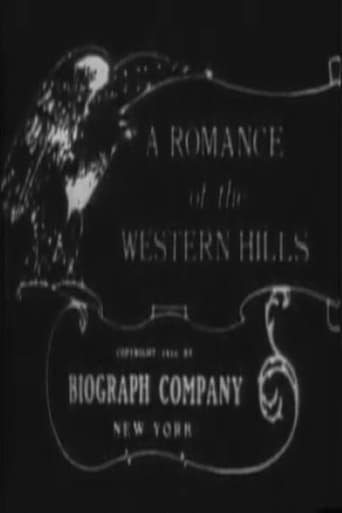
The Goddess of Sagebrush Gulch
"Goddess of Sagebrush Gulch chooses"
Keys: Space play/pause · ←/→ 10s · F fullscreen · M mute · </> speed
About this film
Beloved town beauty chooses between tenderfoot and local prospector Blue-grass Pete. A 1912 mining-camp romance.
Cast & crew
More films like this

More Romance films
View all →





More from D.W. Griffith
View all →
More about this film
About the production
Release dateMarch 25, 1912
ProductionBiograph Company
Filmed inCalifornia, Likely Biograph Studio locations in Los Angeles area
This was one of hundreds of short films D.W. Griffith directed for the Biograph Company during his incredibly prolific period there from 1908-1913. The film was shot on location and in studio, typical of Biograph's production methods. Griffith was known for his efficiency, often completing films in just a few days. The mining town setting was likely created on the studio backlot or at a nearby location that could stand in for the American West.
Themes
Romantic love and competitionHeroism and redemptionBetrayal and loyaltyCivilization versus frontier lawlessnessFemale virtue and beauty
Themes & topics
WesternRomanceMining townLove triangleSnake attackRobbery plotProspectorsFrontier lifeHeroismBetrayalSistersTenderfoot
Historical background
The Goddess of Sagebrush Gulch (1912) reached audiences during the nickelodeon era, when exhibitors mixed shorts and features on the same program.
Why this film matters
Historians retain The Goddess of Sagebrush Gulch as a record of how filmmakers in 1912 addressed popular genres.
Making of
The production of 'The Goddess of Sagebrush Gulch' typified D.W. Griffith's work method at Biograph during this period. He was known for his meticulous planning and ability to shoot quickly while maintaining quality. Griffith often used natural locations around California to stand in for various American settings, taking advantage of the state's diverse landscapes. The cast would have worked long days in period costumes, with minimal special effects beyond practical ones like the prop snake. Griffith was already experimenting with camera techniques that would become more sophisticated in his later work, including varying shot sizes and camera angles. The film would have been accompanied by live music in theaters, either piano or organ, with cue sheets provided to musicians to guide their accompaniment. The entire production likely took only a few days from start to finish, reflecting the incredible efficiency of the studio system Griffith helped pioneer.
What critics said
Trade coverage from 1912 treated The Goddess of Sagebrush Gulch as program material; later writers evaluate it through preservation and genre context.
Did you know?
- the release was released during D.W. Griffith's most productive period at Biograph, where he directed over 450 short films between 1908-1913.
- Blanche Sweet, who played 'The Goddess,' was one of Griffith's favorite actresses and would go on to star in his controversial masterpiece 'The Birth of a Nation' (1915).
- The film features Griffith's early development of cross-cutting techniques to build suspense during dramatic sequences.
- Like many films of this era, 'The Goddess of Sagebrush Gulch' was likely shot on 35mm film at approximately 16 frames per second.
- The Biograph Company refused to credit actors or directors in their films during this period, so audiences wouldn't have known Griffith directed it or the names of the stars.
- the release represents Griffith's contribution to the Western genre, which he helped develop with innovations in location shooting and narrative complexity.
- The title 'Goddess of Sagebrush Gulch' reflects the melodramatic naming conventions common in early cinema.
- Dorothy Bernard, who played the sister, was the daughter of stage star Maurice Barrymore and thus part of the famous Barrymore acting family.
- The snake scene would have been particularly daring for 1912 audiences, representing one of the more thrilling sequences in early Western cinema.
- the release was released just three years before Griffith would revolutionize cinema with his feature-length epics 'The Birth of a Nation' and 'Intolerance.'
Visual style
The cinematography in 'The Goddess of Sagebrush Gulch' reflects the state of the art in 1912, with G.W. Bitzer likely serving as cinematographer, as he did for many of Griffith's Biograph films. The visual style would have included static camera positions typical of the era, but Griffith was already experimenting with varying shot distances from long shots establishing the mining town setting to medium shots for character interactions. The outdoor sequences would have taken advantage of natural lighting, while interior scenes used artificial lighting that was becoming more sophisticated. The camera work would have been functional rather than flashy, focusing on clearly presenting the story rather than creating visual artistry for its own sake. The composition would follow theatrical conventions, with actors positioned to maximize visibility and dramatic impact.
Innovations
While 'The Goddess of Sagebrush Gulch' doesn't feature groundbreaking technical innovations, it represents the refinement of techniques that Griffith had been developing. The film demonstrates Griffith's mastery of cross-cutting to build suspense and parallel action, particularly during the robbery sequence. The use of location shooting combined with studio work shows the industry's move toward more realistic settings. Griffith was also becoming more sophisticated in his use of camera placement and movement within the constraints of 1912 technology. The film's relatively long 17-minute runtime for a single reel shows the gradual expansion of narrative complexity in early cinema. These technical elements, while individually modest, collectively contributed to the evolution of cinematic language.
Music
As a silent film, 'The Goddess of Sagebrush Gulch' would have been accompanied by live music during its theatrical run. Theaters typically provided either piano or organ accompaniment, with larger venues employing small orchestras. Biograph would have distributed cue sheets with the film, suggesting appropriate musical pieces for different scenes - romantic themes for the love scenes, tense music for the snake attack, and dramatic music for the robbery plot. The accompaniment would have drawn from popular classical pieces, folk tunes, and specially composed photoplay music that was being developed during this period. The music would have been crucial in establishing mood and enhancing the emotional impact of the story, compensating for the lack of synchronized sound.
Famous quotes
Silent film intertitles are not widely documented for this specific film, but would have included dialogue advancing the romantic plot and dramatic situations.
Memorable scenes
- The dramatic snake attack sequence where Blue-grass Pete saves The Goddess, representing a key moment of heroism that establishes their romantic connection. This scene would have provided thrilling entertainment for 1912 audiences and demonstrated Griffith's ability to create suspenseful action sequences within the constraints of early cinema technology.
What audiences thought
Audiences in 1912 would have received 'The Goddess of Sagebrush Gulch' as part of a varied program of short films, newsreels, and possibly a live vaudeville act. The combination of Western setting, romantic elements, and dramatic action would have appealed to the broad entertainment tastes of nickelodeon audiences. Griffith's films were consistently popular during his Biograph period, helping establish him as among the leading reliable directors in the industry. The film's romantic plot and thrilling snake scene would have provided the emotional and sensational elements that early cinema audiences craved. While specific audience reactions to this particular film are not documented, the ongoing popularity of Griffith's work during this period suggests it was well-received by contemporary viewers.
Film connections
Influenced by
- Stage melodramas of the late 19th century
- Contemporary Western literature
- Earlier Biograph Westerns
- Griffith's own previous films exploring similar themes
- Theatrical traditions of clear moral storytelling
This film influenced
- Later D.W. Griffith Westerns
- The development of romantic Western subgenre
- Biograph Westerns by other directors
- The broader evolution of Western film conventions
Film restoration
The preservation status of 'The Goddess of Sagebrush Gulch' is not definitively documented, which is common for many Biograph shorts from this period. Many of Griffith's Biograph films survive in archives, particularly the Library of Congress and the Museum of Modern Art, but some remain lost or exist only in fragmentary form. Given that this is a relatively known Griffith title from his Biograph period, there's a possibility it survives in film archives or private collections. The film would have been shot on highly flammable nitrate stock, making preservation challenging. Any surviving prints would likely require restoration due to the natural deterioration of early film stock.
Where to watch
- Due to its age and status as a Biograph short, 'The Goddess of Sagebrush Gulch' is not readily available on commercial streaming platforms. Potential viewing options include: The Library of Congress's online collections (if preserved), The Museum of Modern Art's film archives, Specialized film archive screenings, University film collections with early cinema holdings, Potentially as an extra on DVD releases of Griffith's collected works