

The Grim Game
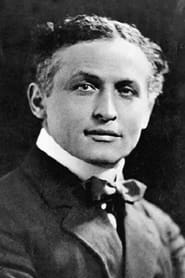
"Houdini escapes prison to clear his name"
Keys: Space play/pause · ←/→ 10s · F fullscreen · M mute · </> speed
About this film
Jailed unjustly for a murder he did not commit, a young man uses his amazing powers of escape to free himself and pursue the actual killers, who hold his fiancée captive.
Cast & crew
More films like this
More Adventure films
View all →

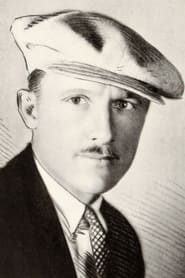
More from Irvin Willat
View all →
More about this film
About the production
Release dateMarch 30, 1919
Box officeUnknown - but was considered a commercial success for Houdini Pictures Corporation
ProductionHoudini Pictures Corporation, Famous Players-Lasky Corporation
Filmed inLos Angeles, California, New York City, New York
The film featured real death-defying stunts performed by Houdini himself, including a famous scene where two airplanes collided mid-air during filming. The collision was unplanned but captured on film and used in the final cut. Houdini insisted on performing all his own stunts, which was unusual even for action stars of the era. The production was rushed to capitalize on Houdini's fame as the world's greatest escape artist.
Themes
Justice vs. InjusticeFreedom and ConfinementTruth vs. DeceptionMastery over Physical LimitationsPerseverance Against Adversity
Themes & topics
wrongful imprisonmentescape artistframed for murderkidnappingaerial sequencesdeath-defying stuntsstraitjacket escapeplane crashpursuitrescue
Historical background
Made in 1919, The Grim Game reflects production norms of the silent era before feature-length dominance—shorter runtimes, regional audiences, and limited preservation infrastructure.
Why this film matters
Historians reference The Grim Game (1919) when discussing 1919 film directed by Irvin Willat.
Making of
The production of 'The Grim Game' was marked by Houdini's intense involvement in every aspect of filmmaking. He personally selected Irvin Willat as director after being impressed with his technical skills. Houdini refused to use stunt doubles and insisted on performing all escape sequences himself, much to the concern of the studio's insurance underwriters. The most famous incident occurred during the aerial sequence when two stunt planes collided mid-air; miraculously, both pilots survived with minor injuries, and Houdini immediately insisted the footage be included in the film. The production was plagued by delays as Houdini would often stop filming to perform live escape demonstrations for curious onlookers and press. The script underwent numerous revisions to better showcase Houdini's specific talents, with writers constantly inventing new scenarios that would require increasingly elaborate escapes.
What critics said
Trade and revival screenings have kept The Grim Game (1919) on the map for collectors and scholars rather than mass first-run promotion.
Did you know?
- The mid-air plane collision during filming was completely accidental but was so dramatic that it was incorporated into the movie's promotion, with advertisements claiming 'The plane crash that wasn't faked!'
- Houdini performed all his own stunts, including being suspended from buildings and escaping from straitjackets while hanging upside down
- This was the first of several films Houdini made for his own production company, Houdini Pictures Corporation
- The film was originally titled 'The Mystery of the Double Death' before being changed to 'The Grim Game'
- Houdini reportedly earned $10,000 per week for his film work, equivalent to over $150,000 in today's money
- The movie's success led to Houdini receiving a star on the Hollywood Walk of Fame (though the Walk wasn't created until decades later)
- A young Boris Karloff appears briefly as an extra in one of the prison scenes
- The film's advertising emphasized that Houdini's escapes were genuine and not camera tricks
- Houdini's wife Bess served as a consultant on the film and appeared in a small uncredited role
- The straitjacket escape from the prison wall was performed in one continuous take with no cuts
Awards & recognition
- No major awards were given for this film during the silent era
Visual style
The cinematography by Arthur Edeson employed innovative techniques for capturing action sequences, including dynamic camera movement during chase scenes and creative angles for the escape sequences. The film utilized multiple cameras to capture Houdini's stunts from various perspectives, a relatively advanced technique for the time. The aerial sequences required specially mounted cameras on planes to capture the thrilling footage. The prison escape scenes used dramatic lighting to emphasize the claustrophobic conditions and Houdini's struggle. The cinematography successfully balanced the need to clearly show Houdini's escape techniques with creating atmospheric tension throughout the narrative.
Innovations
The film featured groundbreaking stunt photography, particularly in its aerial sequences which required innovative camera mounting techniques on aircraft. The accidental plane collision footage represents one of the earliest examples of capturing real aerial disaster on film. The production developed specialized rigging systems for Houdini's escape sequences that allowed cameras to capture his techniques from multiple angles while maintaining the illusion of danger. The film employed early forms of continuity editing to maintain suspense across complex action sequences. The straitjacket escape scene was particularly innovative, using a camera technique that allowed the entire escape to be filmed in what appeared to be a single take.
Music
As a silent film, 'The Grim Game' was accompanied by live musical performances in theaters. The original score was composed by William Furst and featured dramatic orchestral pieces that heightened the tension during escape sequences. Theater organists were provided with detailed cue sheets that suggested specific musical themes for different characters and situations. The music incorporated popular melodies of the era alongside classical compositions to appeal to contemporary audiences. The score emphasized percussive elements during action sequences and romantic themes for scenes with Houdini's love interest. Modern restorations have been accompanied by newly composed scores that attempt to capture the spirit of the original accompaniment while utilizing modern orchestral techniques.
Famous quotes
The locks that hold men are not made of steel, but of fear.
What seems impossible to the many is merely a puzzle to the determined.
Freedom is not given, it must be taken.
The greatest prison is the one we build in our own minds.
Memorable scenes
- The mid-air plane collision sequence that was accidentally captured during filming and became a major promotional point for the movie
- Houdini's straitjacket escape while suspended upside down from the prison wall, performed in what appeared to be one continuous take
- The underwater escape sequence where Houdini frees himself from chains while submerged in a locked tank
- The climactic final escape where Houdini must free himself and his fiancée from a death trap before time runs out
What audiences thought
Audiences in 1919 were enthralled by the film, with theaters reporting sell-out crowds and extended runs. The combination of Houdini's established fame and the film's spectacular stunts created tremendous word-of-mouth buzz. Many viewers attended multiple times to try and figure out how Houdini performed his escapes, though the film maintained the secrecy of his methods. The accidental plane crash became a major talking point and drew even larger crowds. Contemporary newspaper accounts described audiences gasping and cheering during the escape sequences. The film's success led to increased demand for Houdini's subsequent pictures and established him as a bona fide movie star.
Film connections
Influenced by
- The Great Train Robbery (1903)
- The Prisoner of Zenda (1913)
- The Perils of Pauline (1914)
- Douglas Fairbanks action films
This film influenced
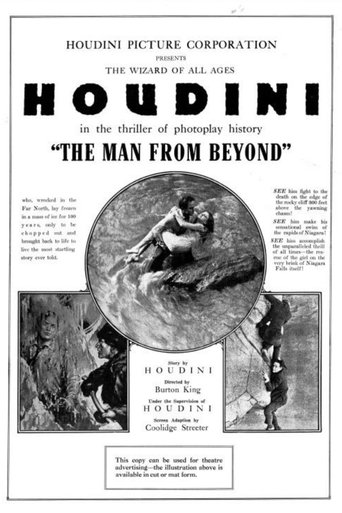
- Houdini's subsequent films including 'Terror Island' and 'The Man from Beyond'
- Later escape films such as 'The Great Escape' (1963)
- Modern action films featuring death-defying stunts
Film restoration
For decades, 'The Grim Game' was considered a lost film, with only fragments known to exist. In 2015, a nearly complete 35mm print was discovered by film preservationist Rick Schmidlin at the Library of Congress. The film has since been restored by the Academy Film Archive and the Library of Congress, with missing scenes reconstructed from production stills and title cards. The restored version premiered at the TCM Classic Film Festival in 2015 and has been screened at various film festivals and archives since. The restoration preserved the original tints and toning used in the 1919 release.
Where to watch
- The restored version is occasionally screened at film festivals and special events
- Available on DVD/Blu-ray from specialty distributors like Kino Lorber
- Streaming on The Criterion Channel during special programming
- Available for viewing at the Library of Congress and major film archives
- Some public domain versions may be found on internet archives, though quality varies significantly