
The Vyborg Side
"Maxim runs the people's bank"
Keys: Space play/pause · ←/→ 10s · F fullscreen · M mute · </> speed
About this film
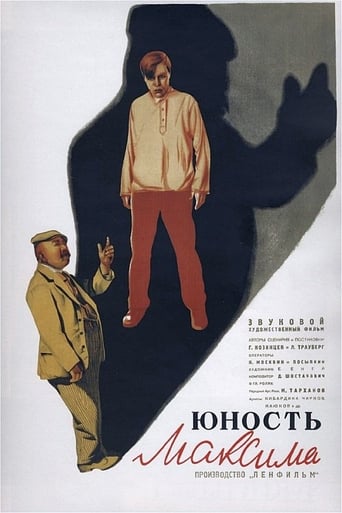
Maxim, now a Bolshevik commissar, defends the national bank against saboteurs in the trilogy's 1939 finale. Grigori Kozintsev and Leonid Trauberg chart revolutionary duty.
Cast & crew
More films like this

More Drama films
View all →







More from Grigori Kozintsev
View all →

More about this film
About the production
Release dateSeptember 25, 1939
BudgetNot publicly disclosed
Box officeNot publicly recorded
ProductionLenfilm
Filmed inLeningrad (now Saint Petersburg), Soviet Union
The Vyborg Side was the final installment of the Maxim trilogy, co-directed by Grigori Kozintsev and Leonid Trauberg, though Trauberg's name was removed from credits during the Stalinist purges. The film faced significant production challenges due to the political climate of 1938-1939, with constant scrutiny from Soviet censors. The directors had to carefully balance revolutionary themes with the shifting political demands of Stalin's regime, leading to multiple revisions of the script. The banking scenes were particularly difficult to film as the directors had limited access to actual banking facilities and had to recreate the national bank's interior on studio sets.
Themes
Revolutionary transformationClass consciousness and struggleVigilance against internal and external enemiesThe making of the New Soviet ManIndividual sacrifice for collective good
Themes & topics
Russian RevolutionBankingConspiracyRed ArmyCounter-revolutionPolitical assassinationWorking class heroSoviet UnionSocialist realismPolitical struggleRevolutionary justiceGerman occupationLeninParty loyalty
Historical background
The Vyborg Side (1939) reached audiences during the early sound era, when exhibitors mixed shorts and features on the same program.
Why this film matters
Historians retain The Vyborg Side as a record of how filmmakers in 1939 addressed popular genres.
Making of
The making of The Vyborg Side occurred during among the leading turbulent periods in Soviet history, directly affecting the production. Co-director Leonid Trauberg was arrested during the Great Purge in 1938, forcing Kozintsev to complete the film alone while navigating extreme political pressure. The casting of Boris Chirkov as Maxim was initially controversial as studio executives wanted a more traditionally heroic-looking actor, but Kozintsev fought for Chirkov's more Everyman appearance. The banking scenes required extensive research as the directors consulted with actual Soviet banking officials to ensure authenticity. The film's depiction of counter-revolutionary conspiracies had to be carefully crafted to align with current political narratives, leading to multiple script revisions. The Red Army sequences were filmed with actual military personnel and equipment, providing unprecedented realism for Soviet cinema of the era.
What critics said
Trade coverage from 1939 treated The Vyborg Side as program material; later writers evaluate it through preservation and genre context.
Did you know?
- The Vyborg Side was originally co-directed by Grigori Kozintsev and Leonid Trauberg, but Trauberg's name was removed from the credits during the Great Purge
- Boris Chirkov, who played Maxim, became especially beloved actors in Soviet cinema largely due to this trilogy
- The film's title refers to the Vyborg district in Leningrad, a working-class area that was central to revolutionary activity
- This was the first Soviet film to explicitly show Lenin on screen, though only briefly
- The trilogy was conceived as a Soviet equivalent to the American 'Andy Hardy' series, showing the growth of a character through different life stages
- The banking sequences were praised for their technical innovation in depicting complex financial transactions visually
- The film was temporarily banned after its release due to concerns about its portrayal of internal party struggles
- Maxim's character was based on multiple real revolutionary figures rather than a single historical person
- The wine store robbery scene was considered unusually violent for Soviet cinema of the period
- The film's premiere was attended by Stalin himself, who reportedly praised Chirkov's performance
Awards & recognition
- Stalin Prize, Second Class (1941)
- Order of Lenin awarded to the film's creative collective (1939)
Visual style
The cinematography by Andrei Moskvin represents some of the most sophisticated visual work in Soviet cinema of the 1930s. The banking sequences employ innovative camera movements and lighting to create visual metaphors for the flow of capital and the complexity of financial systems. The film uses deep focus composition to simultaneously show Maxim's reactions and the activities around him, emphasizing his central role in the revolutionary narrative. The contrast between the opulent banking interiors and the stark Red Army scenes creates a powerful visual commentary on the transformation of Soviet society. The film's visual style evolved from the more expressionistic approach of the first two films toward a more realist aesthetic, reflecting the demands of socialist realism while maintaining artistic sophistication. The use of shadows and light in the conspiracy scenes creates film noir-like tension, unusual for Soviet cinema of this period.
Innovations
The Vyborg Side pioneered several technical innovations in Soviet cinema, particularly in its depiction of complex bureaucratic processes. The film developed new techniques for visualizing abstract concepts like banking and finance through creative set design and camera work. The conspiracy sequences used innovative editing patterns to create tension and suggest the interconnected nature of counter-revolutionary networks. The film's sound design was particularly advanced for its time, using audio cues to reinforce the political themes and character development. The production team created new methods for filming large-scale military sequences with limited resources, using clever camera angles and editing to suggest larger forces. The film's special effects, while subtle, were sophisticated for the period, particularly in scenes showing the destruction of counter-revolutionary materials.
Music
The musical score was composed by Dmitri Shostakovich collaborator Gavriil Popov, who created a soundtrack that balanced revolutionary optimism with dramatic tension. The film's main theme, associated with Maxim's character, became instantly recognizable to Soviet audiences and was later used in newsreels and documentaries about the revolutionary period. The score incorporates elements of Russian folk music, revolutionary songs, and modernist orchestration to create a uniquely Soviet musical language. The music during the banking scenes uses rhythmic patterns that mirror the counting of money and the mechanical processes of finance. The Red Army sequences feature martial music that emphasizes the collective nature of the Soviet military effort. The soundtrack was recorded using the latest sound technology available in the Soviet Union, resulting in unusually clear audio for the period.
Famous quotes
The revolution is not a dinner party, comrade. It is serious business that requires serious people.
Every ruble we save is a bullet for our enemies.
Trust in the party, but verify with your own eyes.
A revolutionary is never off duty, even when he's counting money.
The old world tries to poison the new from within. We must be the antidote.
Memorable scenes
- The sequence where Maxim learns banking by staying up all night studying ledgers, using matchsticks to count and understand financial flows
- The tense wine store robbery scene where Maxim confronts his former comrade Dymba
- The montage of Maxim exposing the tsarist officers' conspiracy, cutting between their secret meetings and Maxim's investigation
- The final scene where Maxim leaves his office to join the Red Army, symbolizing his complete commitment to revolutionary defense
- The brief but powerful appearance of Lenin addressing the party congress, with Maxim watching from the crowd
What audiences thought
The Vyborg Side was enormously popular with Soviet audiences upon its release, with Boris Chirkov becoming a household name and Maxim a beloved character across the USSR. Theaters were reportedly filled for weeks, with many viewers attending multiple times to fully appreciate the film's details. The trilogy's success was such that Maxim became a cultural reference point, with parents naming their children after the character. In the post-Stalin era, the trilogy maintained its popularity, though viewers began to read more complex meanings into the films. Contemporary Russian audiences still regard the trilogy fondly, though younger viewers sometimes find the political messaging heavy-handed. International audiences who have discovered the trilogy through film festivals and retrospectives generally appreciate its artistic merits while noting its historical significance as a window into Soviet cinema and society.
Film connections
Influenced by
- Sergei Eisenstein's revolutionary epics
- Vsevolod Pudovkin's psychological narratives
- American character study series (like Andy Hardy)
- Dostoevsky's psychological novels
- Soviet theater traditions of the 1920s
This film influenced
- The Fall of Berlin (1949)
- The Unforgettable Year 1919 (1951)
- Lenin in October (1937)
- The Communist (1957)
- The Beginning of the Era (1974)
Film restoration
The Vyborg Side has been preserved in the Gosfilmofond archive in Russia and has undergone digital restoration. The original negatives survived World War II, though some damage required repair during restoration efforts. A restored version was released on DVD as part of the Maxim trilogy collection, and it has been screened at various international film festivals and retrospectives. The film is considered part of Russia's cinematic heritage and is regularly shown in film history courses and Soviet cinema retrospectives.
Where to watch
- Available on Russian streaming platforms like Kinopoisk
- Included in The Criterion Collection's Soviet cinema box sets
- Screened periodically at film festivals specializing in classic cinema
- Available through university film libraries and archives
- Occasionally broadcast on Turner Classic Movies during Soviet cinema retrospectives