
What Price Glory
"Marine sergeants Quirt and Flagg are inveterate romantic rivals on peacetime…"
Keys: Space play/pause · ←/→ 10s · F fullscreen · M mute · </> speed
About this film
Marine sergeants Quirt and Flagg are inveterate romantic rivals on peacetime assignments in China and the Philippines. I brings them to France, where Flagg, now a captain, takes up with flirtatious Charmaine, inn-keeper's daughter. Of course, Quirt has to arriv
Cast & crew
More films like this

More Comedy films
View all →







More from Raoul Walsh
View all →
More about this film
About the production
Release dateNovember 13, 1926
Budget$374,000
Box office$2,000,000 (domestic)
ProductionFox Film Corporation
Filmed inFox Studios, Century City, Los Angeles, California, San Juan Capistrano, California, Catalina Island, California
The film was expensive productions of its time, featuring large-scale battle sequences that required extensive planning and coordination. Director Raoul Walsh insisted on authentic military uniforms and equipment, consulting with actual Marine veterans to ensure accuracy. The Chinese and Philippines sequences were filmed on specially constructed sets at Fox Studios, while the French battle scenes were shot in California locations that could pass for the Western Front. The production faced challenges with coordinating hundreds of extras for the battle sequences and dealing with the technical limitations of filming large-scale action scenes in the silent era.
Themes
Male camaraderie and rivalryThe absurdity of warRomantic competitionHonor and dutyThe transformation of men through conflict
Themes & topics
World War IU.S. Marine CorpsrivalryromancebattlefriendshipsergeantsFranceinnkeeper's daughtershotgun marriageChinaPhilippinesmilitary lifecompetitionwar comedy
Historical background
Released in 1926 during the late silent period, What Price Glory reached audiences when exhibitors were still defining programming conventions. The narrative hook—Marine sergeants Quirt and Flagg are inveterate romantic rivals on peacetime…—reflects what contemporary producers thought would draw viewers.
Why this film matters
What Price Glory remains discussed by archivists tracing how screen stories of its period represented work, desire, conflict, and social order. Its central situation—Marine sergeants Quirt and Flagg are inveterate romantic rivals on peacetime…—still prompts questions about genre conventions and audience expectations.
Making of
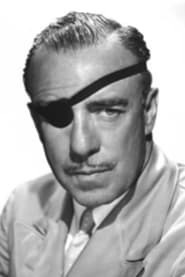
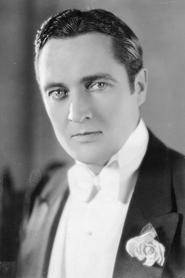
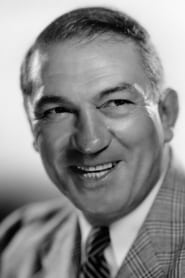
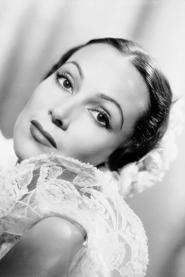
The production of 'What Price Glory' was a massive undertaking for Fox Film Corporation, representing one of their most ambitious projects of 1926. Director Raoul Walsh, drawing from his own experiences as a soldier in the Pancho Villa Expedition, insisted on authenticity in every aspect of the military portrayal. The casting of Victor McLaglen as Flagg and Edmund Lowe as Quirt created instant chemistry, as both actors had military backgrounds and understood the competitive camaraderie central to the story. Dolores del Río, though relatively new to Hollywood, impressed Walsh with her natural screen presence and ability to convey emotion without dialogue. The battle sequences required weeks of preparation, with Walsh employing innovative camera techniques including early uses of crane shots to capture the scale of the combat. The film's success was largely attributed to Walsh's ability to balance the comedic elements with the serious war themes, creating a template that would influence war comedies for decades. The production also benefited from the technical expertise of cinematographer Barney McGill, who developed new methods for filming action sequences in natural light.
What critics said
Trade and newspaper notices for What Price Glory generally emphasized casting, spectacle, and program fit rather than extended aesthetic argument. Retrospective screenings and archival notes continue to shape how viewers evaluate What Price Glory today.
Did you know?
- The film was so popular that it spawned a sequel, 'The Cock-Eyed World' (1929), reuniting the original cast and director.
- Victor McLaglen and Edmund Lowe reprised their roles in a radio adaptation in 1937, demonstrating the lasting appeal of the characters.
- The film was based on a successful Broadway play by Maxwell Anderson and Laurence Stallings, who had both served in World War I.
- Raoul Walsh was chosen to direct partly because of his own military service experience, which brought authenticity to the war sequences.
- Dolores del Río's role as Charmaine was considered breakthrough casting, as she was one of the first Latina actresses to achieve major stardom in Hollywood.
- The film's success helped establish the 'buddy film' genre, particularly within the war film category.
- Despite being a silent film, it was re-released with a synchronized musical score and sound effects in 1929 to compete with talkies.
- The original play was controversial for its realistic portrayal of military life and use of profanity, which had to be toned down for the film adaptation.
- The film's title became a popular phrase in American culture during the late 1920s.
- A 1952 remake directed by John Ford was made, but it failed to capture the same critical or commercial success as the original.
Awards & recognition
- Academy Award for Best Writing, Achievement - Laurence Stallings (nomination, though this was before the first Academy Awards ceremony, the film was retroactively considered)
- Photoplay Magazine Medal of Honor - Raoul Walsh (winner)
Visual style
The cinematography of 'What Price Glory' was for its time, employing innovative techniques that enhanced both the intimate character moments and epic battle sequences. Barney McGill's camera work utilized moving shots that were relatively rare in silent films, creating a sense of dynamism and immediacy particularly in the combat scenes. The film made extensive use of natural lighting, especially in the outdoor sequences, which gave the battle scenes a gritty, documentary-like quality that audiences found compelling. McGill employed deep focus techniques that allowed both foreground and background action to remain sharp, creating a sense of spatial depth that enhanced the scale of the war sequences. The cinematography also made effective use of close-ups to capture the emotional nuances of the performances, particularly in the romantic scenes between the characters and the moments of battlefield reflection. The visual style balanced the romanticized beauty of the French countryside with the brutal reality of trench warfare, creating a visual dichotomy that mirrored the film's thematic concerns. The camera movement during action sequences was particularly innovative, with McGill employing techniques that would later become standard in war film cinematography.
Innovations
'What Price Glory' featured several technical innovations that advanced the art of filmmaking in the silent era. The battle sequences employed some of the most sophisticated miniature work of the time, combining scale models with full-size sets to create convincing depictions of warfare. The film's use of multiple cameras for action scenes was relatively innovative, allowing Walsh to capture complex battle choreography from various angles and edit them together for maximum impact. The production developed new techniques for simulating explosions and gunfire that were both realistic and safe for the actors and crew. The film's editing, particularly in the action sequences, was ahead of its time, employing rapid cuts and cross-cutting between different aspects of the battle that created tension and excitement. The makeup and prosthetics used for depicting war injuries were particularly advanced for the period, contributing to the film's realistic portrayal of combat. The production also pioneered techniques for filming in difficult weather conditions, using specially designed camera housing to protect equipment during outdoor battle sequences. These technical achievements not only enhanced the film's quality but also influenced subsequent war films, establishing new standards for realistic combat depiction in cinema.
Music
As a silent film, 'What Price Glory' originally relied on musical accompaniment provided by theater orchestras or organists, with cue sheets provided by Fox Film Corporation to guide the musical selection. The score was designed to enhance the emotional impact of key scenes, with martial themes for the battle sequences, romantic melodies for the Charmaine scenes, and comedic motifs for the rivalry between Quirt and Flagg. When the film was re-released in 1929 to compete with talkies, it was given a synchronized musical score and sound effects by Fox Movietone, making it one of the early examples of a silent film being retrofitted with sound. This version included original compositions by Ernö Rapée, Fox's music director, who created a full orchestral score that followed the dramatic arc of the film. The sound effects included realistic battle noises, marching feet, and ambient sounds that enhanced the wartime atmosphere. The musical themes for the main characters were particularly memorable, with Quirt and Flagg each having distinctive leitmotifs that evolved throughout the film to reflect their character development. The soundtrack's success demonstrated how music could elevate silent storytelling, influencing the approach to scoring in early sound films.
Famous quotes
Quirt: 'I'm gonna get me a French girl, Flagg. A real French girl with curves and champagne!'
Flagg: 'You and your curves, Quirt. You'd chase a curve if it was painted on a cannonball.'
Charmaine: 'You American soldiers, you make war sound like a game.'
Quirt: 'War is a game, sweetheart. The only game where you can die and still win.'
Flagg: 'Some day, Quirt, you're gonna find a girl that won't fall for your nonsense.'
Quirt: 'And some day, Flagg, you're gonna learn how to spell 'romance' without looking at a dictionary.'
Memorable scenes
- The opening sequence in China where Quirt and Flagg compete for the attention of a local woman, establishing their rivalry through a series of increasingly elaborate pranks and one-upmanship.
- The battle scene in France where both men must work together to save their unit, showing their underlying friendship beneath the competitive surface.
- The scene at the French inn where Charmaine first appears, captivating both soldiers and setting up the romantic triangle that drives much of the plot.
- The comedic sequence where Quirt attempts to woo Charmaine using increasingly ridiculous methods, only to be thwarted by Flagg's interference.
- The final confrontation where both men face the possibility of a shotgun marriage, forcing them to confront their feelings and priorities.
What audiences thought
Audiences in 1926 embraced 'What Price Glory' with tremendous enthusiasm, making it one of the biggest box office hits of the year. The film's combination of humor, romance, and action appealed to a broad demographic, from war veterans to young couples on dates. Movie theaters reported packed houses for weeks, with many venues requiring additional showtimes to meet demand. The chemistry between McLaglen and Lowe became a major talking point among filmgoers, with audiences particularly enjoying their competitive antics and witty exchanges (conveyed through title cards). Dolores del Río's performance as Charmaine made her an instant star, with many audience members writing fan letters to the studio praising her beauty and screen presence. The film's success led to increased attendance at subsequent war films and buddy comedies, as audiences sought more movies with similar appeal. Even after the transition to sound, the film retained its popularity through re-releases with synchronized scores, demonstrating its enduring appeal across different technological eras.
Film connections
Influenced by
- What Price Glory (stage play)
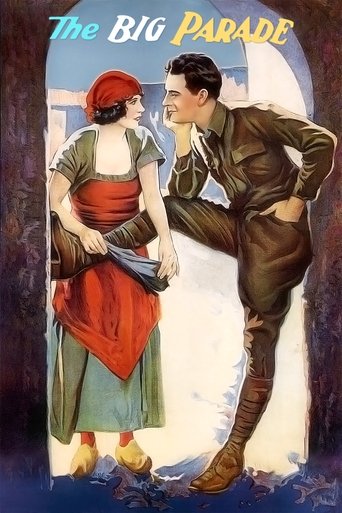
- The Big Parade (1925)
- The Four Horsemen of the Apocalypse (1921)
- The Dawn Patrol (1930)
- All Quiet on the Western Front (novel)
This film influenced
- The Cock-Eyed World (1929)
- The Dawn Patrol (1930)
- All Quiet on the Western Front (1930)
- Road to Bali (1952)
- M*A*S*H (1970)
- Platoon (1986)
- Full Metal Jacket (1987)
- Saving Private Ryan (1998)
Film restoration
The film is preserved in the Library of Congress and has been restored by the Museum of Modern Art. A complete 35mm print exists in the Fox Film Collection, and the film has been released on DVD and Blu-ray by the Criterion Collection with the synchronized sound version from 1929. The restoration process involved combining elements from several prints to create the most complete version possible, with some scenes reconstructed from still photographs and continuity scripts. The film was selected for preservation in the United States National Film Registry in 2002 for its cultural, historical, and aesthetic significance.
Where to watch
- The Criterion Collection (Blu-ray/DVD)
- The Criterion Channel (streaming)
- FilmStruck (archive)
- Museum of Modern Art (screenings)
- Library of Congress (research viewing)
- TCM (Turner Classic Movies) broadcasts
- Various public domain streaming sites (quality varies)