Love's Surprises
Plot
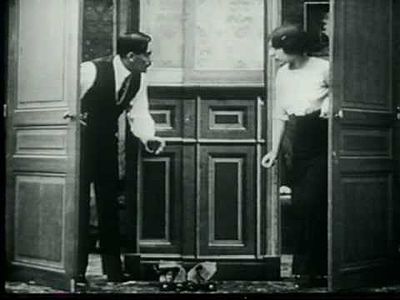
A husband, his wife, and their two sons sit down to a family meal, but the domestic routine quickly turns into a comic tale of concealment and rivalry. One son feigns illness, slips away to retrieve flowers from a cupboard, and heads out to court the same young woman his brother is also visiting. The other son follows suit with his own hidden bouquet, and their father, unsuspectingly or perhaps not entirely innocently, imitates them by leaving with flowers as well. As each man arrives at the young woman's home, he must hide the previous suitor in an improvised hiding place: one under a chair cover, one inside a cupboard, and one in a piano. The situation becomes even more absurd when a girlfriend of the young woman arrives and, realizing what is going on, playfully torments the hidden men by using the piano and chair to unsettle them, until all three are exposed and the father chases his sons outside; in the end, he recognizes his own misconduct, pacifies them with money, and demands their silence.
Director
Max LinderAbout the Production
This is a very short French silent comedy made at the height of Max Linder's early career, when he was developing the refined, situation-based screen persona that made him internationally famous. As with many films from the period, detailed production records are scarce, and specific crew, locations, and financing information are not reliably documented in surviving sources. The film relies on economical staging, a small number of sets, and clearly choreographed physical business, all typical of early one-reel comedies designed to be understood immediately by audiences without intertitles carrying complex narrative weight. Its humor depends on escalating reversals, concealment, and the clash between family authority and romantic misbehavior, all of which were central to Linder's comic style.
Historical Background
Love's Surprises was made in 1909, a period when cinema was rapidly evolving from novelty entertainment into a recognizable narrative art form. In France, companies such as Pathé and Gaumont were producing large numbers of short comedies, melodramas, and actualities for an expanding international market, and comic shorts like this one played a major role in teaching audiences how to follow repeated visual motifs and escalating situations. Max Linder was one of the earliest film comedians to build a durable persona: urbane, vain, stylish, and vulnerable to romantic embarrassment. That matters historically because his screen style helped shape later comic performers, including the idea of a recurring comic character whose personality could carry multiple films. The film also reflects early twentieth-century social attitudes toward courtship, family authority, and gender roles, presenting them through a farcical lens that was widely accessible to contemporary audiences.
Why This Film Matters
Although Love's Surprises is a small-scale short film, it belongs to a crucial phase in the development of screen comedy. Max Linder's work is often cited by film historians as foundational to the later language of comic characterization, particularly the blend of sophistication and humiliation that would reappear in later comedians from Charlie Chaplin to Harold Lloyd and beyond. The film's structure—repetition, concealment, reversal, and the exposure of hypocritical behavior—demonstrates how early cinema could create sophisticated comic meanings with very limited resources. Its historical value today lies less in plot novelty than in what it reveals about the evolution of performance, timing, and visual storytelling at a formative moment in cinema history.
Making Of
Very little production documentation survives for this film, which is typical of small French comedies from the late 1900s. What can be inferred from the film's structure is that it was designed around a tightly blocked series of visual gags, requiring careful timing from the actors so that the successive entrances, concealments, and reveals would remain legible. Max Linder, already developing his signature on-screen elegance and comic vanity, appears to have been central not only as performer but as the creative force organizing the film's rhythm, a role he often occupied in his early work. The film's domestic setting would have allowed production to remain simple and economical, with emphasis placed on movement, gesture, and the furniture-based hiding routines that drive the comedy. The father-and-sons dynamic also suggests a deliberately staged moral punchline, a pattern that was common in early farce and gave comedians a way to include social satire without dialogue.
Visual Style
The film likely uses the straightforward, tableau-based visual style common to 1909 silent cinema, with a static or minimally mobile camera positioned to capture the entire action area clearly. The comedy depends on spatial clarity, so the arrangement of doors, furniture, and hiding places is central to the visual design. Early silent staging of this kind typically favored medium-wide framing so that entrances, exits, and concealments could be tracked in a single glance, and that approach appears consistent with the film's described action. The choreography of bodies in space is the main visual feature: each new arrival rearranges the room's balance, transforming ordinary furniture into comic devices.
Innovations
The film does not appear to be notable for technical innovation in the sense of special effects or advanced camera movement, but it is technically significant as an example of precise early comic staging. Its main achievement lies in the clarity with which it orchestrates multiple concealed bodies within a single domestic space, a difficult task in silent cinema because the audience must always understand who is hidden, where, and why. The sequence of reveal-and-rehide gags demonstrates strong control over screen geography and comic timing. The film also shows how early cinema could create layered irony with minimal production means, relying on composition and performance rather than editing complexity.
Music
As a silent film, Love's Surprises had no synchronized recorded soundtrack. In original exhibition, it would have been accompanied by live music selected by the exhibitor or theater musician, often including piano improvisation and cues tailored to the film's comic rhythm. No surviving original score is known for this title. Any modern screenings or restorations may use newly prepared accompaniment, but there is no documented canonical score associated with the film.
Memorable Scenes
- The sequence in which each man hides the previous suitor in a different piece of furniture, escalating the absurdity of the young woman's visit.
- The playful intervention by the young woman's girlfriend, who uses the piano and chair to torment the hidden men without fully exposing them at first.
- The father's moment of recognition when his sons turn the moral lesson back on him, forcing him to confront his own behavior.
- The final comic chase outside, which resolves the household chaos while preserving the father's embarrassment.
Did You Know?
- The film is an early Max Linder comedy, made before his full international stardom but already displaying the elegant, mischievous screen persona for which he became known.
- Its humor is built around a generational irony: the father behaves no better than his sons, turning the moral authority of the household into part of the joke.
- The plot uses a chain of concealment gags, a structural device that was especially effective in silent comedy because it could be understood instantly by visual action alone.
- The young woman's friend becomes an active comic agent, not just a passive observer, by interrupting the men through playful interference with the furniture used as hiding places.
- The film belongs to the tradition of French one-reel comic shorts that circulated widely in Europe and helped establish screen comedy as a popular form before feature-length narratives became dominant.
- Because the film is from 1909, it predates the standard feature-length era and would originally have been shown as part of a mixed program with other shorts and live accompaniment.
- The surviving plot description suggests a domestic farce rather than slapstick destruction; this is consistent with Linder's reputation for polished, character-based comedy rather than purely chaotic physical humor.
- The title reflects a common early-cinema interest in romantic misadventure and surprise reversals, both of which were staples of period comedy.
- Like many films of its era, precise production credits beyond the director and principal cast are not consistently preserved, making identification through archival listings especially important.
- The film is a useful example of how early silent comedians used props such as chairs, cupboards, and pianos as active elements in the joke rather than merely as background decor.
What Critics Said
Contemporary critical response to this specific short is not well documented in surviving review archives, which is common for many one-reel comedies from the period. In the broader historical assessment of Max Linder's work, critics and film historians have consistently praised his ability to create a refined comic personality and to elevate short-form slapstick into character-based humor. Modern reception is therefore mostly archival and scholarly rather than popular review-based: the film is valued as part of the early corpus that established Linder's importance in silent comedy history. When discussed today, it is typically appreciated for its economical structure, its clean comic logic, and its place in the evolution of European screen farce.
What Audiences Thought
There is no surviving detailed box-office or audience survey data for this film, but it would likely have been received as a brisk, accessible comic diversion for contemporary audiences. Early silent comedies depended on immediate visual readability, and this film's premise of hidden lovers, concealed suitors, and mistaken propriety would have translated well across language barriers. The recurring gag structure and the father’s final embarrassment would have played especially strongly in theater settings where audiences often responded vocally to comic escalation. Today, viewers interested in early cinema tend to receive it as a charming example of pre-feature comedy and as a window into Max Linder’s developing style.
Film Connections
Influenced By
- French stage farce and music-hall comedy
- Early cinematic trick-and-gag comedies
- Domestic boulevard humor common in late 19th-century French theater
This Film Influenced
- Later Max Linder comedies
- Early screen farces built around concealment and mistaken identity
- Silent-era romantic comedies emphasizing elegant embarrassment
You Might Also Like
More Comedy Films
View allMore from Max Linder
View allFilm Restoration
The film appears to survive at least in archival record and is cataloged by modern film databases, but detailed preservation specifics such as restoration history, surviving elements, or print quality are not widely documented in publicly accessible sources. It is not generally treated as a completely lost film, though availability may be limited to archival holdings or specialized film heritage collections rather than mainstream circulation.