




The Cocoanuts
"Why a duck? — swamp land and stolen jewels"
Keys: Space play/pause · ←/→ 10s · F fullscreen · M mute · </> speed
About this film
During the Florida land boom, the Marx Brothers run a hotel, auction off dubious swamp plots, and blunder into stopping a jewel robbery while outwitting scheming guests and crooks.
Cast & crew
More films like this
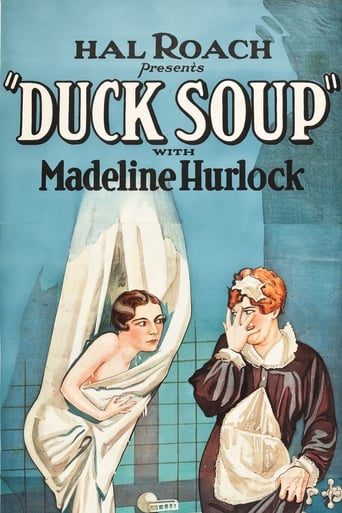
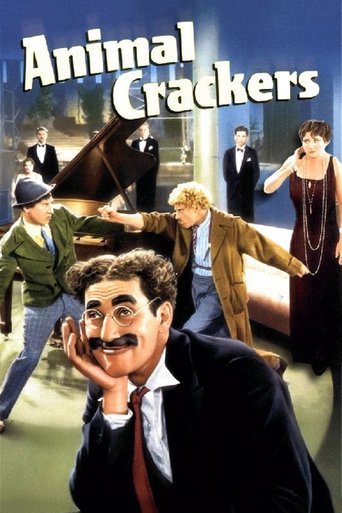
More Comedy films
View all →






More from Robert Florey
View all →
More about this film
About the production
Release dateOctober 24, 1929
BudgetApproximately $500,000 (estimated for early sound production)
Box officeHighly successful, grossing over $1.5 million domestically, making it one of Paramount's biggest hits of 1929
ProductionParamount Pictures
Filmed inParamount Studios, Astoria, Queens, New York
This was one of the first feature films to be shot with a complete synchronized soundtrack, presenting significant technical challenges. The early sound equipment was bulky and restrictive, requiring actors to remain relatively stationary near microphones hidden in plants and on set pieces. The Marx Brothers, accustomed to their fast-paced stage routines, had to adapt their timing for the new medium. The film was based on their successful 1925 Broadway musical of the same name, but several songs and scenes were modified or cut for the film version.
Themes
Satire of capitalism and get-rich-quick schemesClass conflict and social mobilityThe absurdity of social conventionsLove and romance overcoming obstaclesThe American Dream and its corruption
Themes & topics
hotelFlorida land boomjewel theftauctionreal estatemusical comedymistaken identityromancecon artistsbrothers
Historical background
The Cocoanuts (1929) emerged during late silent cinema and the transition toward sound, when exhibition habits and national film industries were still taking shape.
Why this film matters
The Cocoanuts remains accessible through digital archives, giving modern viewers a direct link to 1929 screen culture.
Making of
The production of 'The Cocoanuts' was a pioneering effort in early sound cinema, requiring the cast and crew to adapt to the limitations of primitive recording technology. Director Robert Florey and co-director Joseph Santley had to work with massive microphones hidden throughout the set, restricting the actors' movements. The Marx Brothers, who had perfected their timing on stage, found it challenging to adapt to the slower pace required by early sound recording. Groucho's ad-libs were particularly difficult to incorporate, as the sound engineers needed to know exactly where he would be for proper microphone placement. The film was shot in just a few weeks at Paramount's Astoria Studios, with many scenes being filmed in long takes to avoid the technical difficulties of sound editing. The musical numbers presented additional challenges, requiring the orchestra to be recorded separately and synchronized with the actors' performances. Despite these technical hurdles, the brothers' manic energy and comedic timing managed to shine through, creating a template for their future film successes.
What critics said
Retrospective notes on The Cocoanuts emphasize its value as a transitional sound-era artifact rather than blockbuster reception.
Did you know?
- This was the Marx Brothers' first feature film, adapted from their hit 1925 Broadway musical of the same name
- The film was shot at Paramount's Astoria Studios in New York, as Hollywood studios were still transitioning to sound technology
- The famous 'Why a duck?' routine originated in the Broadway version and was one of the few comedy sketches retained for the film
- The film was released just one week before the stock market crash of 1929, making its Florida land boom theme particularly ironic
- Early sound recording equipment was so primitive that the orchestra had to be recorded separately and mixed in later
- The film's opening sequence showing the hotel exterior was actually a miniature model
- Zeppo Marx, who played the straight man romantic lead, was reportedly paid the least of the four brothers despite having a larger speaking role than Harpo
- The film's success convinced Paramount to immediately sign the Marx Brothers for two more films
- Many of the film's jokes about Florida real estate speculation were based on actual events from the 1920s Florida land boom
- The movie was originally going to be filmed in Technicolor, but the process was deemed too expensive and unreliable for the new sound technology
Awards & recognition
- None - The Academy Awards had only begun in 1929 and this film was not submitted or nominated
Visual style
The cinematography by Henry Gerrard was constrained by the limitations of early sound technology, which required cameras to be housed in soundproof booths. This resulted in relatively static camera work compared to the fluid cinematography of late silent films. Despite these technical restrictions, Gerrard managed to create visually interesting compositions within the hotel set. The film uses medium shots and long takes to accommodate the sound recording equipment, with few close-ups. The lighting design was typical of early sound films, using broad, even illumination to ensure visibility for the new sound cameras. The opening sequence featuring the hotel exterior was particularly effective, using miniature photography to create the illusion of a grand resort. While not innovative by later standards, the cinematography successfully captured the Marx Brothers' physical comedy and the film's musical numbers.
Innovations
The Cocoanuts was a technical achievement in early sound cinema, representing one of the first successful attempts to capture fast-paced comedy and musical numbers in the new medium. The film used the Western Electric sound-on-disc system, which was cutting-edge technology for 1929. The production team developed innovative techniques for hiding microphones in set pieces and props to allow for more natural actor movement. The synchronization of musical numbers was particularly challenging, requiring precise timing between the prerecorded orchestra tracks and the live performances. The film also demonstrated early uses of sound effects to enhance the comedy, particularly in the scenes involving Harpo's physical gags. While technically primitive by modern standards, the film pushed the boundaries of what was possible in early sound recording and helped establish techniques that would become standard in musical comedy production.
Music
The music for The Cocoanuts was composed by Irving Berlin, who had also written the songs for the original Broadway production. The soundtrack includes several memorable numbers including 'When My Dreams Come True,' 'The Monkey-Doodle-Do,' and 'A Little Bungalow.' The film's most famous musical moment is the 'Why a Duck?' routine, which cleverly incorporates music into the comedy sketch. Early sound recording technology presented significant challenges for the musical numbers, requiring the orchestra to be recorded separately from the vocals. The sound quality reflects the limitations of 1929 recording technology, with occasional distortion and limited frequency range. Despite these technical constraints, Berlin's songs effectively capture the Jazz Age spirit of the late 1920s and provide a perfect backdrop for the Marx Brothers' comedic antics. The musical numbers also helped establish the pattern of integrating songs into the brothers' films that would continue throughout their career.
Famous quotes
Groucho: 'You can leave in a taxi. If you can't get a taxi, you can leave in a cab. In fact, if you have no cab, you can leave in a huff. If that's too soon, you can leave in a minute and a huff.'
Groucho: 'Why a duck? Why-a-no-chicken?'
Groucho: 'Here I am talking to parties. I come in here for a quiet drink and a conversation and I have to listen to lectures about septic tanks.'
Groucho: 'And I want to tell you, I'm a pretty good shoveler myself. I can shovel anything. I can shovel money, I can shovel talk, I can shovel people.'
Groucho: 'The next time I see you, I'll have to give you a receipt. I don't give receipts for love.'
Memorable scenes
- The iconic 'Why a Duck?' routine where Chico and Groucho discuss real estate plat maps, creating confusion over the inclusion of a duck in the development plans
- The auction scene where Groucho tries to sell worthless Florida land, employing increasingly ridiculous sales tactics and double-talk
- Harpo's pursuit of the chambermaid, culminating in him hiding under a bed and creating chaos with his horn and physical gags
- The final chase sequence where all the characters converge in a mad dash to recover the stolen necklace, featuring classic Marx Brothers mayhem
- The opening number where Groucho introduces the hotel and its dubious amenities, establishing his character as a con man
What audiences thought
The Cocoanuts was a box office success upon its release, with audiences thrilled to see the Marx Brothers bring their stage comedy to the screen. Moviegoers who had seen the brothers on Broadway were particularly enthusiastic about the film adaptation. The film's timing was fortuitous, as it provided much-needed laughter and escapism just as the Great Depression was beginning. Audience response was so positive that Paramount immediately signed the Marx Brothers for two more films. Over the decades, the film has maintained a devoted following among classic comedy fans and Marx Brothers enthusiasts. Modern audiences often appreciate the film both for its historical significance and for the timeless quality of the Marx Brothers' humor, though some viewers find the early sound technology and pacing challenging compared to later films.
Film connections
Influenced by
- Marx Brothers' Broadway shows
- Vaudeville comedy traditions
- Irving Berlin's musical theater
- Early sound film experiments
- Jazz Age culture
This film influenced
- Animal Crackers (1930)
- Monkey Business (1931)
- Horse Feathers (1932)
- Duck Soup (1933)
- A Night at the Opera (1935)
- Subsequent Marx Brothers films
- Screwball comedies of the 1930s
Film restoration
The Cocoanuts has been preserved by the Universal Studios (which acquired Paramount's pre-1948 library) and exists in complete form. The film has been restored and is available on home video. While the original nitrate negatives have likely deteriorated or been destroyed, preservation copies exist on safety film and digital formats. The sound quality reflects the limitations of early sound recording but has been cleaned up for modern releases. The film is considered to be in good preservation status and is regularly screened at film festivals and classic cinema venues.
Where to watch
- The Criterion Channel
- Kanopy (with participating libraries)
- Amazon Prime Video (for purchase/rental)
- Apple TV (for purchase/rental)
- Google Play Movies (for purchase/rental)
- DVD and Blu-ray collections from Universal Studios
- Turner Classic Movies (occasional broadcasts)
- Public domain streaming sites (though quality may vary)