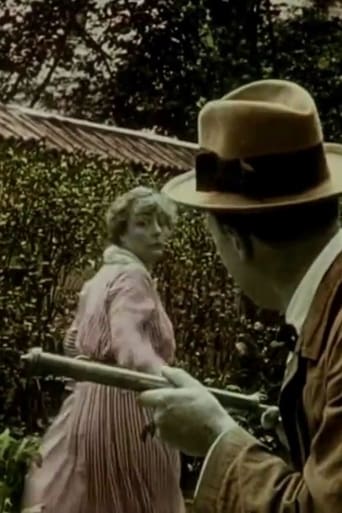
Rigadin in the Balkans
Plot
Charles Prince stars as Rigadin, a comic Everyman whose romantic hopes are dashed when the woman he admires rejects his humble bouquet in favor of a more expensive ring offered by a rival suitor. Stung by this humiliation, he determines to prove himself by rushing off to join the Balkan War, but the film turns that melodramatic impulse into a satire of cinematic make-believe. Rather than truly heading to the front, Rigadin goes to Pathé Frères and persuades the studio to help him stage a film in which he enlists and fights in the Balkans, turning his personal revenge fantasy into a self-conscious movie within a movie. The comedy derives from the gap between his grand ambitions and the absurdly artificial means by which he tries to enact them, as well as from the performance-centered humor for which Charles Prince was famous.
Director
Georges MoncaAbout the Production
This is an early Pathé comedy built around Charles Prince's popular Rigadin persona, a character he used repeatedly in short films of the period. The picture is notable for its playful self-reflexive premise, with the protagonist attempting to solve his romantic humiliation by effectively commissioning a filmic reenactment of his heroic service. Like many French comedies of the early 1910s, it was produced as a short-form studio item rather than as a feature-length production, and exact surviving production records such as budget, exhibition run, or original marketing copy are not well documented. The film belongs to the prolific prewar output of Pathé Frères and reflects the company's reliance on recognizable comic stars, brisk gag construction, and topical references to current events in the Balkans.
Historical Background
The film was produced in 1912, a year when the Balkan Wars were dominating European news and political anxiety. French audiences were deeply aware of the instability in southeastern Europe, and filmmakers frequently drew on current events for timely comic or dramatic material. At the same time, cinema itself was still relatively young and was rapidly developing from novelty attraction into a mass entertainment with recognizable stars, recurring characters, and established genres. Rigadin in the Balkans matters because it shows early French cinema using topical international politics not for realism, but as a comic framework that allowed audiences to laugh at war, vanity, romance, and the pretensions of heroic masculinity.
Why This Film Matters
The film is culturally significant as an early example of self-reflexive comedy in cinema, in which the protagonist effectively turns to filmmaking as a mechanism for transforming private disappointment into public spectacle. It also documents the popularity of Charles Prince's Rigadin character, whose recurring presence helped establish the idea of the serial comic persona before later star vehicles became commonplace. The film reflects the way Pathé Frères and other European studios adapted fast-moving current events into short-form entertainment, revealing how early popular cinema was closely tied to the news cycle. For historians, it is valuable less as a canonical masterpiece than as a representative artifact of prewar French screen comedy, star culture, and the rapid institutionalization of film production.
Making Of
Rigadin in the Balkans was made during the height of Pathé Frères' early dominance in European short filmmaking, when the studio produced a constant stream of comic one-reelers built around stock characters and reliable star performers. The film's central gag is its most notable behind-the-scenes feature: instead of treating military enlistment literally, the narrative sends Rigadin to the film studio itself, implying that cinema can be used to manufacture heroism, fantasy, and revenge. That self-aware premise suggests a sophisticated understanding of film as performance, especially for a 1912 comedy. Exact details about sets, shooting schedule, or crew roles beyond the credited director Georges Monca are not consistently preserved in accessible records, but the film fits the Pathé model of efficient studio production with recognizable comic talent and topical subject matter.
Visual Style
The film's cinematography would have been characteristic of early 1910s French studio comedies: static or minimally mobile camera placement, carefully staged action within a theatrical frame, and emphasis on gesture and composition rather than editing virtuosity. Because the humor depends on visual business and comic performance, the visual style likely focused on clear readability and presentational staging so that the audience could follow Rigadin's ridiculous plan at a glance. Early Pathé comedies often used clean, bright studio lighting and straightforward scene construction, and this film would have fit that approach. The film's strongest visual idea is conceptual rather than technical: the contrast between the real-world romantic slight and the artificial spectacle of staged military heroism.
Innovations
The film does not appear to be associated with major technical innovations, but it is notable for its early use of meta-cinematic structure. By having the protagonist enlist at Pathé Frères and effectively stage his own Balkan War adventure, the film folds filmmaking into the narrative world in a way that feels unusually self-aware for 1912. That narrative device makes the studio itself part of the joke and anticipates later cinema about cinema. Its technical value lies more in the sophistication of its concept and in the efficient comic staging typical of Pathé's studio craftsmanship than in any recorded breakthrough in camera work or editing.
Music
As a silent film, Rigadin in the Balkans would have had no synchronized recorded soundtrack. In original exhibition, it would typically have been accompanied by live piano, small ensemble music, or local theater accompaniment, chosen to match the comic rhythm and any martial or romantic moods in the action. No specific original score is widely documented in surviving reference material. Any modern presentation would likely use a reconstructed or newly commissioned accompaniment rather than a historically attested score.
Famous Quotes
No verified surviving dialogue or intertitle quotations are widely documented for this silent film.
No reliably sourced famous quote from the film is known.
Memorable Scenes
- Rigadin's humiliation when his modest bouquet is rejected in favor of a rival's expensive ring.
- His comic decision to answer romantic disappointment by heading off to the Balkan conflict.
- The self-referential gag in which he goes to Pathé Frères and arranges to have his enlistment and fighting turned into a film.
- The implied transformation of wartime heroics into studio-made spectacle, which serves as the film's central comic payoff.
Did You Know?
- The film is part of the long-running Rigadin series built around Charles Prince's popular comic persona.
- Its premise is unusually meta for 1912, since Rigadin does not simply go to war but turns to the film studio to stage the war on screen.
- The title references the Balkan Wars, a contemporary geopolitical subject that would have been immediately recognizable to audiences in 1912.
- Charles Prince was one of the best-known French comic performers of the pre-World War I era and appeared in many Pathé shorts.
- Ferdinand Zecca is credited in the cast, linking the film to one of the most important early Pathé figures in French cinema.
- The film appears to survive in reference databases and catalog records, but detailed production documentation is sparse, which is common for short silent films of this period.
- As with many early Pathé comedies, the humor likely relied heavily on visual pantomime, situation comedy, and the audience's familiarity with the Rigadin character.
- The story mixes romantic slapstick with topical satire, a combination that was popular in early European shorts.
- The film is an example of how early cinema frequently turned current events into comic narratives almost immediately after they entered public discourse.
- Because it is a silent film, any dialogue or intertitles that once accompanied it are not widely documented in surviving reference material.
What Critics Said
Contemporary critical reception is not well documented in surviving mainstream sources, which is typical for many short silent comedies of the period. In period trade coverage and later archival cataloging, the film is usually treated as part of the broader Rigadin cycle rather than as an individually reviewed prestige title. Modern scholars and archivists are more likely to value it for its historical interest, its connection to Charles Prince and Pathé, and its meta-cinematic joke than for any claim to artistic innovation on the level of the era's most famous classics. As a result, its reputation today is primarily archival and historical rather than the subject of extensive critical debate.
What Audiences Thought
Specific audience-response data is not readily available, but the film was made for the popular commercial market served by Pathé's short comedies, suggesting that it was intended to be accessible, topical, and broadly amusing. Charles Prince was a familiar and beloved comic figure, and films in the Rigadin series generally depended on the audience recognizing his persona and enjoying his hapless, socially embarrassed antics. The contemporary appeal would likely have come from the combination of romance, military pretension, and the novelty of seeing current Balkan headlines transformed into a comic studio fantasy. Like many shorts of the era, its success would have been measured more by routine exhibition popularity than by any preserved box-office accounting.
Film Connections
Influenced By
- Popular stage and vaudeville comedy traditions
- Early French comic film series built around recurring characters
- Contemporary newspaper coverage of the Balkan Wars
- Pathé Frères studio comedy formulas
This Film Influenced
- Later self-reflexive comedies about filmmaking
- Early comic war satires
- Recurring-character silent film series
You Might Also Like
More Comedy Films
View allMore from Georges Monca
View allFilm Restoration
The film is listed in filmographic and archival reference sources, but detailed public information about surviving elements is limited. It may be extant in archive holdings or private/reference copies, but a universally confirmed restoration history is not readily documented in widely available sources. In practical database terms, it should be treated as a historically recorded silent short with uncertain public-access preservation status unless an archive-specific print record is available.