1911 · Approximately 17 minutes

Also available on: Archive.org
His Trust

His Trust

1911 Approximately 17 minutes United States
Loyalty and dutyDomestic sacrifice during wartimeRacial paternalism and the myth of the faithful servantLoss and perseveranceCivil War memory in popular culture

Plot

A Confederate officer is called away to war, leaving behind his wife and young daughter in the care of George, an enslaved Black servant who is portrayed in the film as utterly devoted to the family. When the officer is killed in battle, George remains at the household and continues to protect, serve, and provide for the bereaved women, honoring the trust placed in him. The story follows George’s quiet perseverance as he tends to domestic duties and supports the family through loss, emphasizing his loyalty even after the master’s death. The film closes by presenting George’s steadfast service as an example of faithfulness to duty, a theme that was central to D.W. Griffith’s short Civil War melodramas of the period.

About the Production

Release Date 1911-01-23
Production Biograph Company
Filmed In Fort Lee, New Jersey area studio facilities and outdoor locations commonly used by Biograph in the early 1910s

His Trust is an early Biograph Civil War drama from D.W. Griffith’s prolific 1911 period, when he was producing multiple short films for the company at a rapid pace. Like many Griffith Biograph one-reelers, it was made on a small budget with a compact company of regular repertory players and photographed largely in studio-controlled or nearby exteriors rather than on elaborate constructed sets. The film is especially notable for casting Wilfred Lucas as the Black servant George in blackface, a practice that was routine in American cinema of the era but is now recognized as deeply offensive and historically revealing of the period’s racial attitudes. It is also part of Griffith’s linked Civil War cycle, which includes other shorts centered on a loyal servant and the ideals of fidelity, sacrifice, and domestic devotion.

Historical Background

His Trust was produced in 1911, at a moment when American cinema was rapidly evolving from short novelty items into a more sophisticated narrative medium. D.W. Griffith, working at Biograph, was one of the central figures in that transition, experimenting with crosscutting, closer emotional framing, and more complex dramatic structure across a large number of shorts. The film also reflects the cultural memory of the American Civil War as it was being shaped in early 20th-century popular culture, especially in Northern and Southern reconciliatory storytelling that often sentimentalized the antebellum household and erased the realities of slavery. Its depiction of George as loyal, submissive, and self-sacrificing is historically important because it shows how early film participated in constructing racist myths about Black service and devotion in the Old South. As a result, the film matters today both as an artifact of early film form and as evidence of the racial ideology circulating in American mass entertainment before and during the silent era.

Why This Film Matters

The film is culturally significant because it sits at the intersection of two major histories: the development of classical American film narrative and the representation of race in early cinema. It demonstrates how Griffith’s Biograph shorts helped establish the visual and emotional conventions that would later be expanded in feature-length storytelling, even as those films often carried deeply reactionary social values. His Trust is also a revealing example of the 'loyal servant' myth, a racialized narrative that helped reinforce paternalist fantasies about slavery and the postbellum South in mainstream American culture. For modern scholars, the film is valuable not because of any progressive message but because it illustrates how popular cinema normalized racial hierarchy through sentimentality and melodrama. In film history courses and archives, it is frequently used to discuss the coexistence of formal innovation and offensive representation in early Hollywood's predecessor era.

Making Of

His Trust was made during the busiest phase of D.W. Griffith’s career at Biograph, when he was turning out short dramas at a pace that helped define early American feature filmmaking’s narrative grammar. The production used Griffith’s regular stock company, including performers who moved fluidly from one Biograph title to another, which gave these shorts a consistent acting style and efficient production structure. The role of George was performed by Wilfred Lucas in blackface, an element that was entirely conventional in the period but is now one of the most discussed aspects of the film because it so clearly reflects the racial assumptions embedded in early American popular entertainment. The film’s construction is straightforward but carefully arranged to maximize emotional clarity: domestic scenes establish the family bond, wartime departure creates the dramatic rupture, and George’s continued labor serves as the emotional endpoint. As with many Griffith shorts, the emphasis is less on plot complexity than on legible visual storytelling, with strong use of gesture, tableau composition, and moralized contrast.

Visual Style

The cinematography is characteristic of early 1910s Biograph production: static or minimally mobile camera setups, carefully staged action in depth, and compositions designed for easy readability within a very short runtime. Griffith and his collaborators frequently relied on tableau-like framing, with actors entering and exiting the frame in ways that preserved spatial clarity and emotional emphasis. The film likely uses high-contrast outdoor light and simple interior setups, with intertitles to guide the narrative and reinforce the moral meaning of George’s loyalty. Rather than elaborate camera movement, the visual style depends on expressive blocking, gesture, and sequence-to-sequence progression. The result is a visually plain but narratively efficient short that exemplifies the transitional style between staged theater and cinematic storytelling.

Innovations

His Trust is not remembered for a single spectacular technical innovation, but it belongs to the body of Griffith Biograph shorts that helped standardize cinematic storytelling techniques. Its achievement lies in the disciplined compression of plot into a one-reel format and the clear use of visual staging to communicate emotional and moral relationships. The film participates in Griffith’s broader development of continuity-based narrative expression, including purposeful scene order, legible cutting, and expressive grouping of actors within the frame. It also demonstrates the early studio system’s ability to produce coherent dramatic narratives quickly and economically. In that sense, its technical importance is historical and cumulative rather than singular or flashy.

Music

As a silent film, His Trust originally had no synchronized recorded soundtrack. In exhibition, it would have been accompanied by live music selected by the theater, often a piano soloist or small ensemble improvising or drawing from cue sheets and familiar repertory pieces. No definitive original score is known to survive for the film. Modern presentations of the film may use archival or newly compiled silent-film accompaniment, depending on the distributor or archive. The music in contemporary screenings typically aims to support the film’s domestic melodrama and Civil War atmosphere rather than replicate a documented original.

Famous Quotes

I cannot verify any widely documented surviving dialogue quotes for this short film; like most silent-era one-reelers, its intertitles vary by print and source.
The title concept itself functions as the film's central refrain: the idea of remaining true to a trust placed in one's care.

Memorable Scenes

  • The officer's departure for war, which establishes the family bond and the trust he places in George.
  • The battlefield announcement of the officer's death, which shifts the film from domestic duty to bereavement.
  • George continuing to care for the wife and child after the officer is gone, underscoring the film's central theme of steadfast service.
  • The closing emphasis on George's unwavering loyalty, which frames the character as the emotional and moral center of the story.

Did You Know?

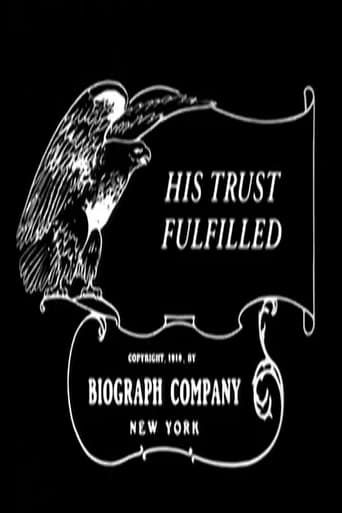
  • The film is commonly discussed alongside His Trust Fulfilled, a companion sequel released later the same year that continues the story of George and the family.
  • Wilfred Lucas, one of Biograph’s regular stock-company actors, portrayed George in blackface, reflecting standard but now highly controversial early-1910s screen practice.
  • The film is part of D.W. Griffith’s frequent Civil War-themed output, which often framed loyalty, domestic sacrifice, and wartime separation as melodramatic subjects.
  • Because it is a one-reel film, the story is told in a very compressed format, with the narrative progression conveyed through visual tableaux and intertitles rather than extended dialogue.
  • The movie is significant as an early example of the 'faithful servant' trope in American film, a trope that became a recurring feature of racialized Southern melodrama.
  • It was produced during Griffith’s intense Biograph years, when he directed a remarkably large number of short films in rapid succession while refining editing and visual storytelling techniques.
  • The title itself emphasizes the moral idea of a 'trust'—a duty entrusted by one person to another—which is the film’s central dramatic concept.
  • The film survives in print and is known today through archival circulation and home-video/online presentations of silent-era Griffith works.
  • Claire McDowell and Dell Henderson were among Biograph’s familiar performers, appearing in numerous Griffith productions of the period.
  • Modern viewers often approach the film as both a historical artifact of early narrative cinema and a document of early 20th-century racial ideology.

What Critics Said

Contemporary reviews for many Biograph shorts were often brief and trade-oriented, and specific surviving critical commentary on His Trust is limited compared with later Griffith works. In its own time, the film likely would have been received as an effective sentimental melodrama typical of Griffith’s Biograph output, especially for audiences accustomed to Civil War domestic stories and star repertory players. Modern criticism is more sharply divided between appreciation for its place in early film form and condemnation of its racial imagery and blackface casting. Today it is generally discussed in academic and archival contexts as a historically important but ideologically troubling short, valuable for study rather than admiration. Its reputation is therefore tied more to historical analysis than to mainstream popularity or critical canonization.

What Audiences Thought

There is little detailed surviving box-office or audience-response documentation for this specific short film, which was released in the era when many one-reel Biograph titles circulated quickly and were replaced by new offerings. At the time, audiences for nickelodeons and split-reel programs were accustomed to concise melodramas, and Griffith’s films were widely exhibited due to Biograph’s strong distribution presence. The emotional clarity of the story and the familiarity of its Civil War setting would likely have made it accessible to contemporary viewers. However, modern audiences often respond to it through a historical-critical lens, with the blackface performance and the romanticized racial hierarchy strongly affecting reception. As a result, the film is far more often discussed in archives, classrooms, and scholarly writing than in general audience enthusiasm.

Film Connections

Influenced By

  • Turn-of-the-century stage melodrama
  • Civil War sentimental fiction
  • Lost Cause narratives in post-Reconstruction American culture
  • Biograph's own short domestic dramas

This Film Influenced

  • Subsequent Civil War melodramas featuring the loyal servant motif
  • Later Griffith-era domestic war shorts
  • Early American films that borrowed the 'faithful servant' and plantation nostalgia framework

Film Restoration

The film is extant and preserved in archival form; it survives today as a historically important silent short and has been circulated in film archives and scholarly collections.

Themes & Topics

Civil Warservant loyaltyblackfacefamily separationdomestic melodramawartime deathSouthern nostalgia